By Kyle Orton (@KyleWOrton) on September 6, 2015
By Kyle Orton (@KyleWOrton) on August 5, 2015

Few men did more than the historian Robert Conquest to refute the lies of the Soviet Union, undermining its ideology and propaganda, therefore its appeal, and ultimately its regime. Indeed, at the final meeting of the Soviet Central Committee a Stalinist hack described Conquest as “anti-Sovietchik No. 1“; a compliment if ever there was one. Continue reading
By Kyle Orton (@KyleWOrton) on August 1, 2015
Charles Ruud’s and Sergei Stepanov’s Fontanka 16: The Tsar’s Secret Police traces the evolution of political policing in Russia, focusing on the Okhranka, the final incarnation of the secret police before the Russian Revolution in 1917, and along the way puts paid to a whole array of myths about the pre-Bolshevik Russian government, especially as regards the Jewish Question.
The growth of the Russian political police occurred in four major stages. The first phase lasted from the founding of the Russian State by Ivan the Terrible (1533-84) after the expulsion of the Tatars to the opening of the “Third Section” in 1826 as a reaction to the Decembrist revolt the previous year—the first time the Imperial State security services were housed at Fontanka 16 in St. Petersburg—which intended to (and succeeded in, as 1848 would demonstrate) extirpate the liberal spirit that challenged the autocracy. The third phase saw the Third Section become the Department of Police at the onset of a crackdown after the assassination of Alexander II in 1881, who had enacted broad liberal reforms on censorship and serfdom. The elite secret police force grew out of the palace guard, becoming known as the Okhranka (though this is more usually rendered in English as Okhrana). The final phase began in 1906, after the 1905 revolution, when the Okhranka worked to stop a liberal-radical coalition building. Continue reading
By Kyle Orton (@KyleWOrton) on February 6, 2015
Produced and directed by Laura Poitras, a Berlin-based, American-born producer and director, who has made numerous films attacking America’s foreign policy, Citizenfour rounds out a trilogy that started in 2006 with My Country, My Country about the U.S. regency in Iraq, and had its last instalment in 2010 with The Oath, a film that apparently follows two al-Qaeda members in Yemen and concludes they’re not such bad chaps.
The target this time for Poitras is the National Security Agency (NSA). Continue reading
By Kyle Orton (@KyleWOrton) on January 5, 2015

Mother Agnes Mariam on RT. An agent of the regime, she dismissed Syria’s rebels as a foreign conspiracy.
Fouad Ajami once said Syria was the “first YouTube war“. An academic study called Syria “the most socially mediated civil conflict in history“. From the start of the Syrian war, the media and propaganda dimension has been of immense importance, impacting the course of the war on the ground and affecting the policy of foreign States who could make a decisive difference in the conflict. Continue reading
By Kyle Orton (@KyleWOrton) on December 28, 2014
There has been much gloating from the U.S. government in the last few weeks about the damage the sanctions have done to the value of the Russian ruble, including a rather strange episode when President Obama adopted the third person to deny that he had been “rolled” by Vladimir Putin, and to take credit for the “financial crisis” Putin was now faced with.
By Kyle Orton (@KyleWOrton) on November 17, 2014

Abby Martin and George Galloway: Both host conspiracy-laden shows on RT
While having lunch on Saturday I got stuck for fifteen minutes in a room where the television was tuned to Russia’s English-language propaganda station, RT, formerly Russia Today. I once saw James Kirchick write that “after 20 minutes of watching RT … I did what any sensible person would do: turned RT off.” I conclude from this that he is a much braver man than I. Continue reading
By Kyle Orton (@KyleWOrton) on November 2, 2014
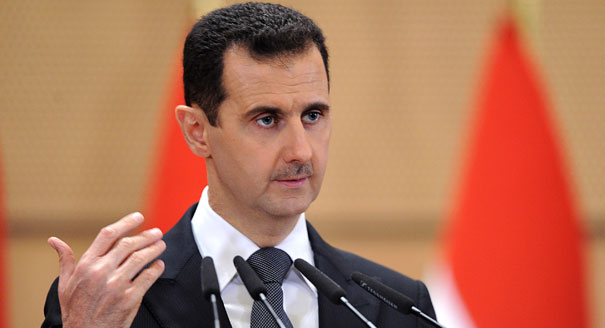
An ally against the Islamic State? Not quite.
The United States signals intelligence (SIGINT) apparatus in Syria, which monitors the communications of Bashar al-Assad’s regime, has “yield[ed] unexpected intelligence over the Sunni jihadists that has helped guide American military operations in Syria and Iraq,” the Wall Street Journal print edition reported yesterday, based on high-level leaks. Continue reading
By Kyle Orton (@KyleWOrton) on October 21, 2014
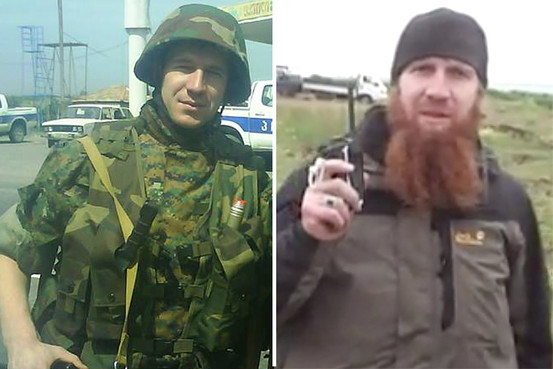
Abu Omar a-Shishani, while in Georgian military, now as I.S. leader in Syria/Iraq
The Syrian rebellion, on Oct. 5, took over areas of Tel al-Hara, near Nawa, a major town twenty miles north of Deraa City, which is a strategic gateway to the road networks that keep the Assad regime alive in Deraa Province. The videos (1/2/3) showed FSA-branded rebels like Liwa al-Furqan and Jabhat Thuwar as-Suriya (the Syrian Revolutionaries’ Front) in control. Jabhat an-Nusra, the Syrian branch of al-Qaeda, had an important presence, but it was not dominant. So this seemed like good news on its own terms.
Two days later the plot thickened when a further video was uploaded to YouTube, showing the rebels touring a captured regime intelligence station in Tel al-Hara: Continue reading
By Kyle Orton (@KyleWOrton) on August 16, 2014
Also cross-posted at the Gerasites blog

Stephen F. Cohen
Since the Ukraine crisis began earlier this year, Stephen Cohen has acquired quite the reputation for apologetics for the Putin dictatorship and its aggression against Ukraine. Cohen, a scholar of Russia, especially the Bolshevik Revolution, has printed most of his pieces in support of Vladimir Putin in The Nation, a magazine edited by his wife Katrina vanden Heuvel. Now he has done so again. Credit where it is due: each salvo has been more hysterical than the last. Continue reading

