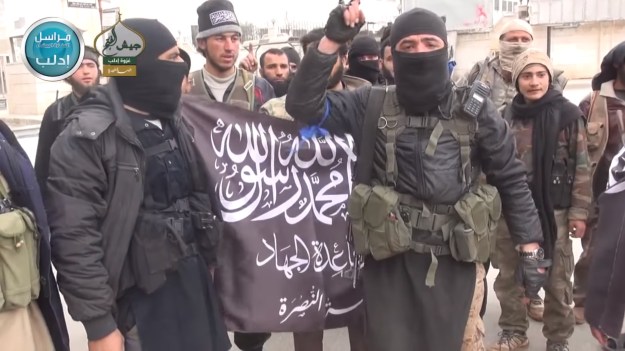
The Third Deputy of the Islamic State: Muhammad Khalaf Shakar

By Kyle Orton (@KyleWOrton) on 12 November 2017
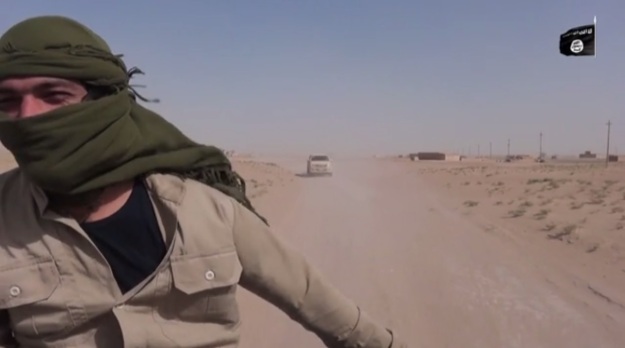
Muhammad Shakar had, according to his martyr biography, “become influenced by Salafism in 1997-98 while serving as a part of [Saddam] Hussein’s Special Republican Guard”.[1] Quitting the military and returning to his home in Mosul, Shakar was harassed by the regime until he went to join Ansar al-Islam in the mountains of Kurdistan.[2]

Shakar, known as Abu Talha al-Ansari or Abu Talha al-Mawsuli, joined the predecessor to Islamic State either just before or just after Saddam fell, and he was arrested in Mosul on 14 June 2005. Continue reading
Hamza bin Ladin Presents Al-Qaeda As the Guardian of Revolution

By Kyle Orton (@KyleWOrton) on 9 November 2017

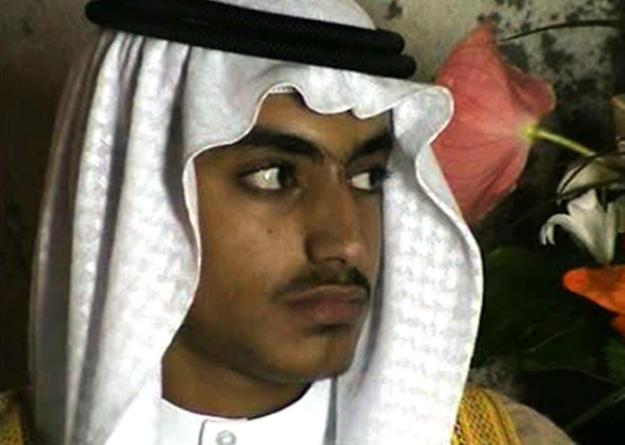
Hamza bin Ladin on his wedding day in Tehran, under the protection of the Quds Force, the expeditionary unit of the Islamic Revolutionary Guard Corps that attempts to spread the Iranian revolution through subversion and terrorism

Hamza bin Ladin, whose profile is being deliberately raised within al-Qaeda, released a speech on 7 November 2017, “The Fighter Against Invaders And The Inciter of Rebellion Against Tyrants”, an English transcript of which was produced by As-Sahab Media, and is reproduced below. Continue reading

Islamic State and Female Fighters

By Kyle Orton (@KyleWOrton) on 8 November 2017

The Khansaa Brigade, the all-female Islamic State espionage network and morality enforcement police, based in Raqqa city (image source)

A debate has been ongoing among analysts since the summer about the view the Islamic State (IS) has of mujahidat (female fighters). IS now seems to have settled the matter in its newsletter, Al-Naba. Continue reading

The Islamic State Claims the Manhattan Terror Attack

By Kyle Orton (@KyleWOrton) on 3 November 2017

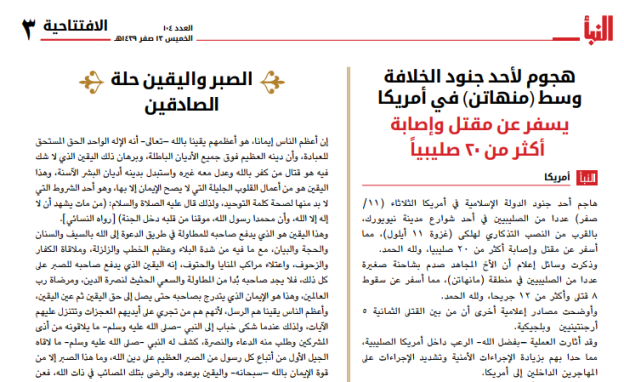
The Islamic State’s claim for the 31 Oct. 2017 Manhattan terror attack is on the right. (Al-Naba 140, 2 Nov. 2017, page 3.)

The Islamic State released the 140th edition of its newsletter, Al-Naba, on 2 November 2017, which contained an article claiming that the perpetrator of the vehicular ramming terrorist attack in New York city on Halloween night, Sayfullo Saipov, an Uzbek immigrant to the United States, was one of the caliphate’s “soldiers”. The Islamic State also repeated its much-contested claim that Stephen Paddock, whom it refers to as “Abu Abd al-Bir al-Amriki”, was motivated by its call when carrying out the massacre at the concert in Las Vegas on 1 October. The article is reproduced below.
Continue reading

The Syrian Regime’s Funding of the Islamic State

By Kyle Orton (@KyleWOrton) on 28 October 2017

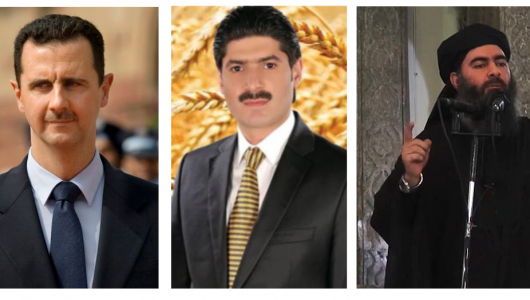
Bashar al-Assad, Hussam al-Katerji, Ibrahim al-Badri (Abu Bakr al-Baghdadi)

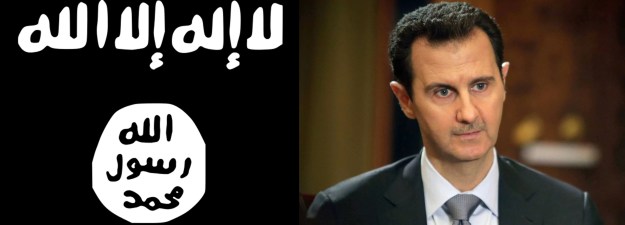
Reuters reported on 11 October that Hussam al-Katerji, a member of Bashar al-Asad’s Syrian regime, has been engaged in trading wheat with the Islamic State (IS), helping supply the terrorists with resources to run their statelet and threaten the security of Syria’s neighbours and the wider world. This pattern of behaviour from the Asad regime—holding itself out as a counterterrorism partner, while it bolsters terrorist organizations—is well-established, and has its origins in the regime’s survival strategy: to destroy all acceptable opposition forces and make the Syrian war a binary contest between the dictatorship and terrorists. Continue reading

Further Evidence of Trade Between Assad and the Islamic State

By Kyle Orton (@KyleWOrton) on 28 October 2017

Watan FM, one of the free media outlets that sprang up in the early days of the Syrian uprising in 2011 and which has since migrated to Turkey, reported on 17 March 2017 about the trade between the regime of Bashar al-Assad and the Islamic State. The article is reproduced below. Continue reading

Clerics Put Forward an Initiative to Unite Jihadists in Syria

By Kyle Orton (@KyleWOrton) on 27 October 2017

It was announced on 25 October that a unity proposal had been formulated to resolve the dispute in Syria between Hay’at Tahrir al-Sham (HTS), its former command organization, al-Qaeda, and the jihadi splinter faction from Ahrar al-Sham, Jaysh al-Ahrar, which has broken between the two. The initiative was backed by major jihadi-salafist clerics, Issam al-Barqawi (Abu Muhammad al-Maqdisi) and Umar Othman (Abu Qatada al-Filistini), and invited the support of all jihadi “scholars”. The text of the proposal, translated by Al-Maqalaat, is reproduced below, with some editions to transliteration and syntax. Continue reading

Don’t Celebrate the Fall of Raqqa Just Yet

By Kyle Orton (@KyleWOrton) on 24 October 2017

Raqqa city has been destroyed (image source)

The Islamic State (IS) captured Raqqa city, its first provincial capital, in January 2014. Six months later, IS declared its caliphate and Raqqa became its de facto capital. Last Tuesday, the partner force of the US-led anti-IS Coalition, the “Syrian Democratic Forces” (SDF), entered the city centre in Raqqa. A deal had evacuated most of the remaining jihadists over the prior weekend, though a determined core remained and still held about 10 per cent of the city. The caliphate is crumbling and the Coalition says IS has 6,500 fighters left. According to the Coalition, this puts IS “on the verge of a devastating defeat”. Unfortunately, there is no reason to believe this is true. To the contrary, IS is more powerful at this point, in theatre, even after the military reverses inflicted on it by the Coalition, than in the period after the “defeat” of 2008, and the outlook is more favourable now to IS. Moreover, IS now has an international reach, physically and ideologically, it did not previously possess. Continue reading

Al-Maqdisi Weighs in on Turkey’s Intervention in Idlib and Hay’at Tahrir al-Sham

By Kyle Orton (@KyleWOrton) on 14 October 2017

Issam al-Barqawi (Abu Muhammad al-Maqdisi), the Jordan-based jihadi-salafist cleric, put out a message on 12 October 2017 in reaction to the Turkish government moving forces into the Idlib Province in north-western Syria on 7 October. Initially it had seemed that Turkey was to confront Hay’at Tahrir al-Sham (HTS), the former al-Qaeda branch in Syria, but it soon became apparent that the operation was a redrawing of terms that was largely coordinated between Ankara and HTS. Given how critical al-Barqawi has been of HTS, this was interesting. Al-Barqawi’s statement was translated by Trunk News Translations and is republished below. Continue reading

The Islamic State Planned For Sectarian War in Iraq From the Beginning

By Kyle Orton (@KyleWOrton) on 13 October 2017

The Iraqi Kurdish authorities arrested Mustafa Haji Muhammad Khan (Hassan Ghul) on 23 January 2004. Khan had been dispatched to Iraq by Nashwan Abd al-Baqi (Abd al-Hadi al-Iraqi), one of the key military officials of al-Qaeda “central” (AQC), to function as AQC’s intermediary with Ahmad al-Khalayleh (Abu Musab al-Zarqawi), the founder of the Islamic State movement. Khan replaced Abdallah al-Kurdi, the first envoy sent by Abd al-Baqi. Al-Kurdi had failed to establish any footing to do his job effectively, but Khan, a battle-hardened jihadist from Baluchistan, earned a measure of respect from al-Khalayleh and facilitated a productive conversation between AQC and al-Khalayleh. Al-Khalayleh, possessed of a pathological anti-Shi’ism, wrote a seventeen-page memo to Usama bin Laden explaining his strategy to defeat the Americans by starting a total war between the sects in Iraq. That memo, in digital form, was given to Khan, and Khan had it in his possession when he was captured. A translation of the letter is given below with some interesting sections highlighted in bold.[1] Continue reading