By Kyle Orton (@KyleWOrton) on 18 March 2021
By Kyle Orton (@KyleWOrton) on 17 March 2021
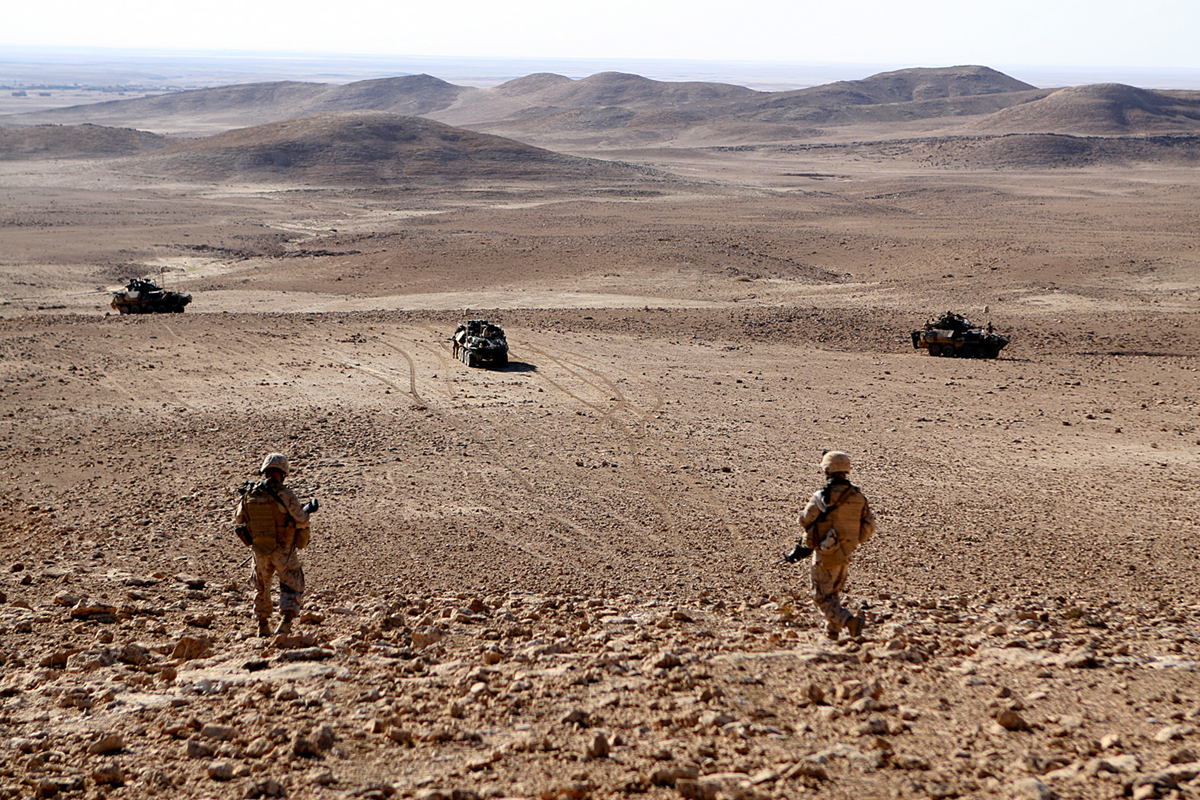
Abu Umar al-Baghdadi, the implied caliph of the Islamic State movement between 2006 and 2010, gave his sixteenth speech on 17 March 2009. The title of the speech was, “Harvest of the Good (The Gathering Will Be Defeated, and They Will Turn Their Backs and Flee)”.[1]
By Kyle Orton (@KyleWOrton) on 5 March 2021

The Islamic State (IS) movement announced its second “cabinet” on 21 September 2009. The “State” had been announced in October 2006, and the first cabinet had been “appointed” in April 2007.
By Kyle Orton (@KyleWOrton) on 5 March 2021
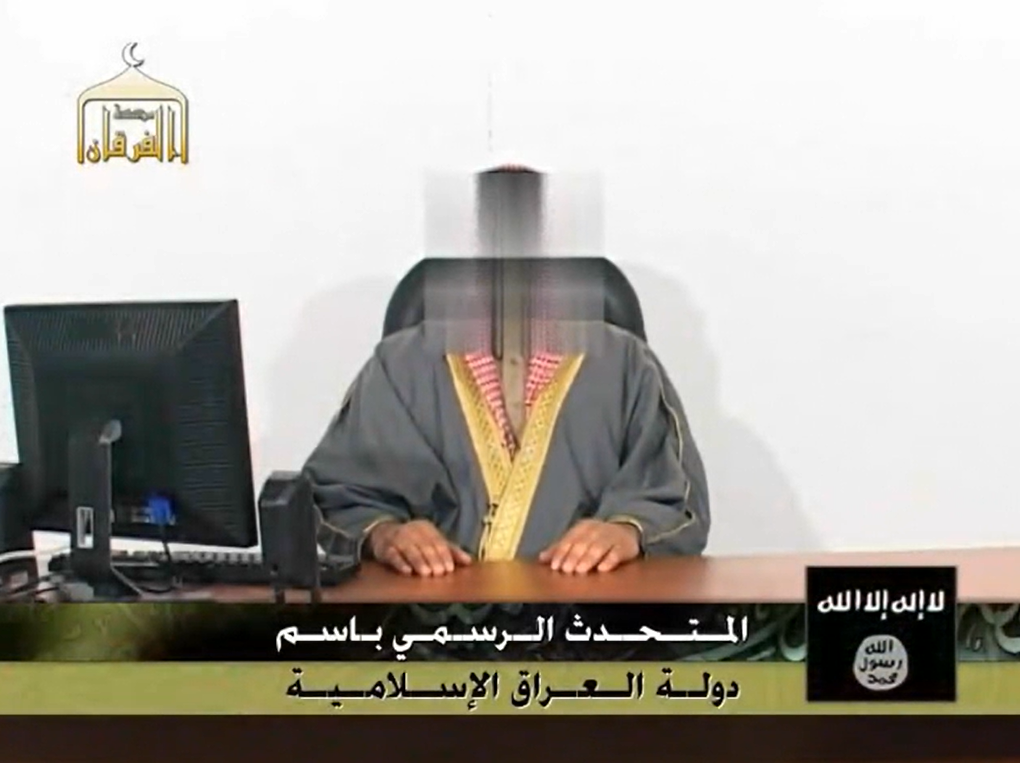
On 19 April 2007, seven months after the Islamic State (IS) movement declared its “State”, the official spokesman, Muharib al-Jaburi, announced the first “cabinet” for this “state”, appointing leaders for various “ministries”. Unusually for IS in this era, the speech was delivered as a video address—albeit (as can be seen) with Muharib’s face blurred out—rather than as an audio address. The reason for this was clearly to push back against the criticism of the IS movement that its leader could not be the “caliph” of all the Muslims, which at this stage IS was not overtly claiming, while being faceless and nameless, known only by his kunya.
By Kyle Orton (@KyleWOrton) on 2 February 2021
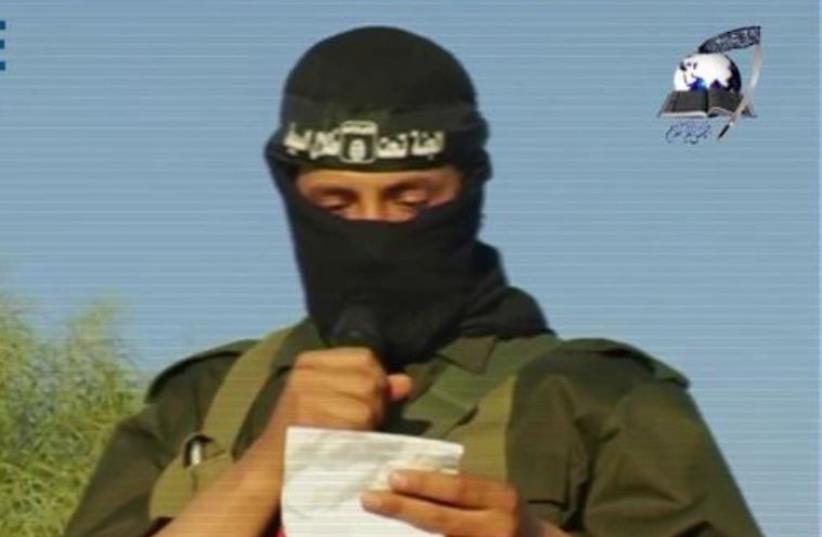
Jaysh al-Islam in Gaza joins the Islamic State in 2015 (image source)
Hamid al-Zawi (Abu Umar al-Baghdadi), the second leader of the Islamic State movement, known at the time as the Islamic State of Iraq (ISI), made his ninth speech out of what would prove to be twenty-three, entitled “Al-Deen al-Naseeha” or “The Deen is Sincere Advice” (الدين النصيحة), on 14 February 2008. “Deen” is often translated as “religion”, but the implication of referring to the “spiritual” side of life—and not the “secular”—is inadequate to describe the totality contained within the word; something like “creed” or “lifeway” is more accurate. The speech is most notable as something of a rarity in that it focused on Palestine. A transcript of the speech was put out by ISI and is reproduced below with edits for grammar and clarity. Continue reading
By Kyle Orton (@KyleWOrton) on 17 January 2021

One of the few pictures in existence of Abd al-Munim al-Badawi (Abu Hamza al-Muhajir)
Abd al-Munim al-Badawi (Abu Hamza al-Muhajir) had become the leader of Al-Qaeda in Mesopotamia (AQM) after its founder, Ahmad al-Khalayleh, much better known as Abu Musab al-Zarqawi, had been killed in June 2006. AQM was the dominant faction within the Islamic State (IS) when it was announced in October 2006 as a merger of jihadist insurgents, and for that reason most analysts at the time considered IS a “front” for AQM. When IS’s emir, Hamid al-Zawi (Abu Umar al-Baghdadi), made his first speech in December 2006 affirming the statehood declaration, most read this as the foreign-led AQM putting an Iraqi face on their enterprise. In fact, as can now be seen, dynamics were essentially as presented by the jihadists.
Crucial was a speech Al-Badawi gave on 10 November 2006, his fifth of what would prove to be fifteen, released by Al-Furqan Media Foundation within IS’s “ministry of information”, entitled, “I’na al-Hukm I’la Allah” (إن الحكم إلا لله), something like “Judgment is Only for God” or “Judgment is God’s Only”, where he gave his bay’a (oath of allegiance) to Al-Zawi, put AQM’s troops under Al-Zawi’s command, and effectively dissolved Al-Qaeda’s presence in Iraq. A transcript of the speech is available here, and a summary of the speech is below. Continue reading
By Kyle Orton (@KyleWOrton) on 23 May 2020
There is now, with various caveats, a general agreement that the Islamic State (IS) is on the upswing—in Iraq, particularly, but also in the Badiya, the desert regions of eastern Syria, and more recently in the south of Syria around Deraa. Still, there have been some recent notable gains against the terrorist group. Continue reading
By Kyle Orton (@KyleWOrton) on 10 November 2019
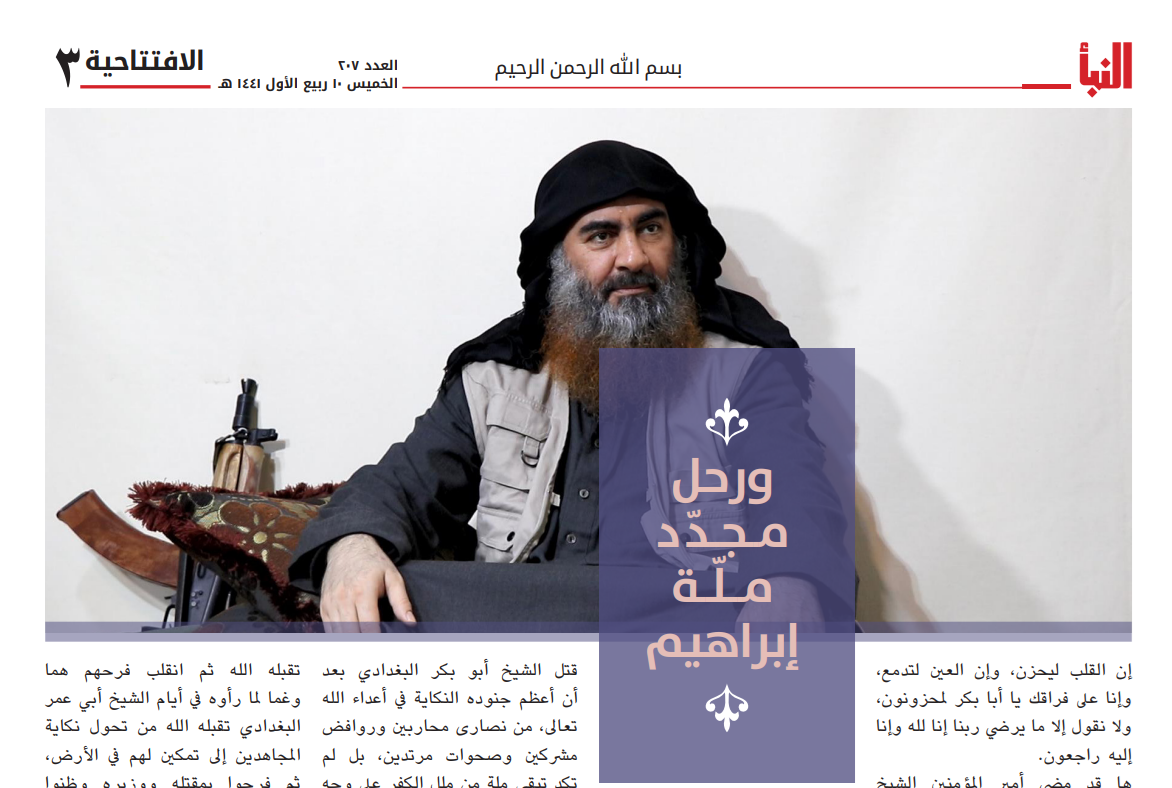
The 207th edition of Al-Naba, the weekly newsletter of the Islamic State (IS), published on 7 November 2019, devotes its main editorial to Ibrahim al-Badri (Abu Bakr al-Baghdadi), the first “Caliph” when the “Caliphate” was declared in June 2014, who was killed on 27 October 2019.
By Kyle Orton (@KyleWOrton) on 7 November 2019

Taha Falaha (Abu Muhammad al-Adnani) [right] appearing in an Islamic State video alongside Tarkhan Batirashvili (Abu Umar al-Shishani, 3 June 2017, displaying a scene from 2014 when IS demolished the borders between Iraq and Syria. Falaha was killed in August 2016. It is common for IS to hold back pictures and footage of its leaders for time-spans that can reach over a decade.
By Kyle Orton (@KyleWOrton) on 2 December 2018
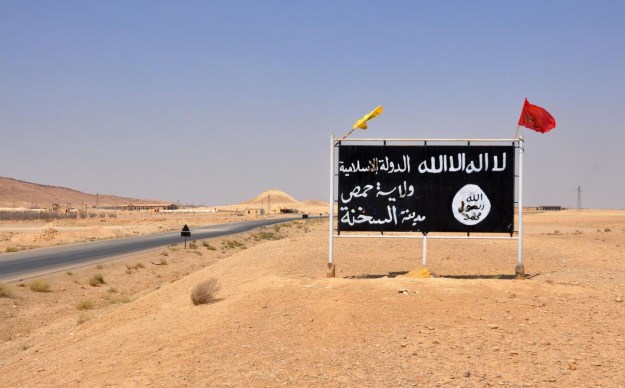
An Islamic State poster near al-Sukhna in the eastern Homs desert, Syria, August 2017 (source)
Over the past week, two members of the Islamic State (IS) have been arrested—a rarity in itself during the Coalition campaign against the group—and both in different ways give a glimpse of archetypes that have made up the organisation, from its inception to its expansion into Syria. Continue reading

 Kyle Orton's Blog