Tag Archives: Abu Omar al-Shishani

The Riddle of Haji Bakr

By Kyle Orton (@KyleWOrton) on November 10, 2015
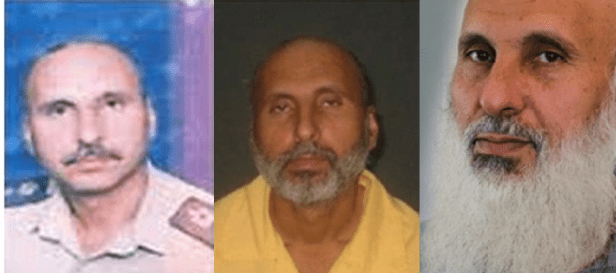
Samir al-Khlifawi (Haji Bakr): in Saddam's army, in American prison, as a commander of the Islamic State

Samir al-Khlifawi (Haji Bakr): in Saddam’s intelligence service, in American prison, as a commander of the Islamic State

In the last few months I’ve increasingly focussed on the former (Saddam) regime elements (FREs) within the Islamic State (IS). There’s now an entire section on this blog about it, and Aaron Zelin over at Jihadology recently gave me time to elaborate in a podcast.

In studying this topic there is one inescapable name: Samir Abd Muhammad al-Khlifawi, better-known by his pseudonym Haji Bakr, and sometimes by his kunya, Abu Bakr al-Iraqi. Al-Khlifawi is a former colonel in an elite intelligence unit of the Saddam Hussein regime—focussed on air defence at Habbaniya airbase, though what exactly that entails is murky. Al-Khlifawi was also apparently involved in weapons development.

Al-Khlifawi came to international attention in April when Christoph Reuter published an article in Der Spiegel naming al-Khlifawi as the “architect” of IS’s expansion into Syria, and the man who had been “pulling the strings at IS for years.” Continue reading
How Russia Manipulates Islamic Terrorism

By Kyle Orton (@KyleWOrton) on September 8, 2015

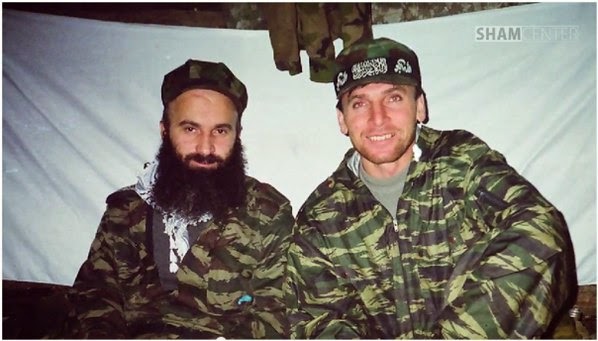
Shamil Basayev and Murad Margoshvili (a.k.a. Muslem al-Shishani)

Shamil Basayev and Murad Margoshvili (a.k.a. Muslem a-Shishani)

Last year I wrote about the murky role Russia was playing in the Syrian war, bolstering the Bashar al-Assad tyranny while facilitating the rise of the Islamic State (ISIS) and other Salafi-jihadists as a means of dividing and discrediting the Syrian opposition. This strategy and the associated tactics—infiltrating the insurgency, facilitating the arrival of al-Qaeda and other global jihadists to displace the nationalists, and in general driving the rebellion into the political dead-end of extremism and barbaric atrocities—has worked in other States where the intelligence services were trained by Moscow, and it worked internally to defeat the separatist movement in Chechnya. In Syria, Russia is reinforcing an old client regime, which has staked its life on the proposition that it is the last line of defence against a terrorist takeover and a genocide against the minorities, a policy now largely directed on-the-ground by Iran, to whom Assad surrendered sovereignty some time ago. New evidence has emerged to underline these points. Continue reading

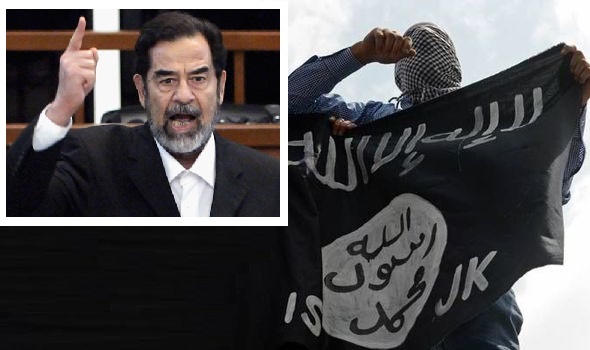
Saddam Hussein’s Regime Produced The Islamic State

By Kyle Orton (@KyleWOrton) on April 21, 2015

1

Having presented the evidence that Saddam Hussein Islamized his foreign policy and then Islamized his regime, above all with the Islamic Faith Campaign, beginning in June 1993 that tried to fuse Ba’athism with Salafism, encouraging (and keeping under surveillance) a religious revival in Iraq that redounded to the benefit of the regime’s legitimacy and support, I wanted to look at what this history means for Iraq and the wider region now.

I pointed out in October that the “military strength” of the Islamic State (ISIS) “comes from the remnants of Saddam Hussein’s military-intelligence apparatus and the Caucasus’ Salafi-jihadists.” Continue reading

CAGE Still Has Questions To Answer About Mohammed Emwazi (“Jihadi John”)

By Kyle Orton (@KyleWOrton) on April 3, 2015

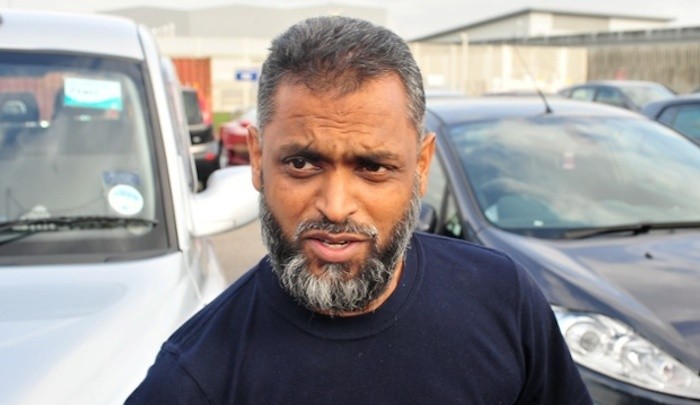
Moazzam Begg

Moazzam Begg

The outreach director of CAGE (formerly Cageprisoners), Moazzam Begg, went to Syria between October 2012 and April 2013. Begg was arrested in Britain on Feb. 25, 2014, on terrorism-related charges because while in Syria, Begg attended a terrorist training camp. Begg was held in Belmarsh until Oct. 1, 2014. Begg had been due to begin trial on Oct. 5, 2014, but that trial was abandoned because of new evidence that meant there was “no longer a realistic prospect of gaining a conviction,” and Begg was released.

Begg is on record as having said that he “help[ed] to run a training camp in the countryside near Idlib … where opponents of the [Assad] regime could undergo physical exercise and acquire the rudiments of first aid and military training, with fake wooden guns.” There is certainly an ambiguity here: the only real defensive policy for Syria’s civilians is one that overthrows Assad, so Begg’s claim that what he did “was not an act of terrorism, but an attempt to help people defend themselves,” is not, on its face, ridiculous. Begg’s problem is that this was not a camp for Syrians; the camp he “help[ed] to run” was for foreign al-Qaeda members, who have done immense damage to the anti-Assad cause, associating it with fanaticism and atrocity and warding off necessary international support that could have toppled the dictator. Continue reading

ISIS’s Leader Calls for the Syrian Rebels to Cease Attacking the Jihadists

By Kyle Orton (@KyleWOrton) on December 6, 2014

The leader of the Islamic State in Iraq and Syria (ISIS), Abu Bakr al-Baghdadi, gave an untitled speech on January 19, 2014. It was a response to the Syrian rebellion having launched a full-scale offensive against ISIS on January 3, 2014, which had driven them from large swathes of territory in northern Syria and was ongoing at the time. The rebel offensive continued for six months—until Mosul fell to ISIS in June, and the captured resources were fed into eastern Syria, breaking the rebels. Al-Baghdadi struck a relatively conciliatory note, though did accompany this with threats, should the rebels continue resisting the jihadists. A translation of the speech was made by Pieter Van Ostaeyen, and is reproduced below. Continue reading

Islamic State Biography of the Spokesman: Abu Muhammad al-Adnani

By Kyle Orton (@KyleWOrton) on November 8, 2014

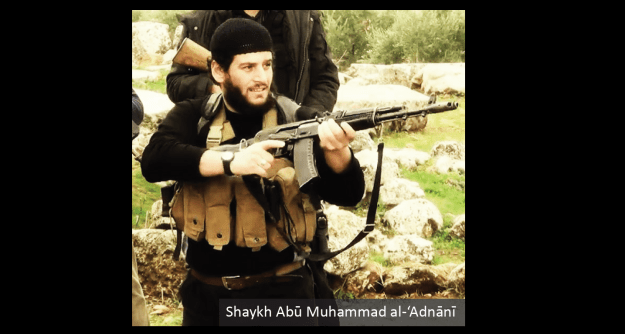
Picture of Abu Muhammad al-Adnani from the second edition of Dabiq magazine (July 27, 2014)

A Bahraini jihadist ideologue, Turki al-Binali, who has become a cleric in the Islamic State, put out a profile of the Islamic State’s official spokesman, Abu Muhammad al-Adnani, on November 1. By this account, al-Adnani took up jihadism in 2000 and was among a small cadre of people who joined the Islamic State’s founder, Ahmad al-Khalayleh, the infamous Abu Musab al-Zarqawi, when he journeyed through Syria on a recruitment-drive in 2002. Learned in Islamic jurisprudence and rigid in doctrinal literalness, al-Adnani was associated with some of the titans of the Islamic State’s legend like Abu Muhammad al-Lubnani and Abu Anas al-Shami. Appointed as emir of a small town in Anbar, Haditha, the first leader after the declaration of “the State” in 2006, Hamid al-Zawi (Abu Umar al-Baghdadi), worked under al-Adnani’s command. Al-Adnani then moved on to be an ideological instructor. Such was al-Adnani’s status, he did not have to consult al-Zarqawi before ordering operations; he only had to brief al-Zarqawi afterwards. Al-Adnani was arrested by the Americans in Iraq in May 2005, thereafter spending six years behind the wire, though never giving up his missionary activity. Indeed, the profile says al-Adnani developed the first full training program, academic and physical, for jihadi inmates. Upon release, al-Adnani took the post of official spokesman and has maintained it ever since. This profile is reproduced below with some minor editions for transliteration, syntax, and spelling. Continue reading

Russian Intelligence and the War In Syria

By Kyle Orton (@KyleWOrton) on October 21, 2014

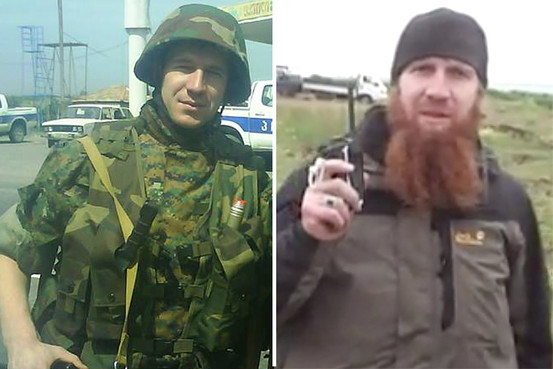
Abu Omar a-Shishani, while in Georgian military, now as I.S. leader in Syria/Iraq

Abu Omar a-Shishani, while in Georgian military, now as I.S. leader in Syria/Iraq

The Syrian rebellion, on Oct. 5, took over areas of Tel al-Hara, near Nawa, a major town twenty miles north of Deraa City, which is a strategic gateway to the road networks that keep the Assad regime alive in Deraa Province. The videos (1/2/3) showed FSA-branded rebels like Liwa al-Furqan and Jabhat Thuwar as-Suriya (the Syrian Revolutionaries’ Front) in control. Jabhat an-Nusra, the Syrian branch of al-Qaeda, had an important presence, but it was not dominant. So this seemed like good news on its own terms.

Two days later the plot thickened when a further video was uploaded to YouTube, showing the rebels touring a captured regime intelligence station in Tel al-Hara: Continue reading

WikiBaghdady Claims to Leak the Islamic State’s Secrets

By Kyle Orton (@KyleWOrton) on October 8, 2014

Before the account, first published in April 2014, by an ostensible Islamic State (IS) defector, “Abu Ahmad”, there was the Twitter account @WikiBaghdady, which released a lot of information in the same vein about the alleged impiousness of the jihadist organization. @WikiBaghdady’s testimony, as collected by Yousef Bin Tashfin, is republished below, with some editions for transliteration and syntax, to ensure its preservation. Continue reading

The Sahel Front

By Kyle Orton (@KyleWOrton) on March 28, 2014

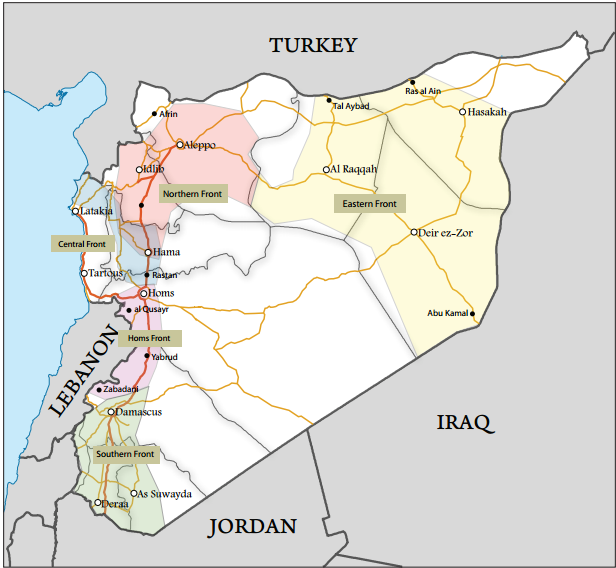
A map of the Five Fronts command, an early effort at rebel unification that split the country into five strategic zones. The Sahel or Coast Front is also called the Central Front

A map of the Five Fronts command, an early effort at rebel unification that split the country into five strategic zones. The Sahel or Coast Front is also called the Central Front

On March 21, a major offensive began by anti-regime forces in the north of Latakia, an area where the regime has long been unable to re-fasten its rule. Continue reading