By Kyle Orton (@KyleWOrton) on 24 January 2021

Sakib Mahmuljin [image source]
By Kyle Orton (@KyleWOrton) on 24 January 2021

Sakib Mahmuljin [image source]
By Kyle Orton (@KyleWOrton) on 20 January 2021

Last week, as one of his last acts in office, U.S. Secretary of State Mike Pompeo gave a speech about Iran’s collaboration with Al-Qaeda. It was unfortunate that Pompeo did this at this time and in this way, with such blatant political intent, because the factual content of Pompeo’s speech was unassailable: the Islamic Republic’s long relationship with Al-Qaeda does stretch back about three decades, the killing of Al-Qaeda’s deputy Abdullah Ahmed Abdullah (Abu Muhammad al-Masri) in Tehran in August 2020 is demonstrative of a shift in the strategic positioning of the organisation away from Pakistan to Iran, and even the part of Pompeo’s speech that got the most pushback—about Tehran’s contact with the 9/11 killers—is not controversial and is not new.
Unmentioned in Pompeo’s speech was one of the crucibles that forged this relationship, and forged Al-Qaeda into something more than a regional menace, namely the Bosnian war of 1992-5. Continue reading
By Kyle Orton (@KyleWOrton) on 16 November 2020
This article was originally published at European Eye on Radicalization

Credible reports over the last few days indicate that Al-Qaeda’s leader Ayman al-Zawahiri is dead, and there are even clearer reports that two of his most senior deputies have been killed. The terrorist network itself, however, will survive. Al-Qaeda has, in the last ten years, survived the killing of its charismatic founder Usama bin Laden, the upheaval of the “Arab spring”, and the rise of the Islamic State (IS)—all of them greater challenges than whatever short-term turbulence might attend the succession process.
Continue readingBy Kyle Orton (@KyleWOrton) on 15 November 2020

Al-Naba 260, page 10
The Islamic State (IS) put out the 260th edition of its newsletter, Al-Naba, on 13 November. Much of the focus was on IS’s war with its jihadi rival, Al-Qaeda, in northern and western Africa. There are reports of guerrilla operations from elsewhere in Africa, from the Centre (in Iraq and Syria), as well as from Egypt and Afghanistan. IS notably feels secure enough in the strength of its networks to draw attention to its responsibility for several attacks in the Turkish-held areas of northern Syria, and there is a rare report of an attack in Indonesia. Al-Naba 260 also has IS’s response to the U.S. Election. Continue reading
By Kyle Orton (@KyleWOrton) on October 23, 2020

A chapter about Islamism in Syria I wrote for the American Foreign Policy Council’s (AFPC) ‘World Almanac of Islamism’ was published today. Do check it out, and the broader site, which is a great, accessible resource. The format of the website necessitated that the chapter as I submitted it was edited, condensed, and split up to fill out the various categories. In case it is of any interest, the original version of the chapter is reproduced below.
By Kyle Orton (@KyleWOrton) on October 4, 2020

A chapter about Al-Qaeda I wrote for the American Foreign Policy Council’s (AFPC) ‘World Almanac of Islamism’ was published today. Do check it out, and the broader site, which is a great, accessible resource. The format of the website necessitated that the chapter as I submitted it was edited, condensed, and split up to fill out the various categories. In case it is of any interest, the original version of the chapter is reproduced below.
By Kyle Orton (@KyleWOrton) on 20 September 2020

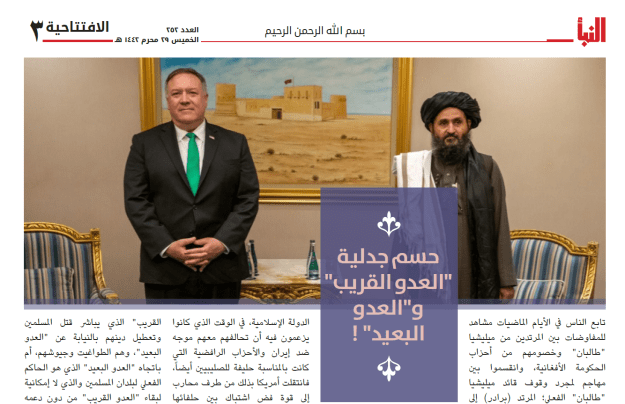
Al-Naba 252, page 3
The 252nd edition of Al-Naba, the weekly newsletter of the Islamic State (IS), was released on 17 September.
Al-Naba 252 contained reports of guerrilla attacks and targeted assassinations at the Centre—against Iraqi security forces and the Iranian proxy militias in the Hashd al-Shabi in Iraq, and against the SDF/PKK in eastern Syria—and the “West African State”, Chad and Niger specifically. IS has been making the Maghreb a primary front since the caliphate collapsed. There was, as ever, the ideological essay on page eleven (of twelve).
The two most notable aspects of Al-Naba 252—expanded on below—were the devotion of the main editorial on page three to an attack on the Taliban for the deal they have made with the Americans over Afghanistan, and IS finally claiming responsibility for the murder of the French aid workers in Niger on 9 August, while continuing its ideological war with Al-Qaeda in Africa. Continue reading
By Kyle Orton (@KyleWOrton) on September 11, 2020

In writing a chapter earlier this year about the current status of Al-Qaeda, part of the process was reviewing the organisation’s history since its formation in the late 1980s. What really struck me was how extensively Al-Qaeda is now manipulated, under the influence of, and in places even controlled by state powers. To mark the nineteenth anniversary of 9/11, I thought I could give a brief sketch of this development.
By Kyle Orton (@KyleWOrton) on 22 August 2020

Al-Naba 248
The Islamic State (IS) produced the 248th edition of Al-Naba, its newsletter, on 20 August. The front page was devoted to recent events in Yemen, which had not gone well for IS—although one could easily miss that fact when reading a story that a focuses almost entirely on enemy casualties and the failures of others. IS is, of course, not pleased about the Israeli normalisation of relations with the United Arab Emirates, but Al-Naba makes clear that it is more perturbed that Muslims should believe Turkey or Qatar are any better than the U.A.E., despite their different approach to Islamists. Al-Naba 248 documents IS’s continuing advances in Afghanistan—and, indeed, Iraq, Syria, Africa (the Sahel), and Egypt. There is also a report of insurgent activity in the Philippines. Continue reading
By Kyle Orton (@KyleWOrton) on 29 June 2020

Al-Qaeda’s General Command released a statement on 29 June 2020 through its As-Sahab Media, entitled, “A Message For The Oppressed Masses In The West”, which seeks to capitalise on the recent unrest in the United States by offering Islam as the solution to racial divisions. Al-Qaeda, of course, diagnoses the root cause of America’s problems in its greed “Jewish overlords”, an antisemitic conspiracy theory that is common to most jihadists. The text of this message is reproduced below. Continue reading