Tag Archives: al-Qaeda

The PKK and Terrorism in Europe

By Kyle Orton (@KyleWOrton) on 16 March 2018

Screenshot from video of a PKK attack on Turkish diplomats in Paris, France (13 March 2018)

A wave of politically motivated violence has swept over Europe in the last few days, carried out by an extremist group and its sympathisers, accompanied by public statements threatening further attacks.

These attacks are intended to change western policy to one more suitable to the attackers.

The conventional term for this is “terrorism”.

These assailants are not Islamist, however; they are from the Kurdish PKK, and this seems to have both reduced the amount of attention this campaign has received, and to have dulled the reaction from some who suggest that perhaps the attackers have a point. Continue reading

Syria’s Revolution Has Been Overtaken By Outside Powers

By Kyle Orton (@KyleWOrton) on 16 March 2018

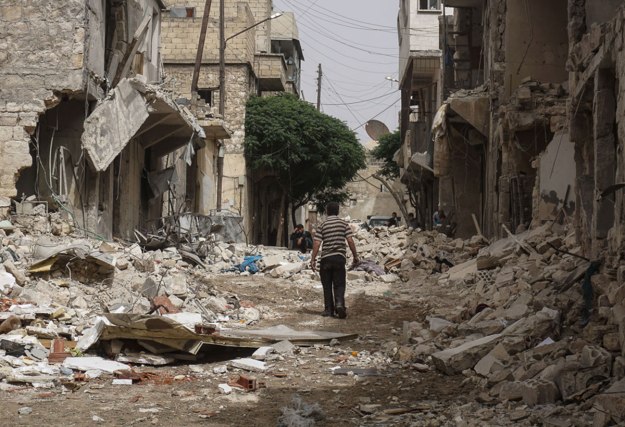
Devastation in Aleppo (image source)

This week marks the seventh anniversary of the Syrian revolution. A movement that began with peaceful street protests calling for reform and—after the government responded with lethal violence—the downfall of the dictator, descended into war that has to this point cost the lives of at least 500,000 people and displaced nearly twelve million others—more than half of Syria’s pre-war population.

In any strategic sense the rebellion has been defeated—it is not able to overthrow Bashar al-Assad by force on its own—and its political cause is increasingly strained as the remnants of the armed opposition are increasingly co-opted by external actors, state and non-state. Continue reading

Islamic State Recommends More Gentleness in Dealing With Sinners

By Kyle Orton (@KyleWOrton) on 10 March 2018

1

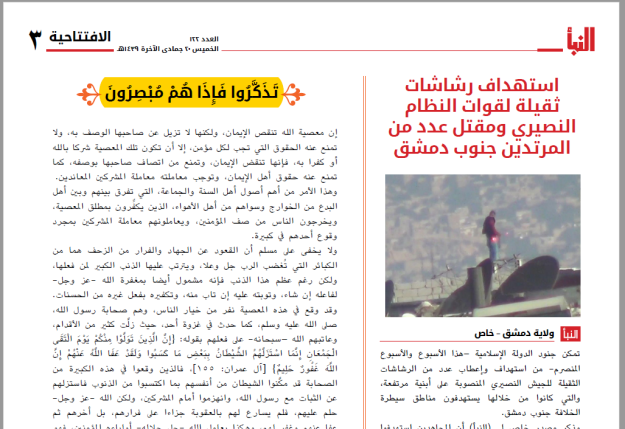
The 122nd edition of Al-Naba, the Islamic State’s weekly newsletter, was released on 9 March 2018 and contained an article, on page 3, suggesting that the use of takfir (excommunication) should be circumscribed. A rough translation is reproduced below. Continue reading

Focused on North Africa, Al-Qaeda’s Leader Condemns the “Compromising” Revolutionaries

By Kyle Orton (@KyleWOrton) on 7 March 2018

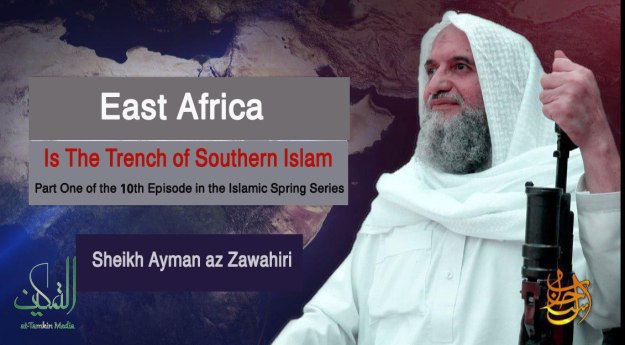
Ayman al-Zawahiri during speech on 6 March 2018 (screen grab)

Al-Qaeda’s leader, Ayman al-Zawahiri, gave a nine-minute speech on 6 March 2018, entitled, “France Has Returned Oh Descendants of the Lions”. The essential message is that European “invaders” are back in the Maghreb, the Muslim-majority states west of Egypt (those states to the east are referred to as the Mashriq), either directly or through local regimes that adhere to the foreigners’ program, political and economic. Al-Zawahiri condemns the post-“Arab Spring” governments that have sought stability by compromise between the revolutionary movements that ousted the dictatorships and the old elites. For al-Zawahiri, the only just solution one achieved by a violent, jihadist campaign that sweeps the old order out entirely. An English transcript of the speech was released by al-Qaeda’s As-Sahab Media, and is reproduced below. Continue reading

The United Nations Ceasefire for East Ghouta is a Farce

By Kyle Orton (@KyleWOrton) on 2 March 2018

Aftermath of an Assad regime bombardment in Hamouriyah, Eastern Ghouta, 9 January 9, 2018. Samir Tatin/Anadolu Agency/Getty Images

The international community tried to impose a ceasefire in Syria on 24 February, passing resolution 2401 through the United Nations Security Council. The ceasefire never took hold and it is now clear it will not. This was inevitable.

Bashar al Assad’s regime, and the governments that support him in Iran and Russia, have repeatedly made use of ceasefires to sequence their war, taking advantage of the calm on some fronts to concentrate firepower on other areas. The only question is why Western diplomats gambled that this time would be any different. Continue reading

A New Branch of Al-Qaeda Emerges in Syria

By Kyle Orton (@KyleWOrton) on 1 March 2018

Hurras al-Deen logo

A new jihadi faction announced its formation in Syria on 27 February 2018: Tanzim Hurras al-Deen,[1] which translates as The Organization for the Guardians of the Religion or the Religious Guardians’ Organization. Hurras al-Deen is, unofficially, the re-emergence of a branch of al-Qaeda in Syria after the schism between al-Qaeda “central” and Hay’at Tahrir al-Sham (HTS). The first statement from Hurras al-Deen was released via Telegram and is reproduced below. Continue reading

Al-Qaeda Leader Profiles the Founder of the Islamic State

By Kyle Orton (@KyleWOrton) on 28 February 2018

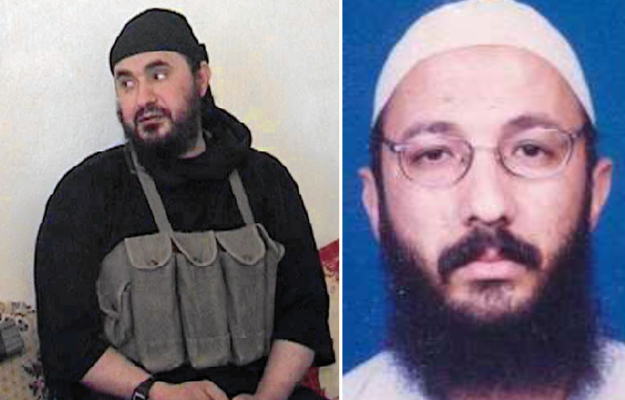
Ahmad al-Khalayleh (Abu Musab al-Zarqawi) [picture via Getty], Muhammad Zaydan (Sayf al-Adel) [picture via Kronos Advisory LLC]

The military leader of al-Qaeda, Muhammad Saladin Zaydan (Sayf al-Adel), wrote a biography for Ahmad al-Khalayleh (Abu Musab al-Zarqawi), the Jordanian jihadist who founded what is now the Islamic State in Taliban Afghanistan in 1999. Zaydan wrote the biography in 2005 while in Iran, under the protection of the Islamic Republic, where he still is. The biography is reproduced below with some interesting and important sections highlighted in bold. Continue reading

Al-Qaeda’s Leader Tells Syrian Insurgents To Avoid State Allies, Focus on Guerrilla Tactics

By Kyle Orton (@KyleWOrton) on 21 February 2018

Al-Qaeda’s leader, Ayman al-Zawahiri, released a video statement on 20 February 2018, entitled, “Oh Our Brothers in Syria, Reconcile Amongst Yourselves”. The speech continued themes Dr. al-Zawahiri has hit on many times before, notably encouraging the Syrian insurgency to avoid allying with the West or other foreign states, to unite behind al-Qaeda since all outside actors are conspiring against the Syrian opposition, and to refuse all compromise in imposing the shari’a. Simultaneously, al-Zawahiri suggests that his adherents avoid trying for quick results and “cling[ing] to ground”, an echo of the advice given in the summer of 2016 that al-Qaeda’s operatives and the Syrian insurgents they can co-opt should prepare for a long war focused on guerrilla tactics, rather than holding territory. An English translation of al-Zawahiri’s speech was made by As-Sahab Media, disseminated by pro-al-Qaeda Telegram channels, and is reproduced below with some editions for syntax and transliteration. Continue reading

Al-Qaeda Continues to Take Advantage of Egypt’s Dictatorship

By Kyle Orton (@KyleWOrton) on 15 February 2018

Al-Qaeda’s leader, Ayman al-Zawahiri, released a speech on 15 February 2018, entitled, “Glad Tidings of Victory To Our People in Egypt”. Al-Zawahiri’s address was the eighth episode of the “Brief Messages To A Victorious Umma (Islamic community or nation)” series. Al-Zawahiri reiterated a theme al-Qaeda has used many times, by referring to the downfall of Muhammad Morsi, the first elected president of Egypt, who was deposed in a military coup d’état in July 2013. Morsi, a member of the Muslim Brotherhood, had taken part in elections and had tried to find a compact with the non-Islamist sections of the Egyptian state and society, including the felul, the remnants of the fallen tyranny, notably in the military, police, bureaucracy, and judiciary, plus the media and business class. It had served Morsi no good: severely constrained in his authority, Morsi’s government unravelled quickly when these forces came together with foreign sponsors for a putsch. The old regime was restored in Egypt, with the support of Western countries, despite being more violent than ever. For al-Qaeda, the lesson of this episode is clear: without a violent revolution that creates tabula rasa, Islamist politics will not get a chance. An English-language transcript of al-Zawahiri’s speech was made available by al-Qaeda’s media apparatus and is reproduced below. Continue reading

America’s Kurdish Allies in Syria Can’t Counter Iran

Published at The Arab Weekly

By Kyle Orton (@KyleWOrton) on 11 February 2018

US Secretary of State Rex Tillerson laid out the Trump administration’s vision for Syria, making clear that, contrary to the expectations of many, the United States will stay in Syria beyond the collapse of the Islamic State’s (ISIS) self-proclaimed caliphate, holding the jihadists at bay and establishing an order compatible with US interests.

Crucially, Tillerson—in a sharp break with US President Donald Trump’s predecessor—specified that countering Iranian influence within Syria was a central US objective. The problem with the strategy is that it seems to rely on repurposing the United States’ anti-ISIS Kurdish militia allies against the Iranian revolution. Continue reading