Tag Archives: Aleppo

Russia Teams Up With Islamic State Against Syria’s Rebels

By Kyle Orton (@KyleWOrton) on October 11, 2015

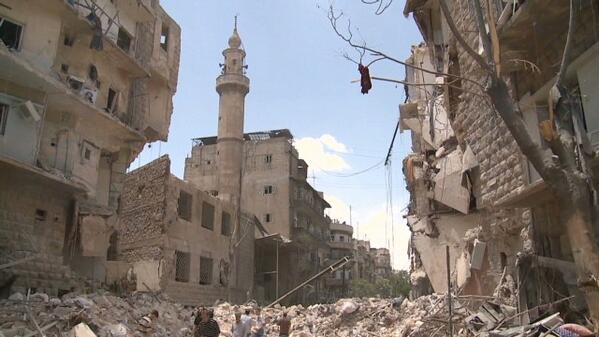
Devastation of the Ibrahim al-Khalil mosque in Tareeq al Bab after Assad's barrel bombs, Aleppo, April 2015 (source)

Devastation of the Ibrahim al-Khalil mosque in Tareeq al Bab after Assad’s barrel bombs, Aleppo, April 2015 (source)

The main intention of Russia’s intervention in Syria is to prop up the dictatorship of Bashar al-Assad and to do that Russia is seeking to ensure that the Islamic State (I.S.) is the only alternative to Assad’s regime. If the conflict becomes binary—Assad or I.S.—nobody can support I.S., and by default it will be accepted that Assad has to stay; even if international help is not given to put down the insurgency at that point, tacit support and political legitimacy will be extended to Russia’s effort to keep its client regime alive. In service of this mission, Moscow has consistently targeted the moderate rebels and even some non-moderate rebels, while avoiding I.S., in the conscious hope that the rebel positions it destroys will be replaced by I.S. fighters. In northern Syria in the last few days, Russia got its wish in a major way. Continue reading
The Local And Regional Implications From The Fall Of Idlib

By Kyle Orton (@KyleWOrton) on March 31, 2015

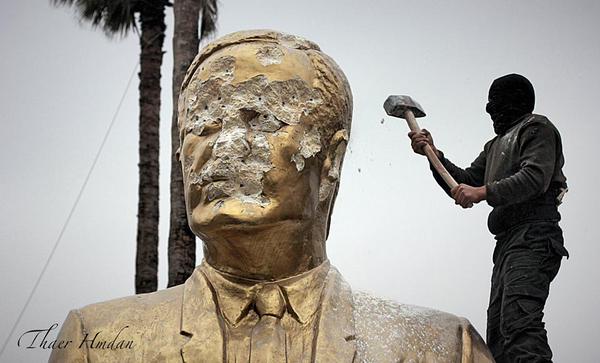
Statue of Hafez al-Assad defaced after Idlib City falls, March 29, 2015

Statue of Hafez al-Assad defaced after Idlib City falls, March 29, 2015

After an insurgent offensive began on March 24, Idlib City fell on March 29, making it only the second—of Syria’s fourteen—provincial capitals to slip from the control of Bashar al-Assad’s regime, the last one being Raqqa City on March 4, 2013. The regime has been on borrowed time in Idlib City since Wadi al-Deif to the south, near Maarat an-Numan, fell in mid-December.

In a scene reminiscent of Raqqa—and indeed the fall of Baghdad—a statue of Hafez al-Assad was destroyed. The insurgents broke open some secret prisons, while finding that in a final act of needless cruelty the regime had murdered other prisoners in the cells before retreating.

An operations room, Jaysh al-Fatah (Army of Conquest), organised this offensive, and is composed of: Faylaq a-Sham (Sham Legion), Liwa al-Haq, Ajnad a-Sham, Jaysh al-Sunna, Ahrar a-Sham, Jund al-Aqsa (JAA), and al-Qaeda’s Syrian branch, Jabhat an-Nusra. Continue reading

Iran and Global Terror: From Argentina to the Fertile Crescent

By Kyle Orton (@KyleWOrton) on February 27, 2015

Khobar Towers, which Iran jointly bombed with al-Qaeda

Khobar Towers, which Iran jointly bombed with al-Qaeda

Argentina’s government yesterday announced it was dissolving the Secretariat of Intelligence (S.I.), an intelligence agency tainted by the “Dirty War” regimes (1974-83), and more recent abuses as President Cristina Kirchner has taken Argentina back toward autocracy, and replacing it with a Federal agency. Just two days before, charges of corruption were levelled against Antonio Stiusso, S.I.’s director until Kirchner fired him in December. At the beginning of this month, Stiusso went missing. It now seems Stiusso has taken shelter in a neighbouring State.

These events are the latest twist in an extraordinary saga that has followed the discovery of the body of Alberto Nisman on Jan. 18 in his apartment in Buenos Aires, shot in the head in an apparent suicide. Nisman was a prosecutor investigating the July 18, 1994, bombing of the Argentine Israelite Mutual Association (AMIA) building in Argentina’s capital. All the evidence that Nisman had gathered pointed to Iran as the perpetrator. Few believe Nisman committed suicide, and—the history of Argentines being “suicided” considered—most fingers are pointing at Iran. Continue reading

What To Do About Syria: Sectarianism And The Minorities

By Kyle Orton (@KyleWOrton) on December 24, 2014

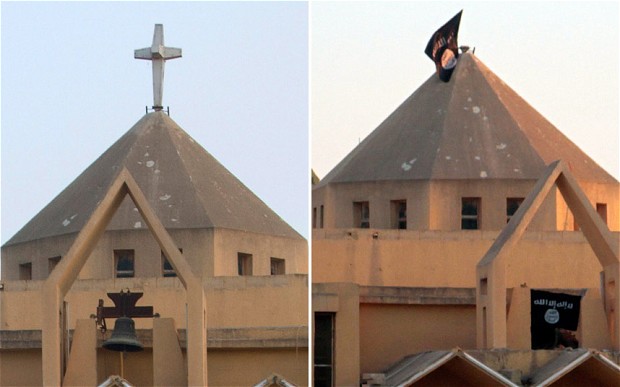
The Armenian Catholic Church of the Martyrs in Raqqa City

The Armenian Catholic Church of the Martyrs in Raqqa City

In the last few days I’ve been asked a lot about my longstanding view that the beginning of a Western strategy in Syria is the removal of Bashar al-Assad. The question has come from various angles and been phrased in various ways but it always boils down to: “What comes next?”

The best response I have seen to this comes from Thomas Nichols: “When someone says ‘tell me how it ends,’ it’s another way of saying: ‘I just don’t happen to like this particular case for intervention,’ for whatever reason.” Continue reading

If Assad Murdered His Own Brother-In-Law To Survive, What Wouldn’t He Do?

By Kyle Orton (@KyleWOrton) on December 19, 2014

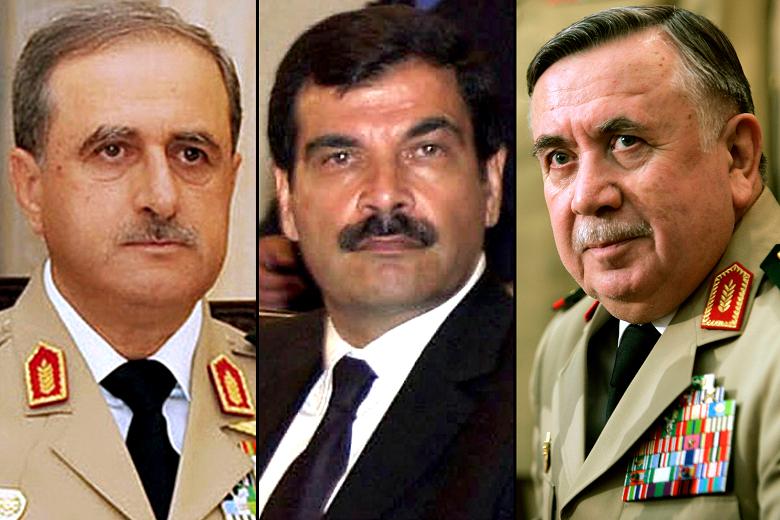
Defence Minister Daoud Rajha, General Assef Shawkat and General Hassan Ali Turkmani

Defence Minister Daoud Rajha, General Assef Shawkat and General Hassan Ali Turkmani

Sam Dagher at the Wall Street Journal has identified the July 18, 2012, bombing, which killed four senior Assad regime officials, most seriously Assef Shawkat, as the turning point in Syria, reversing the rebellion’s momentum, bringing the scale of the killing above where it had been before, closing the ranks of the minorities around the regime, and opening the country up to Iran.

Dagher certainly has the timing correct. It was the late summer, and most noticeably the fall of 2012, when the death toll in Syria markedly increased. 5,000 people had been killed in all of 2011, and another 5,000 by May 2012. By September 2012, 30,000 people were dead, the kill-rate now reaching 5,000-per-month. By January 2013, 60,000 people were dead, a kill-rate of 10,000-per-month. Nobody really knows what the total, let alone the rate, is now, but this was when it spiked. This period is also concurrent with the massive operation mounted by Clerical Iran to rescue the Bashar dictatorship.

Given how beneficial this bombing was to the regime, there have long been rumours it was an inside job. A recent report by Naame Shaam said exactly this, that this was an Iranian-orchestrated counter-intelligence operation to snuff-out the softliners within the regime who were trying to reach a deal with the protesters and rebels inside the country and their Gulf Arab patrons, which would have involved some concessions from the regime on its absolute control. Continue reading

A Freeze In Aleppo Won’t Help Save Syria—But It Might Help Assad

By Kyle Orton (@KyleWOrton) on December 15, 2014

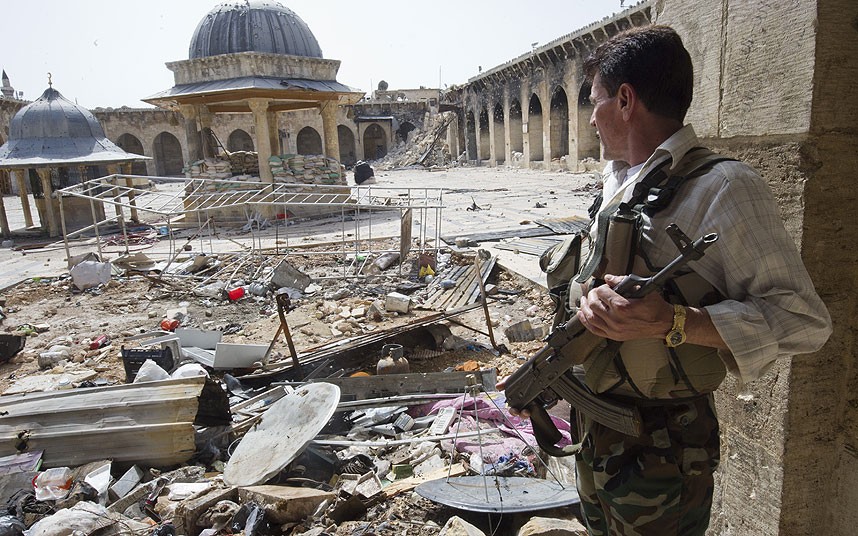
Great Mosque in Aleppo


On October 30, the United Nations peace envoy Staffan de Mistura presented an “action plan” for Syria, which included a plan for a “freeze zone” in Aleppo to give “an opportunity for some type of humanitarian improvement”. De Mistura wanted this to re-focus efforts of fighting units on all sides against the Salafi-jihadists of the Islamic State and Jabhat an-Nusra (al-Qaeda). Small wonder then that Assad’s U.N. envoy, Bashar Jafaari, said the regime was giving the proposal “due consideration”.

This freeze idea had emerged just after the Obama administration had, through surrogates, said it was sympathetic to the idea of trying to use local “ceasefires” Continue reading

Ghouta: One Year On

By Kyle Orton (@KyleWOrton) on August 21, 2014

Some of the children killed by the Assad regime's CW attack on Aug. 21, 2013

Some of the children killed by the Assad regime’s CW attack on Aug. 21, 2013

Can it really be twelve whole months since Bashar al-Assad gassed to death more than 1,400 people in a morning? I happened to be in London when the attack on the Damascus suburbs of Ghouta took place, exactly a year ago. London has become (in)famous recently for mass-protests that throw around the word “genocide”—against Israel’s (in my view ill-thought out) recent response to HAMAS’ rocket fire. London had no time for Syria’s grief: Continue reading

Syria’s Rebellion on the Ropes

By Kyle Orton (@KyleWOrton) on July 9, 2014

3

The devastated city of Aleppo

As we approach the forty month mark for the Syrian uprising the situation is grimmer than it has ever been. Not just the casualties: more than 200,000 people dead. Not just the physical devastation and mass-displacement of more than a third of the country. But now in military terms the rebellion is on the defensive in a way it has not been since it erupted at the end of 2011, after more than six months of peaceful protests.

Continue reading

The Coming Fall of Homs

By Kyle Orton (@KyleWOrton) on May 4, 2014

This afternoon it is being reported that a deal has been struck over Homs City, allowing 2,250 people, mostly rebels, to evacuate. Continue reading