Tag Archives: assassination

Human Rights Abuses in Rojava and the Anti-ISIS War

By Kyle Orton (@KyleWOrton) on 3 March 2018

Guerrillas from the Sinjar Resistance Units (YBS), the name the Kurdistan Workers’ Party (PKK) uses in Sinjar, Iraq, together with operatives from the People’s Defence Forces (HPG), the armed units of the PKK inside Turkey, holding a picture of PKK leader Abdullah Ocalan. (image source)

The American-led Coalition’s partner against the Islamic State (IS) in Syria, the so-called Syrian Democratic Forces (SDF), presents itself, ideologically and in terms of the governance structure it controls, in universalistic liberal and democratic terms, emphasizing ecological and feminist themes. The reality is that the SDF is under the politico-military control of the Kurdistan Workers’ Party (PKK), a designated terrorist organization that has run a four-decade-long insurgency against Turkey. The PKK has brought some measure of stability to the areas it controls, but it continues to struggle for legitimacy and without locally-legitimate government IS and other jihadi-Salafists will find political room to operate. The PKK’s continued monopolization of power and abusive governance practices undermine the chances for the “Rojava” system to evolve into a long-term solution to the jihadist terrorists that have used Syrian territory to threaten the region and the wider world. Continue reading
Islamic State Newsletter Tells the Story of Transition Between Statehood and Insurgency

By Kyle Orton (@KyleWOrton) on 13 January 2018

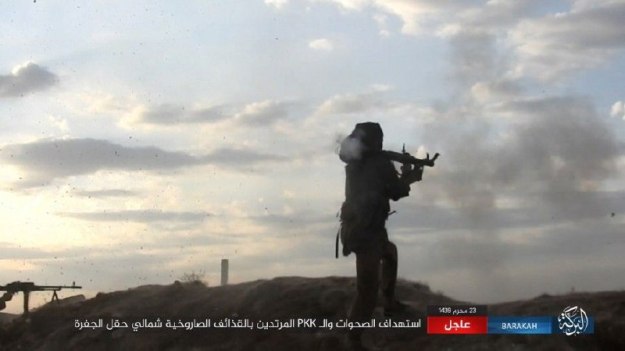
Islamic State, Wilayat al-Baraka, fighting north of al-Jafra with PKK, 14 October 2017

The Islamic State’s (IS) tactical behaviour, particularly its attitude toward the holding of territory, has become a centrally important matter recently with the destruction of the “caliphate” and IS’s reversion to insurgency. Continue reading

Crackdown Continues in Syrian Kurdish Areas

By Kyle Orton (@KyleWOrton) on 12 May 2017

Fasla Yusef, Syrian Kurdish opposition leader

The Kurdistan Workers’ Party (PKK) controls areas of northern Syria, operating under the name of the Democratic Union Party or PYD (its political wing) and the People’s Protection Units or YPG (its military wing). On Tuesday, President Donald Trump approved plans to arm the YPG directly, abandoning a fiction that the U.S. was only arming the Arab parts of an ostensible coalition, the Syrian Democratic Forces (SDF), which is in fact controlled by the YPG/PKK. This is in preparation for the U.S. backing the “SDF” to liberate Raqqa City, the Syrian capital of the Islamic State’s (IS) caliphate. Leaving aside the geopolitical implications of the U.S. decision for NATO and regional order, and putting aside, too, the likelihood that this decision will defeat its own purposes and give IS a new lease on life, there is a purely humanitarian dimension that deserves more attention. In March the PYD effectively legalized its one-party state in northern Syria and escalated its already-severe persecution of the Kurdish opposition. That crackdown has continued. Continue reading

Islamic State Operative Connected to Charlie Hebdo Attack Might Still Be Alive

By Kyle Orton (@KyleWOrton) on 15 April 2017

Boubaker al-Hakim (Abu Muqatil al-Tunisi) in Dabiq

Earlier today, an Iraqi military statement made public that the Iraqi government had provided coordinates to Bashar al-Assad’s air force, via the intelligence-sharing cell set up in Baghdad with Russia and Iran, for targets in Raqqa and al-Bukamal. One of the targets was Boubaker al-Hakim (Abu Muqatil al-Tunisi), a French-Tunisian Islamic State (IS) operative. Whether the Syrian regime’s strikes against al-Hakim were successful was not made clear. The interest here is that the U.S. announced on 10 December 2016 that it had killed al-Hakim in an airstrike near Raqqa on 26 November 2016, meaning that either the U.S. was mistaken or the Iraqis are. Al-Hakim is a very interesting figure in his own right with an extensive history in the jihadist movement and also highlights some broader trends, notably the assistance the Assad regime has provided to the IS movement. Continue reading

The Assad Regime Admits to Manipulating the Islamic State

By Kyle Orton (@KyleWOrton) on January 6, 2017

Khaled Abboud

From the beginning of the uprising in Syria in 2011, there have been accusations that Bashar al-Assad’s regime was in a de facto partnership with the Islamic State (IS) against the mainstream opposition. These accusations have a considerable basis in fact: during the entirety of the Anglo-American occupation of Iraq, Assad collaborated with IS jihadists in the destabilization of Iraq, killing thousands of Iraqi civilians and hundreds of American and British troops. Once the Syrian uprising was underway, the regime undertook various measures to bolster extremists in the insurgency. Assad and IS worked in tandem to leave Syria as a binary choice between themselves: Assad was sure this would rehabilitate him in the eyes of the world and transform his criminal regime into a partner of the international community in suppressing a terrorist insurgency, and IS wanted to rally Sunnis to its banner. The Secretary of the Syrian Parliament has now come forward to underline this. Continue reading

Litvinenko Verdict: What Happens Now?

By Kyle Orton (@KyleWOrton) on January 25, 2016

Published at Left Foot Forward.

The British inquiry into the death of Alexander Litvinenko concluded on Thursday, making official what everyone already knew: the Russian intelligence services, “probably” at the direct order of Russian President Vladimir Putin, murdered Litvinenko in London in November 2006.

Welcome as it is to have this on the record and to have Litvinenko’s killers named for all the world to see, it now leaves questions, primarily:

Will similar forensic scrutiny be brought to bear on several other odd instances of political and other crime in Russia?

And what does the British government intend to do now that the Kremlin is carrying out assassinations on its territory again? Continue reading

Islam’s First Terrorists

By Kyle Orton (@KyleWOrton) on August 24, 20151. The Assassins (book)

Book Review: The Assassins: A Radical Sect in Islam (1967) by Bernard Lewis

This review can be read in six parts: one, two, three, fourfive, and six.

Abstract

The fourth Caliph, Ali, was assassinated during a civil war that his supporters, Shi’atu Ali (Followers of Ali), lost to the Umayyads, who thereafter moved the capital to Damascus. The Shi’a maintained that the Caliphate should have been kept in the Prophet’s family; over time this faction evolved into a sect unto themselves, which largely functioned as an official opposition, maintaining its claim to the Caliphate, but doing little about it. Several ghulat (extremist) Shi’a movements emerged that did challenge the Caliphate. One of them was the Ismailis. Calling themselves the Fatimids, the Ismailis managed to set up a rival Caliphate in Cairo from the mid-tenth century until the early twelfth century that covered most of North Africa and western Syria. A radical splinter of the Ismailis, the Nizaris, broke with the Fatimids in the late eleventh century and for the next century-and-a-half waged a campaign of terror against the Sunni order from bases in Persia and then Syria. In the late thirteenth century the Nizaris were overwhelmed by the Mongols in Persia and by the Egyptian Mameluke dynasty which halted the Mongol invasion in Syria. The Syrian-based branch of the Nizaris became known as the Assassins, and attained legendary status in the West after they murdered several Crusader officials in the Levant. Attention has often turned back to the Assassins in the West when terrorist groups from the Middle East are in the news, but in the contemporary case of the Islamic State (ISIS) the lessons the Nizaris can provide are limited. Continue reading

Islam’s First Terrorists, Part 6

By Kyle Orton (@KyleWOrton) on August 22, 2015

This is the final part of a six-part series. Read parts one, two, three, four, and five, or read the whole essay.

Masyaf fortress, the headquarters of the Nizari Ismailis (The Assassins) in Syria

Masyaf fortress, the headquarters of the Nizari Ismailis (The Assassins) in Syria

Conclusion

The Nizari Ismailis did not invent assassination, of course; only lent it their name. The Ismailis were “part of a long tradition that goes back to the beginnings of Islam … of popular and emotional cults in sharp contrast with the learned and legal religion of the established order.” Still, the Nizaris did rely on the Holy Law. The ideal of Islamic governance might be authoritarian, but it is not arbitrary; if a ruler crosses the shari’a it becomes a duty to resist. This element became gradually more marginal as the religion formed into a State and Empire, but it was there and many other sects had called on it in their opposition to the prevailing regimes. The Nizaris were the first to call up this tradition of righteous rebellion and combine it with an effective opposition organization.

In their use of conspiracy, assassination, and even the ceremonial nature of the murders and the weapon-cult, the Assassins were hardly unique. But they might well be the first terrorists: those who, at an overwhelming disadvantage in conventional terms, used unconventional means in a planned, long-term campaign of targeted violence as a political weapon with the intention of overturning the established order. Continue reading

Black September: the PLO’s Deniable Terrorism Wing

By Kyle Orton (@KyleWOrton) on January 19, 2015

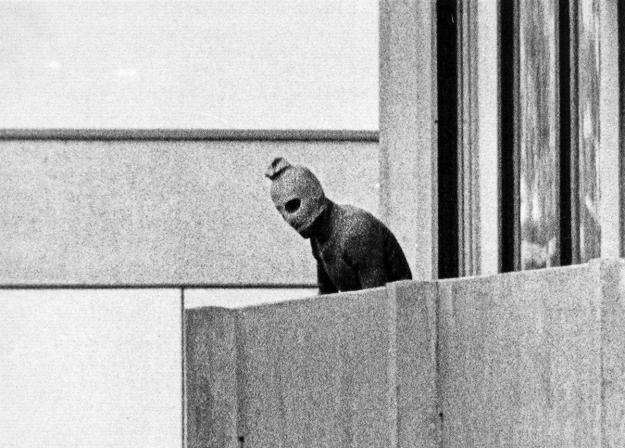
A Black September terrorist appears on the balcony in the Olympic Village in Munich, September 1972 (photo via AP)

The Black September group was formed in September 1971, ostensibly as a splinter from the Palestine Liberation Organization (PLO), but in reality the PLO retained control of Black September and used it to carry out terrorist operations that raised the Palestinian organisations’ profile, without staining the PLO with these atrocities. Continue reading