Tag Archives: assassination

The First Speech of Islamic State Spokesman Abu Muhammad al-Adnani

By Kyle Orton (@KyleWOrton) on 7 November 2019

Taha Falaha (Abu Muhammad al-Adnani) [right] appearing in an Islamic State video alongside Tarkhan Batirashvili (Abu Umar al-Shishani, 3 June 2017, displaying a scene from 2014 when IS demolished the borders between Iraq and Syria. Falaha was killed in August 2016. It is common for IS to hold back pictures and footage of its leaders for time-spans that can reach over a decade.

Taha Falaha was the effective deputy of the Islamic State (IS) when he was killed on 30 August 2016, by which time he was also overseeing the foreign attacks campaign by IS and serving as governor of the IS-held areas in Syria. Likely, however, Falaha, is best-known internationally by his kunya, Abu Muhammad al-Adnani, and for his role as IS’s official spokesman, particularly his speech in September 2014 inciting Muslims in the West to commit terrorist attacks against their native countries. Falaha had been recruited in Aleppo in 2002 by IS’s founder, Ahmad al-Khalayleh (Abu Musab al-Zarqawi) and steadily advanced through IS’s media department, eventually being announced as the official spokesman with his first speech, released on 1 August 2011. An English-language transcript of that first speech, an hour-long audio message entitled, al-Dawlat al-Islam Baqiya (“The Islamic State Remains” or “The Islamic State Endures”), was released by “Ansar al-Mujahideen English Forum Language and Translation Department” and was posted to their forum on 4 March 2012. The transcript is reproduced below with some editions from the Arabic transcript and some important parts highlighted in bold. Continue reading

When Terrorism … Isn’t

By Kyle Orton (@KyleWOrton) on 15 April 2019

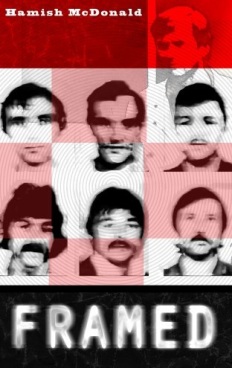
In February 1979, police in south-eastern Australia arrested six people. The suspects were members of the Croatian nationalist scene that agitated against Communist Jugoslavija and they had planned to commit a series of attacks against symbols of Marshal Tito’s regime that could have killed hundreds of Australians. Except they hadn’t, as Hamish McDonald, a journalist with the Sydney Morning Herald, shows in Framed (2012). Despite the “Croatian Six” being convicted for terrorism and spending a decade in prison, the reality of what had happened was nearly the exact opposite—and at least some powerful people in the Australian government knew or suspected as much from the get-go. Continue reading

The Shah, the Cold War, and the Islamists

By Kyle Orton (@KyleWOrton) on 20 March 2019

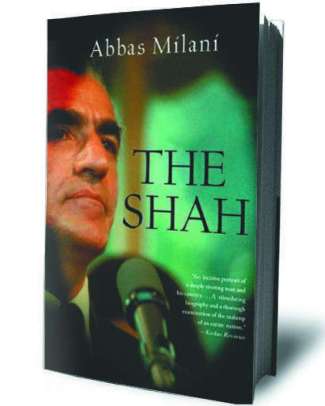
Abbas Milani’s The Shah gives a portrait of Iran’s last monarch, Muhammad Reza Pahlavi, and the impact that his downfall forty years ago continues to have in the Middle East, notably the emboldening of the Islamist movement. Continue reading

Islamic State Urges Defiance as the Caliphate Collapses, Attacks Other Islamists

By Kyle Orton (@KyleWOrton) on 9 March 2019

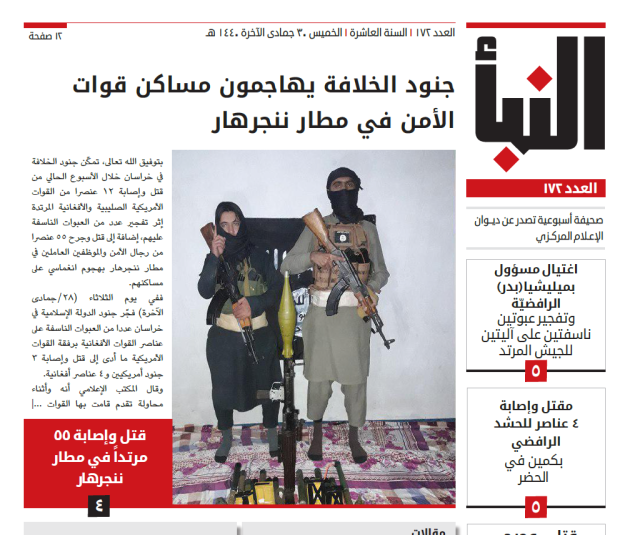
Al-Naba 172 front page

The Islamic State (IS) released the 172nd edition of Al-Naba, its newsletter, on 7 March 2019. Continue reading

Islamic State Newsletter Reiterates Group’s Tactics and Doctrine

By Kyle Orton (@KyleWOrton) on 26 November 2018

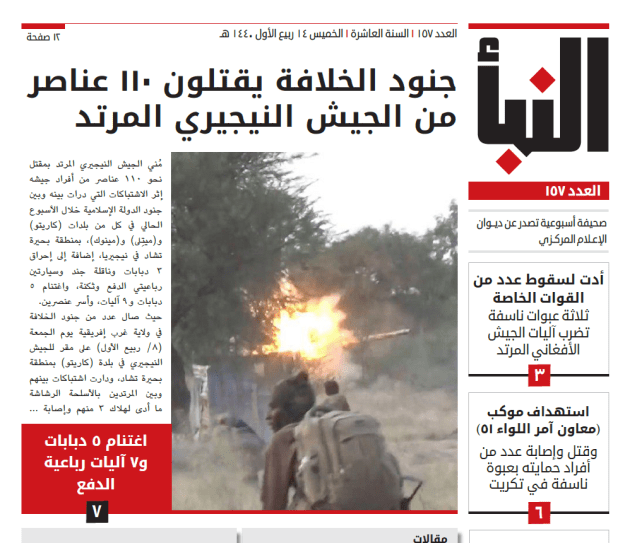
Al-Naba 157

The Islamic State (IS) released the 157th edition of its newsletter, Al-Naba, on 22 November. The content was fairly standard, underlining IS’s ideology, particularly its belief that the current hardships are merely bumps on the road to a victory that has been pre-ordained by God. The bulk of the newsletter is devoted to the fierce insurgent campaign IS is waging in northern Iraq and parts of eastern Syria. Continue reading

The Turkey-Saudi Rivalry for America’s Attention

This article was published at Ahval

By Kyle Orton (@KyleWOrton) on 26 October 2018

The Turkish government’s recent record in foreign policy is hardly a success story. It is therefore noteworthy that, so far, Ankara has handled the murder of Saudi journalist Jamal Khashoggi with a singular deftness. Whether Turkish President Recep Tayyip Erdoğan can see this through is now the key question. Continue reading

The Islamic State’s Lessons-Learned About Insurgency

By Kyle Orton (@KyleWOrton) on 5 October 2018

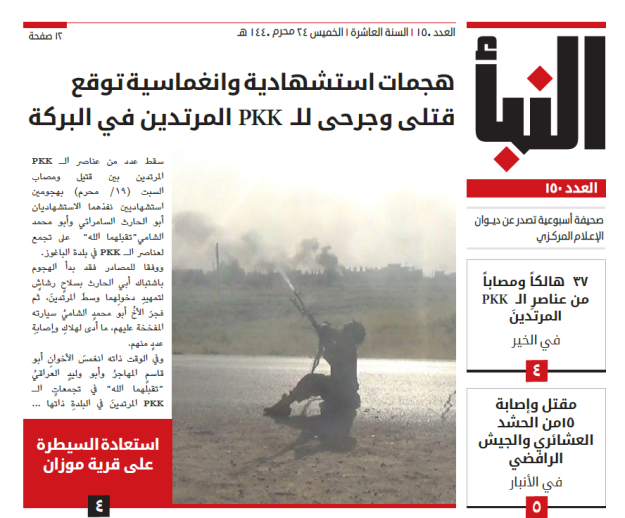
Al-Naba 150

The 150th edition of Al-Naba, the Islamic State’s (IS) weekly newsletter, was published on 4 October. IS focused on the progress of its guerrilla campaign in “Syraq” since the collapse of the caliphate, and gave a historical explanation of how it developed its insurgent methodology. Continue reading

Islamic State Spokesman Claims the Attack in the Arab Area of Iran

By Kyle Orton (@KyleWOrton) on 26 September 2018

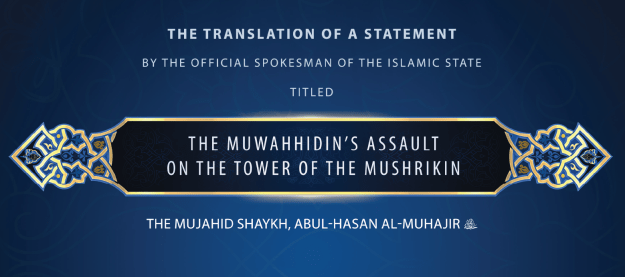
The spokesman for the Islamic State (IS), Abu Hassan al-Muhajir, gave a short speech today, “The Muwahhidin’s Assault on the Tower of the Mushrikin” (The Monotheists’ Assault on the Tower of the Polytheists). Abu Hassan’s speech was further confirmation of IS’s responsibility for the terrorist attack in Iran on 22 September. IS has published an English-language transcript of this speech, which is reproduced below with some editions for transliteration. Continue reading

Who Killed Kennedy?

By Kyle Orton (@KyleWOrton) on 18 September 2018

To even pose the question is, for most of us, to be already well-advanced down the road of madness that leads to saying the U.S. federal government murdered President John F. Kennedy. Dr. David Kaiser’s The Road to Dallas (2008) rejects such vast conspiracy theories, as it does the notion of Lee Harvey Oswald as the lone killer. Kaiser instead argues for a more limited conspiracy, led by the mob bosses of mid-20th century America, and originating in the grey-zone where that world met the Cuban exile community and the Central Intelligence Agency’s efforts to bring down Fidel Castro. Continue reading

Australia’s No-Nonsense Approach to the PKK

By Kyle Orton (@KyleWOrton) on 17 August 2018

Funeral for the victims of the TAK/PKK terrorist attack on the Besiktas football stadium in Istanbul, December 2016. Photograph: Sedat Suna/EPA

The Kurdistan Workers’ Party (PKK), the separatist group in Turkey that is a designated terrorist organisation across much of the West, has always used a vast array of front-groups in the West to raise funds and recruit. After 9/11, with the advent of the War on Terror, the PKK switched tactics in the region to try to conceal its operations and avoid the “terrorism” label. This involved rebranding its operations in Iraq, Syria, and Iran, and setting up a special forces-style urban terrorism wing, the Kurdistan Freedom Falcons (TAK), to deniably carry out its most atrocious activities. The PKK’s rebranding has not been without success. In Australia, however, the government has refused to accept the PKK’s propaganda about TAK and lists it, quite correctly, as simply an alias for the PKK. Continue reading