Tag Archives: caliphate

The Official Declaration that Made Abu Bakr al-Baghdadi Leader of the Islamic State

By Kyle Orton (@KyleWOrton) on 30 December 2017

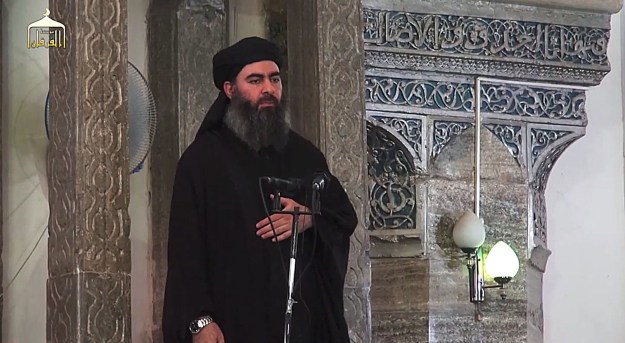
The leader of the Islamic State, Ibrahim al-Badri (Abu Bakr al-Baghdadi), speaking at the Zengi Mosque in Mosul, 4 July 2014 // AP Images

The current leader of the Islamic State (IS), Ibrahim al-Badri (Abu Bakr al-Baghdadi), was appointed as al-amir al-mu’mineen (the commander of the faithful or prince of the believers) on 16 May 2010, after his predecessor, Hamid al-Zawi (Abu Umar al-Baghdadi), was killed on 18 April 2010 in the company of his deputy and “war minister”, Abdul Munim al-Badawi (Abu Hamza al-Muhajir). The official statement appointing al-Badri is reproduced below. Continue reading

American Islamic State Jihadist Plotted to Bomb Trump’s First Presidents’ Day

By Kyle Orton (@KyleWOrton) on 17 December 2017

Robert Hester (image source)

The U.S. Department of Justice indicted Robert Lorenzo Hester, Jr., 25, of Columbia, Missouri, on 21 February 2017, for attempting to provide material support to the Islamic State (IS) and plotting an act of domestic terrorism. The plan had been an attack on 20 February, the first Presidents’ Day of the Donald Trump administration. Continue reading

The Islamic State Says the Loss of the Caliphate Does Not Mean Defeat

By Kyle Orton (@KyleWOrton) on 16 December 2017

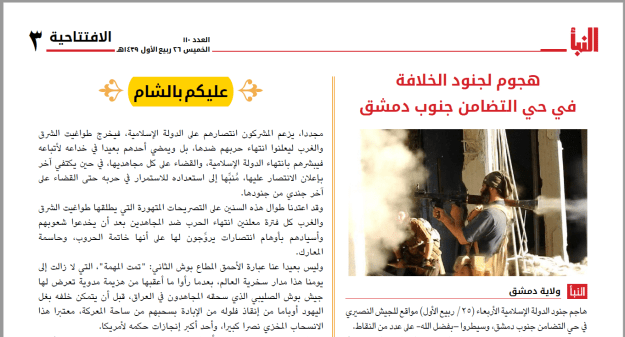
Ak-Naba 110, page 3

The Islamic State newsletter, Al-Naba, had an article on page 3 of its 110th edition, released on 15 December, which mocked those who have declared that the Islamic State is finished, pointing out that it has survived such obituaries before. A rough translation of the article is produced below. Continue reading

Islamic State Officially Gives Up the Caliphate, Returns to Insurgency

By Kyle Orton (@KyleWOrton) on 15 November 2017

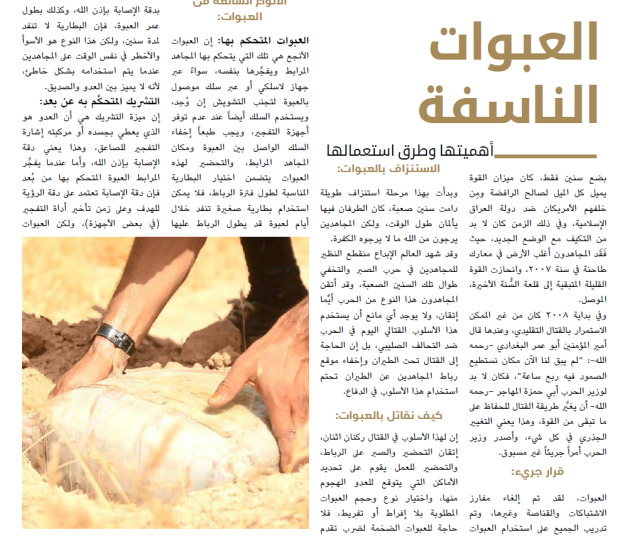
Al-Naba 101, page 8

In the 101st edition of the Islamic State’s weekly newsletter al-Naba (page 8-9), released on 12 October 2017, the organisation gave some fascinating details about how they responded to the “defeat” inflicted on them in 2007-08 by the American surge and the tribal Sahwa (Awakening) forces. The article describes how IS switched wholly to insurgent-terrorist tactics, dismantling its conventional fighting units and even its sniper teams in March 2008, and training in hit-and-run bombings. The leadership at that time, the emir Hamid al-Zawi (Abu Umar al-Baghdadi) and his deputy, the “first minister” and the “war minister” Abdul Munim al-Badawi (Abu Hamza al-Muhajir), encountered some initial scepticism, but the rank-and-file soon came on board when they saw its effectiveness. IS says that it is time to return to this form of warfare. In short, IS marked a switch in al-Naba 101 entirely from the statehood and governance phase of its revolutionary warfare, back into insurgency mode. The article is reproduced below. Continue reading

Hamza bin Ladin Presents Al-Qaeda As the Guardian of Revolution

By Kyle Orton (@KyleWOrton) on 9 November 2017

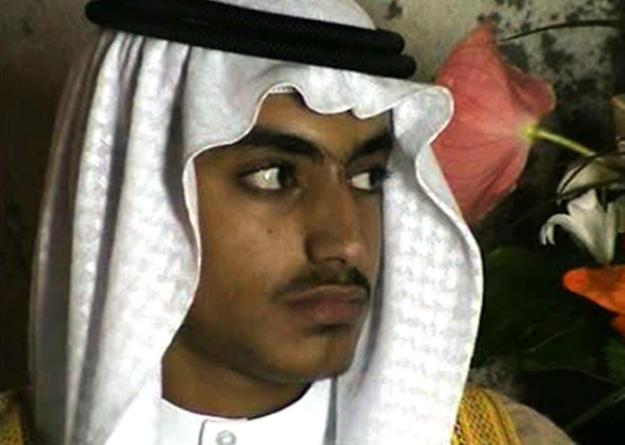
Hamza bin Ladin on his wedding day in Tehran, under the protection of the Quds Force, the expeditionary unit of the Islamic Revolutionary Guard Corps that attempts to spread the Iranian revolution through subversion and terrorism

Hamza bin Ladin, whose profile is being deliberately raised within al-Qaeda, released a speech on 7 November 2017, “The Fighter Against Invaders And The Inciter of Rebellion Against Tyrants”, an English transcript of which was produced by As-Sahab Media, and is reproduced below. Continue reading

The Islamic State Claims the Manhattan Terror Attack

By Kyle Orton (@KyleWOrton) on 3 November 2017

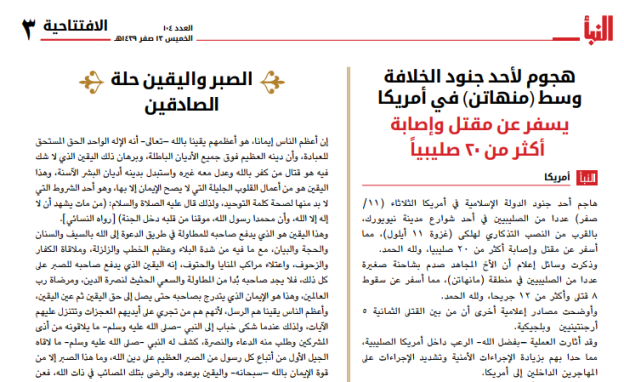
The Islamic State’s claim for the 31 Oct. 2017 Manhattan terror attack is on the right. (Al-Naba 140, 2 Nov. 2017, page 3.)

The Islamic State released the 140th edition of its newsletter, Al-Naba, on 2 November 2017, which contained an article claiming that the perpetrator of the vehicular ramming terrorist attack in New York city on Halloween night, Sayfullo Saipov, an Uzbek immigrant to the United States, was one of the caliphate’s “soldiers”. The Islamic State also repeated its much-contested claim that Stephen Paddock, whom it refers to as “Abu Abd al-Bir al-Amriki”, was motivated by its call when carrying out the massacre at the concert in Las Vegas on 1 October. The article is reproduced below.
Continue reading

Don’t Celebrate the Fall of Raqqa Just Yet

By Kyle Orton (@KyleWOrton) on 24 October 2017

Raqqa city has been destroyed (image source)

The Islamic State (IS) captured Raqqa city, its first provincial capital, in January 2014. Six months later, IS declared its caliphate and Raqqa became its de facto capital. Last Tuesday, the partner force of the US-led anti-IS Coalition, the “Syrian Democratic Forces” (SDF), entered the city centre in Raqqa. A deal had evacuated most of the remaining jihadists over the prior weekend, though a determined core remained and still held about 10 per cent of the city. The caliphate is crumbling and the Coalition says IS has 6,500 fighters left. According to the Coalition, this puts IS “on the verge of a devastating defeat”. Unfortunately, there is no reason to believe this is true. To the contrary, IS is more powerful at this point, in theatre, even after the military reverses inflicted on it by the Coalition, than in the period after the “defeat” of 2008, and the outlook is more favourable now to IS. Moreover, IS now has an international reach, physically and ideologically, it did not previously possess. Continue reading

The Coalition Kills Three Islamic State Drone Developers

By Kyle Orton (@KyleWOrton) on 29 September 2017

The international coalition against the Islamic State (IS) announced that it has killed “three senior and highly skilled ISIS officials” near Mayadeen in eastern Syria between 12 and 14 September. Continue reading

Coalition Risks Replacing the Islamic State With the Islamic Republic

By Kyle Orton (@KyleWOrton) on 14 September 2017

By recent reports, one could easily come away with the impression that war and instability across the Fertile Crescent are winding down. Predictions about what comes next, always a risky enterprise in the Middle East, are at a point of unique vulnerability. Chaos and violence for some considerable time to come look like a safe bet, though the timing and scale look more uncertain. Nonetheless, certain trendlines are visible, most clearly the emergence of a regional order, abetted by the international coalition’s campaign against the self-proclaimed Islamic State (ISIS), dominated by the Islamic Republic of Iran. Continue reading

Senior Islamic State Cleric Turki al-Binali Killed in an Airstrike

By Kyle Orton (@KyleWOrton) on 11 June 2017

Turki al-Binali at prayers in Raqqa, July 2015

It was reported on jihadist websites and by local activists that Turki al-Binali (Abu Hammam al-Athari), a senior cleric of the Islamic State (IS) and perhaps the most important public proponent of the caliphate’s formation, had been killed in Syria by an airstrike from the U.S.-led Coalition on 29 May. IS has been silent on this despite releasing their newsletter al-Naba and the tenth edition of their English-language propaganda magazine Rumiyah since then. On Tuesday, the intelligence services of the Kurdistan Regional Government (KRG) in northern Iraq confirmed that al-Binali had been killed. Continue reading