Tag Archives: espionage

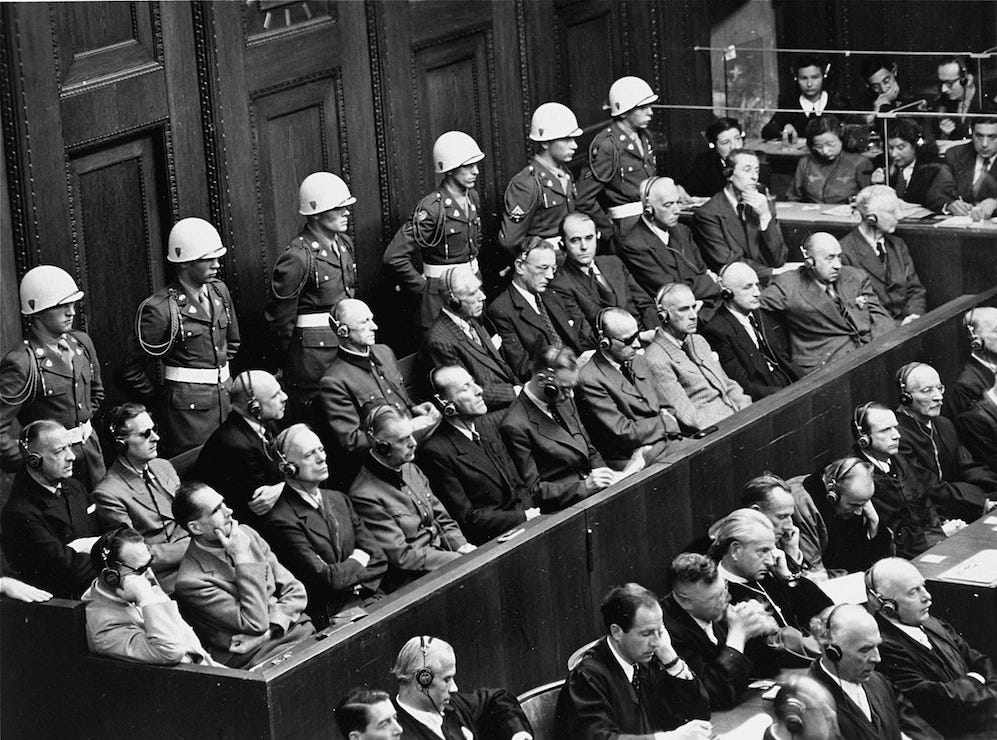
The  Soviet Role and (the Lack of) “Justice” At Nuremberg

By Kyle Orton (@KyleWOrton) on 11 April 2023

Continue reading

British MP, Soviet Spy: Tom Driberg

By Kyle Orton (@KyleWOrton) on 26 March 2023

Continue reading

Nazism: Origins and the Weimar Context

By Kyle Orton (@KyleWOrton) on 4 March 2023

Continue reading

Reviewing the Mystery of Jihadi Ideologue Abdullah Azzam’s Assassination Three Decades Later

By Kyle Orton (@KyleWOrton) on 11 August 2022

Abdullah Azzam [image source]

Continue reading

United Nations Report Finds Al-Qaeda and Islamic State Reduced, But Reviving

By Kyle Orton (@KyleWOrton) on 30 July 2022

Islamic State in Palmyra, December 2016

Continue reading

Britain Won the Spy War with the Irish Republican Army

By Kyle Orton (@KyleWOrton) on 3 July 2022

An IRA parade in Belfast || Image source

Continue reading

The Challenge for Western Intelligence in Talibanized Afghanistan

By Kyle Orton (@KyleWOrton) on 18 June 2022

A U.S. helicopter above the American Embassy in Kabul, 15 August 2021 | AP

Continue reading

Intelligence and the English Civil Wars

By Kyle Orton (@KyleWOrton) on 30 January 2022

Review of ‘The King’s Spy’ (2021), by Mark Turnbull

Continue reading

The February Revolution: The End of the Russian Monarchy

By Kyle Orton (@KyleWOrton) on 19 December 2021

Skobelev Square during the February Revolution, painting by Aleksandr Gerasimov, 1917

The “February Revolution” is so-called because Russia at the time was on the Julian (Old Style (O.S.)) calendar. By the Gregorian (New Style (N.S.)) calendar, which Russia adopted in February 1918, these events take place in March 1917. And momentous events they were, leading to the abdication of the last Tsar, the end of a monarchy and an entire system of power and authority that dated back more than 350 years. For eight months in 1917, Russia struggled to extend the constitutionalist reforms that had begun under the Tsardom within a more liberal framework. The liberals never did gain the upper hand over the radicals, not even after the September 1917 de facto return to autocracy. In November 1917, a coup by the most extreme Leftist faction, the Bolsheviks, terminated the experiment, burying for seven decades even the aspirations in Russia for liberalism and democracy. Continue reading

Unravelling the “Kornilov Affair”: The Last Stop Before the Bolshevik Takeover of Russia

By Kyle Orton (@KyleWOrton) on 8 December 2021

General Lavr Kornilov, 27 August 1917

The final key event on the road to the Bolshevik takeover of Russia in November 1917 was the “Kornilov Affair” that took place about two months earlier. Alexander Kerensky had become Prime Minister of the Provisional Government in July 1917 and around the same time General Lavr Kornilov had become Commander-in-Chief. A lot of accounts portray the “Kornilov Affair” as a “reactionary” coup attempt by Kornilov against Kerensky. The reality is very nearly the exact opposite. As historian Robert Pipes summarises: “All the available evidence, rather, points to a ‘Kerensky plot’ engineered to discredit the general as the ringleader of an imaginary but widely anticipated counterrevolution, the suppression of which would elevate the Prime Minister to a position of unrivaled popularity and power, enabling him to meet the growing threat from the Bolsheviks.”[1] Continue reading