By Kyle Orton (@KyleWOrton) on 30 July 2022
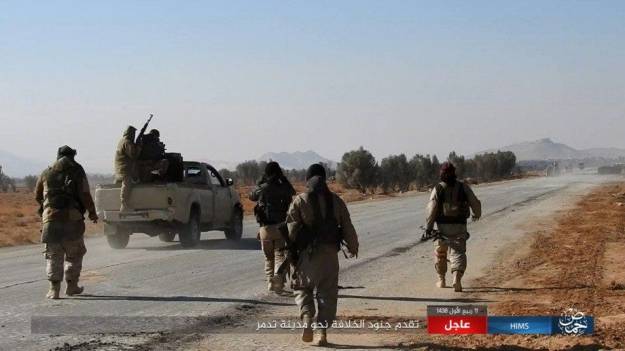
Islamic State in Palmyra, December 2016
By Kyle Orton (@KyleWOrton) on 30 July 2022
Islamic State in Palmyra, December 2016
By Kyle Orton (@KyleWOrton) on 22 July 2022

The United States announced on 12 July that it had killed the Islamic State’s (ISIS) governor of Syria in a drone strike in the village of Galtan in the Jinderes district of the north-western Syrian province of Efrin on the border with Turkey. The U.S. Central Command (CENTCOM) statement identified the slain man as “Maher al-Agal”, though a more precise transliteration is Maher al-Aqal (ماهر العقال). Riding on the motorcycle alongside Al-Aqal when he was killed was a “senior ISIS official” with whom he was “closely associated”. This ISIS official was “seriously injured during the strike”, CENTCOM notes, adding that the Jinderes strike caused no civilian casualties. Continue reading
By Kyle Orton (@KyleWOrton) on 22 February 2022

Kabul, the capital of Afghanistan, fell to jihadists on 15 August 2021, and this has emboldened the jihadist movement across the world, providing it with a morale boost and a model, as well as renewing the terrorist safe haven that incubated 9/11. Continue reading
By Kyle Orton (@KyleWOrton) on 3 February 2022

The compound where Islamic State leader Amir Muhammad al-Mawla killed himself, 3 February 2021 || Image taken from social media
By Kyle Orton (@KyleWOrton) on 22 October 2021
This article was originally published at European Eye on Radicalization

Sami Jassim al-Jaburi (Haji Hamid) | IMAGE SOURCE
Mustafa al-Khadhemi, the Iraqi Prime Minister, announced on the morning of 11 October that the Iraqi National Intelligence Service (INIS) had arrested Sami Jassim al-Jaburi (Haji Hamid), the effective finance emir of the Islamic State (ISIS), in “a complex external operation”. Continue reading
By Kyle Orton (@KyleWOrton) on 12 August 2021
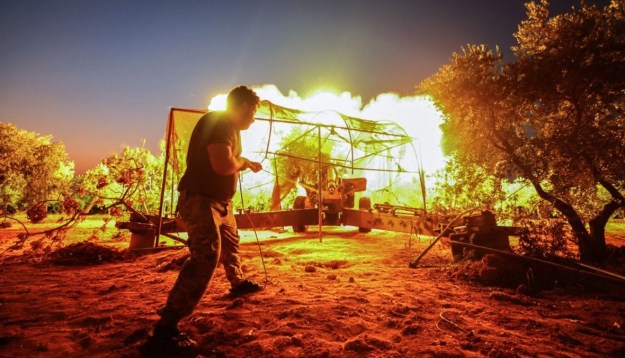
In early July, President Joe Biden confirmed his intention to withdraw all American troops from Afghanistan by September 2021. Biden cited a February 2020 U.S. “agreement” with the Taliban that he had “inherited” from the Trump administration. In truth, President Donald Trump had made no agreement. He had already begun pulling troops out by October 2019 and signed a fig leaf to cover his unconditional withdrawal.
Biden reassessed other Trump policies and could have reassessed this one, not least since the Taliban were in violation even of their vague paper promises — most notably on their commitment to deny space to al Qaeda and negotiate peace in good faith. The truth is that Biden is ideologically committed, as Barack Obama and Trump were, to ending American involvement in “forever wars.” Regardless, this does not mean those wars end or the threats that drew the United States in actually go away. Continue reading
By Kyle Orton (@KyleWOrton) on 22 July 2019

U.S. President Donald Trump and Turkey’s President Recep Tayyip Erdogan meeting during the G20 leaders summit in Osaka, Japan, 29 June 2019 [image source]
By Kyle Orton (@KyleWOrton) and Oved Lobel on 14 July 2019

Abror Azimov in court in Moscow in April 2017 [photo source] and Mukhamadyusup Ermatov [photo source]
This article was published at The New Turkey
By Kyle Orton (@KyleWOrton) on 27 October 2018

Today in Istanbul, four governments—Turkey, Russia, Germany, and France—are meeting for a summit over Syria, attempting to consolidate the Sochi Agreement signed by Russia and Turkey over Idlib, and re-invigorate the international political process. There is little reason to think that these talks can succeed on either front. Continue reading
A version of this article was published in CapX
By Kyle Orton (@KyleWOrton) and James Snell on 8 May 2018

The Barzeh chemical weapons facility in Damascus, Syria, demolished by U.S. cruise missiles on 14 April 2018 (image source)
The United States and its allies, Britain and France, launched over 100 missiles at the Syrian regime of Bashar al-Assad in the early hours of 14 April. This was retaliation for the regime’s use of poison gas in the town of Douma, east of the capital, Damascus, exactly a week earlier, which massacred at least 43 people and wounded 500 more. The military strikes were an important signal and will likely be some deterrent against the future use of chemical weapons in Syria, but ultimately this was another missed opportunity by the West to meaningfully affect the course of the war. Continue reading
 Kyle Orton's Blog