Tag Archives: Iran

The CIA and Iraq: Intelligence Failures, Media Successes

By Kyle Orton (@KyleWOrton) on 28 December 2019

In a long article last week, I looked at why the U.S. ran a formal occupation of Iraq for fourteen months after the fall of Saddam Husayn in April 2003, given that there had been an explicit pre-invasion decision not to have an occupation government. The short answer is that the occupation was installed through deception by the State Department, supported by the Central Intelligence Agency (CIA). State and CIA had argued for a protracted occupation in the Situation Room debates in 2002, but President George W. Bush had sided with the Pentagon, which advocated a rapid transfer of power to Iraqis. Having lost in the formal inter-agency process, the State Department succeeded by subversion in getting its way on the ground in Iraq. The disaster this caused in the mismanagement of post-Saddam Iraq was, as the article explained in detail, only the most serious impact of the toxic schism between State/CIA and the Pentagon, a factor whose import is difficult to overstate when examining how the Bush administration functioned. (This feud also at times drew in the Vice President’s Office, which tended to support the Pentagon.)

Continue reading

Why Was There Ever An American Occupation of Iraq?

By Kyle Orton (@KyleWOrton) on 22 December 2019

Douglas Feith was the U.S. Under Secretary of Defense for Policy from 2001 to 2005, one of the most senior positions at the Pentagon during one of the most consequential periods in recent history, covering the 11 September 2001 atrocities and early phase of the U.S.-led response. Feith later wrote a highly illuminating memoir, War and Decision: Inside the Pentagon at the Dawn of the War on Terrorism, which tried to drain some of the hysteria out of the public “debate” about the Iraq dimension of the U.S. policy in particular by explaining the internal arguments in the Bush administration leading up to the decision to finish with Saddam Husayn in 2003, and trying to set those arguments in their proper historical context, both in relation to Iraq—where “the war” had begun twelve years earlier—and the altered American threat perceptions in the shadow of 9/11. Unlike a lot of the gossipy tomes that emerged from former officials, Feith’s book is notably light on opinion and contains reams of declassified documents so readers can check his analysis against the source material. One of Feith’s key judgments is that “the chief mistake was maintaining an occupation government in Iraq for over a year”.[1] As Feith explains in great detail in the book, this was never supposed to happen. So how did it?

Continue reading

Britain’s Brexit Debate is Finally Over

By Kyle Orton (@KyleWOrton) on 15 December 2019

This article was published at QPosts

The victory of Boris Johnson’s Conservative Party, and the crushing defeat of Jeremy Corbyn’s Labour Party, is the beginning of the end of three years of turbulence in Britain. Continue reading

The Darker Side of the Western Enthusiasm for “The Kurds”

A version of this article was published in The Arab Weekly

By Kyle Orton (@KyleWOrton) on 24 November 2019

Solider from the Syrian regime holds up a portrait of Bashar al-Asad and a Syrian national flag, another stands by the Kurdish YPG/PKK flag, in Kobani, 18 October 2019. (AFP)

Mustafa Bali, head of the press office for the Syrian Democratic Forces (SDF), the coalition partner against the Islamic State (ISIS) in Syria, sent a tweet on November 14 showing Turkey’s Arab proxies engaged in “ISIS chants.” By this, he meant the takbir, “God is Great,” an expression used by Muslims every day. When criticised, Bali doubled down and blocked many critics. This was a microcosm of one of the darker threads in an SDF messaging strategy that is among the most effective propaganda campaigns on record. Continue reading

Trump’s Middle East Failure Was Made By Obama

By Kyle Orton (@KyleWOrton) on 19 November 2019

President Barack Obama meeting President-elect Donald Trump, 10 November 2016 [image source]

October 2019 may well remain in the popular memory as the inflection point marking the collapse of America’s — and by extension, the West’s — position in at least the northern Middle East. Having been thwarted twice before in efforts to leave Syria, in March and December 2018, President Donald Trump made one more try. For many, ‘Trump betrayed the Kurds’ will be the summary of the events that followed as Turkey made a swift move into the vacuum. The reality is a lot more complicated, and in truth the amount of blame that Trump can take for the events of the last month is rather limited. This catastrophe was baked into the policy of Barack Obama, and Trump’s main fault is to have followed the policy track laid down by his predecessor. Continue reading

The Rearrangement of Northeastern Syria and Signs of Rifts in the PKK

By Kyle Orton (@KyleWOrton) on 18 November 2019

“SDF commander “General Mazlum Kobani” (the PKK executive official Ferhat Abdi Shahin) being interviewed by AFP in Hasaka city, 24 January 2019 [image source]

Even by the standards of Syria’s complicated war, October 2019 was a tumultuous month. The contradictions inherent in the U.S. effort to conduct a counter-terrorism war against the Islamic State (IS) divorced from the realities of the underlying conflict erupted into view. Continue reading

Islamic State Bids Farewell to the Caliph

By Kyle Orton (@KyleWOrton) on 10 November 2019

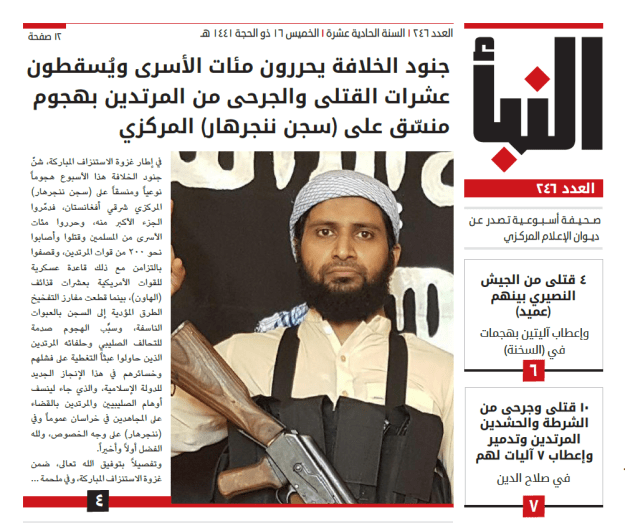
The 207th edition of Al-Naba, the weekly newsletter of the Islamic State (IS), published on 7 November 2019, devotes its main editorial to Ibrahim al-Badri (Abu Bakr al-Baghdadi), the first “Caliph” when the “Caliphate” was declared in June 2014, who was killed on 27 October 2019.

Continue reading

The First Speech of Islamic State Spokesman Abu Muhammad al-Adnani

By Kyle Orton (@KyleWOrton) on 7 November 2019

Taha Falaha (Abu Muhammad al-Adnani) [right] appearing in an Islamic State video alongside Tarkhan Batirashvili (Abu Umar al-Shishani, 3 June 2017, displaying a scene from 2014 when IS demolished the borders between Iraq and Syria. Falaha was killed in August 2016. It is common for IS to hold back pictures and footage of its leaders for time-spans that can reach over a decade.

Taha Falaha was the effective deputy of the Islamic State (IS) when he was killed on 30 August 2016, by which time he was also overseeing the foreign attacks campaign by IS and serving as governor of the IS-held areas in Syria. Likely, however, Falaha, is best-known internationally by his kunya, Abu Muhammad al-Adnani, and for his role as IS’s official spokesman, particularly his speech in September 2014 inciting Muslims in the West to commit terrorist attacks against their native countries. Falaha had been recruited in Aleppo in 2002 by IS’s founder, Ahmad al-Khalayleh (Abu Musab al-Zarqawi) and steadily advanced through IS’s media department, eventually being announced as the official spokesman with his first speech, released on 1 August 2011. An English-language transcript of that first speech, an hour-long audio message entitled, al-Dawlat al-Islam Baqiya (“The Islamic State Remains” or “The Islamic State Endures”), was released by “Ansar al-Mujahideen English Forum Language and Translation Department” and was posted to their forum on 4 March 2012. The transcript is reproduced below with some editions from the Arabic transcript and some important parts highlighted in bold. Continue reading

Obama Made America’s Collapse in the Middle East Inevitable

A version of this article was published at The Arab Weekly.

By Kyle Orton (@KyleWOrton) on 12 October 2019

Turkish Armed Forces heading towards the border with Syria, 8 October 2019 // BULENT KILIC / AFP

The beginning of Turkey’s third incursion into Syria on Wednesday, this time dubbed Operation PEACE SPRING and aimed at the areas east of the Euphrates River, is the culmination of an American policy started under Barack Obama that has been continued by Donald Trump. That it is inevitable makes it no less tragic for the innocents caught up in this mess. It does mean that the emotive posturing on social media, and attempts by Obama era officials to cast the blame for the Syria catastrophe onto Trump, are more-than-usually grotesque. Continue reading

Some thoughts on Turkey, ‘the Kurds’, America, and Syria

By Kyle Orton (@KyleWOrton) on 9 October 2019

Interview with De Re Militari Journal. Continue reading