As the regime of Bashar Assad appears to be consolidating in Syria, many Israelis have concluded that their government’s handling of the crisis was generally laudable.
Satellite pictures before and after Israel’s attack on an Iranian weapons cache in Damascus, January 2019 [source]
The Israeli government has launched an air attack into Syria and stepped up its rhetoric about further interventions against Iranian targets in the country. Despite this, there remains a significant gap between Israeli words and deeds. Continue reading →
At the beginning of September, New America published a paper, based on recovered al-Qaeda documents, which concluded that there was “no evidence of cooperation” between the terrorist group and the Islamic Republic of Iran. New America’s study lauds itself for taking an approach that “avoids much of the challenge of politicization” in the discussion of Iran’s relationship with al-Qaeda. This is, to put it mildly, questionable.
A narrative gained currency in certain parts of the foreign policy community during the days of the Iraq war, and gained traction since the rise of the Islamic State (IS) in 2014, that Iran can be a partner in the region, at least against (Sunni) terrorism, since Tehran shares this goal with the West. Under President Barack Obama, this notion became policy: the US moved to bring Iran’s revolutionary government in from the cold, to integrate it into the international system. Continue reading →
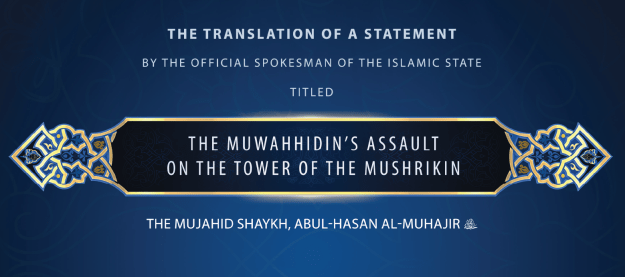
The spokesman for the Islamic State (IS), Abu Hassan al-Muhajir, gave a short speech today, “The Muwahhidin’s Assault on the Tower of the Mushrikin” (The Monotheists’ Assault on the Tower of the Polytheists). Abu Hassan’s speech was further confirmation of IS’s responsibility for the terrorist attack in Iran on 22 September. IS has published an English-language transcript of this speech, which is reproduced below with some editions for transliteration. Continue reading →
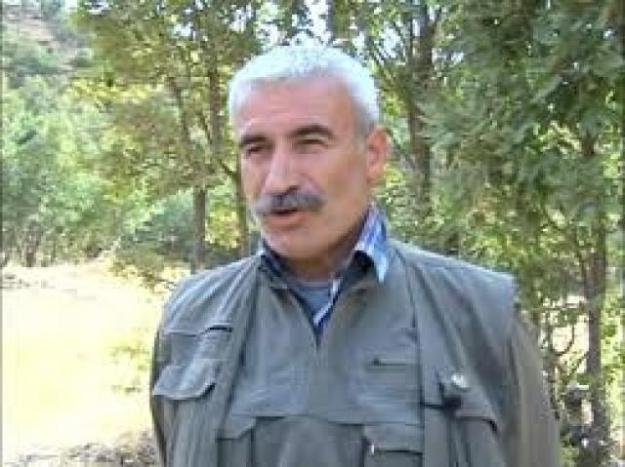
Turkey killed a senior operative of the Kurdistan Workers’ Party (PKK), the internationally-recognised terrorist organisation and narcoticstraffickingentity that has been at war with the Turkish state since 1984, in Iraq last week. Turkey launched a wave of airstrikes against PKK targets in Syria and Iraq in April 2017 and for the last several months Ankara has been widening its campaign against the PKK outside Turkey’s borders, particularly in Iraq, where the PKK is not protected by the United States, as it is in eastern Syria. Having feinted in June toward an attack on the historic PKK headquarters in the Qandil Mountains—a somewhat symbolic target at this stage, with the bulk of the PKK’s leadership and resources in Syria—it appears the Turks have opted for a more targeted approach.
This operation underscores the continuance of U.S.-Turkey relations, and the mutual benefits of the relationship, even in its current damaged state, where both sides have a laundry list of legitimate grievances with the other. If a formula for normalisation can be found, the potential to contain and weaken some of the worst, most destabilising elements in the region, saliently the PKK and the Iranian regime, is within reach. Continue reading →
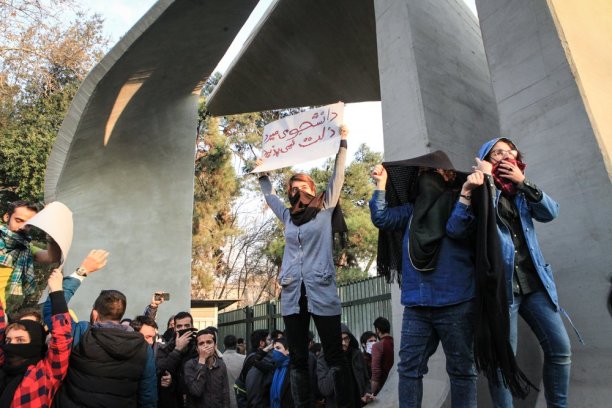
Protests in Tehran, Iran, 30 December 2017. (Photo by Stringer/Anadolu Agency/Getty Images)
Protests broke out against the Iranian government on 27 December, and have achieved a wider geographic spread in the country than even the massive uprising of June 2009, reaching into religiously conservative, working-class towns and districts traditionally regarded as pro-regime. It is likely these demonstrations will be suppressed, but that does not obviate the need for Western policy. To the contrary, the protests exposed several flawed assumptions in recent policy-making, and a course correction is urgently necessary. Continue reading →
Fire at the oil pipeline in Buri village, south of Manama, Bahrain, 10 Nov. 2017. REUTERS/Hamad I Mohammed
Just over a week ago, the major oil pipeline in Bahrain was bombed by operatives the government says were working for the Islamic Republic of Iran. This is the latest in an escalating series of terrorist attacks inside Bahrain. Throughout the year, Manama has also been rolling up terrorist cells that have links to Iran’s intelligence services and Bahraini citizens now in Iran that form part of Tehran’s regional terrorist network. The breakdown in Gulf unity is especially worrying in the face of this intensified Iranian aggression and subversion in Bahrain. Continue reading →
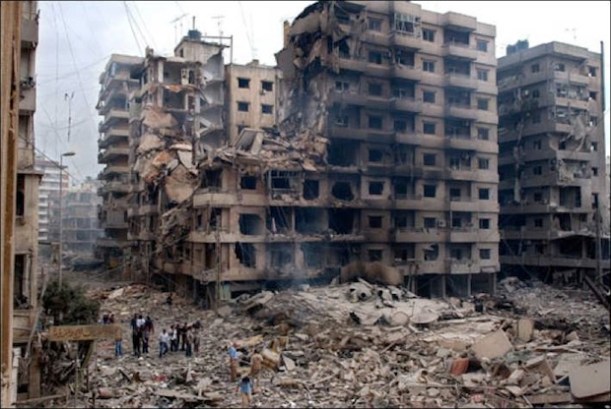
The destroyed Marine barracks that Iran’s agents blew up in Beirut on 23 October 1983 (image source)
The United States Department of Justice released indictments on 8 June 2017 for two operatives of the jihadist terrorist organisation, Hizballah, the Lebanese branch of Iran’s Islamic Revolutionary Guard Corps (IRGC), which is tasked with exporting the Islamist revolution in Iran through terrorism, subversion, and other means. The two men, Ali Kourani of New York and Samer al-Debek of Michigan, had been arrested on 1 June, and are charged with conducting surveillance for potential future terrorist attacks in the United States. Continue reading →
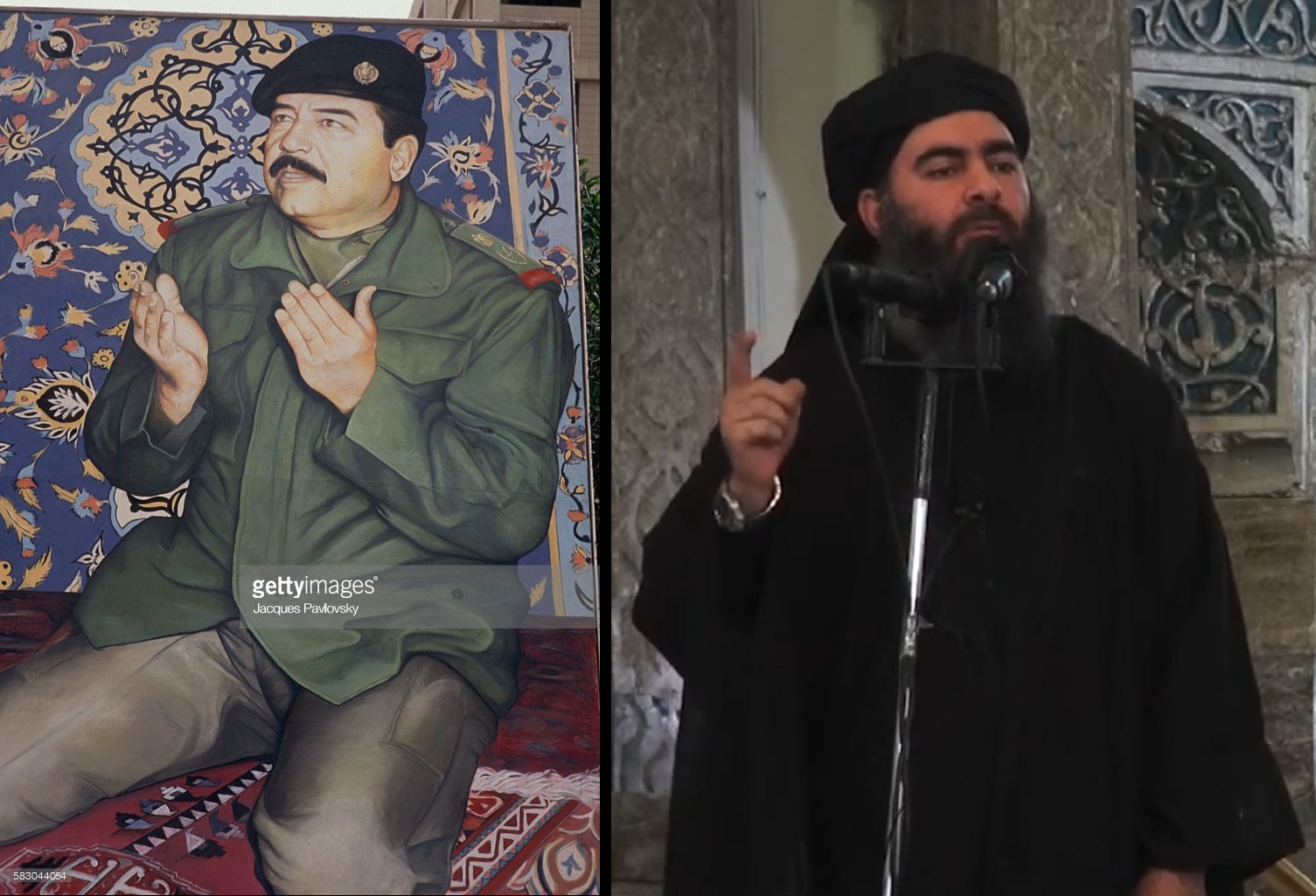
This essay, written to tie together my work on the relationship between the Saddam Hussein regime and the Islamic State, was completed last summer and submitted to an outlet, where it entered a form of development hell. After giving up on that option late last year, the opportunity arose to get a shorter version published in The New York Times in December. But I procrastinated too long over what to do with the full essay and a recent change in my work situation means I no longer have the bandwidth to go through the process of finding it a new home, so here it is.
“Abu-Bakr al Baghdadi is a product of the last decade of Saddam’s reign,” argues Amatzia Baram, a scholar of Iraq. He is correct in at least three ways. First, in its last decade in power, the Iraqi Ba’ath regime transformed into an Islamist government, cultivating a more religious, sectarian population on which the Islamic State (ISIS) could draw. Part of Saddam Hussein’s “Faith Campaign” also involved outreach to Islamist terrorists, including al-Qaeda, which meant that the synthesis of Ba’athism and Salafism that fused into the Iraqi insurgency after the fall of Saddam was already well advanced by the time the Anglo-American forces arrived in Baghdad in 2003. Second, the ISIS leadership and military planning and logistics is substantially reliant on the intellectual capital grown in the military and intelligence services of the Saddam regime. And finally, the smuggling networks on which ISIS relies, among the tribes and across the borders of Iraq’s neighbours, for the movement of men and materiel, are directly inherited from the networks erected by the Saddam regime in its closing decade to evade the sanctions. The advantages of being the successor to the Saddam regime make ISIS a more formidable challenge than previous Salafi-jihadist groups, and one that is likely to be with us for some time.
Khobar Towers, which Iran jointly bombed with al-Qaeda
Argentina’s government yesterday announced it was dissolving the Secretariat of Intelligence (S.I.), an intelligence agency tainted by the “Dirty War” regimes (1974-83), and more recent abuses as President Cristina Kirchner has taken Argentina back toward autocracy, and replacing it with a Federal agency. Just two days before, charges of corruption were levelled against Antonio Stiusso, S.I.’s director until Kirchner fired him in December. At the beginning of this month, Stiusso went missing. It now seems Stiusso has taken shelter in a neighbouring State.
These events are the latest twist in an extraordinary saga that has followed the discovery of the body of Alberto Nisman on Jan. 18 in his apartment in Buenos Aires, shot in the head in an apparent suicide. Nisman was a prosecutor investigating the July 18, 1994, bombing of the Argentine Israelite Mutual Association (AMIA) building in Argentina’s capital. All the evidence that Nisman had gathered pointed to Iran as the perpetrator. Few believe Nisman committed suicide, and—the history of Argentines being “suicided” considered—most fingers are pointing at Iran. Continue reading →




 Kyle Orton's Blog