The U.S. Treasury Department sanctioned Abdullah Ibrahim al-Faisal (born: Trevor William Forrest), a Jamaican cleric who supports the Islamic State (IS) on 5 December. This was long overdue. Al-Faisal’s record of disseminating jihadist ideology, and influencing and/or interacting with terrorists, goes back several decades. And since 2014, al-Faisal has been one of IS’s influential English-language propagandist-recruiters. Continue reading →
The leader of al-Qaeda, Ayman al-Zawahiri, gave a thirty-five-minute speech on 28 November 2017, entitled: “Let Us Fight Them As A Solid Structure” (or “Let Us Fight Them As One Body” or “Let Us Fight Them With Solid Foundations”), dealing with the vexed question of al-Qaeda’s relationship with the Syrian jihadi group, Hay’at Tahrir al-Sham, a situation that escalated again in recent days. The mention of an impending Turkish intervention into Idlib—which began on 7 October—suggests that al-Zawahiri recorded this speech in the last days of September or the first few days of October. An English transcript of the speech was released by As-Sahab Media, and is reproduced below with some edits for syntax and transliteration. Continue reading →
The latest edition of the Islamic State’s newsletter, Al-Naba 108, released on 1 December 2017, has a profile on page 7 of a fighter named Abu Sulayman al-Libi, a Libyan jihadist who came to Syria soon after the caliphate declaration in June 2014 and became the senior religious official in Homs. Abu Sulayman was killed in the fighting between IS and the pro-Asad coalition in the deserts of eastern Homs Province, near the T3 oil pumping station. This probably means Abu Sulayman was killed in the last days of September or the first few days of October during the IS counter-attack to the regime coalition’s push into Deir Ezzor. A rough translation of the Naba obituary is published below. Continue reading →
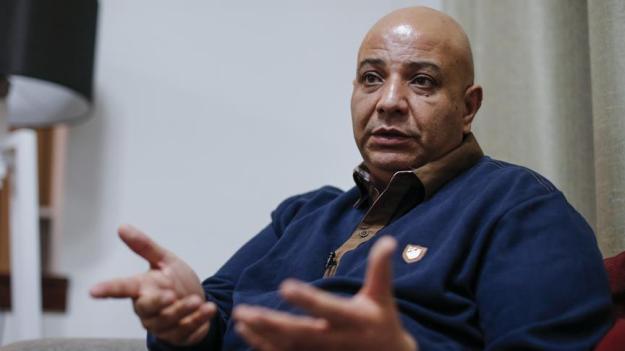
Talal Silo was the leader of an ethnic Turkoman unit within the Syrian Democratic Forces (SDF), the ground partner in Syria of the American-led international coalition against the Islamic State (IS). Having defected recently, Tilo has now given an interview about his experiences, the nature of the SDF, and the SDF’s links to the Bashar al-Asad regime and its supporters, Russia and Iran. Continue reading →
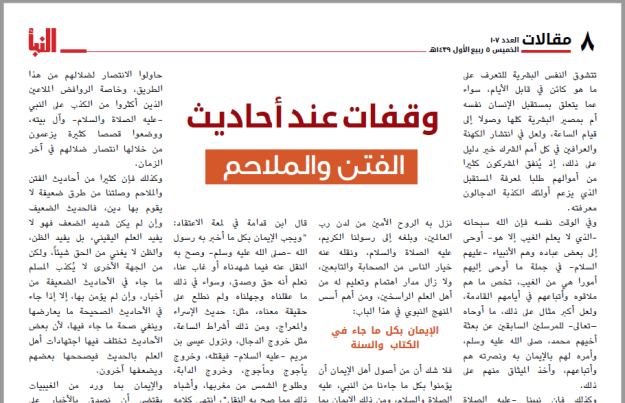
The 107th edition of Al-Naba, the Islamic State’s newsletter, was released on 27 November 2017. On page 8 there was an article that cautioned against applying apocalyptic prophecies to the present day. A very rough translation is produced below. Continue reading →
I released a report today, published by the Henry Jackson Society, Qatar and the Gulf Crisis. The intent was to examine the charges made against the Qatari government by its Gulf neighbours with regard to the funding of terrorism, the hosting of extremists, the dissemination of hate speech and incitement, among other things. Having separated fact from fiction with regards to he accusations against Qatar, the report proposes how Britain might proceed in such a way as to press Doha on issues of concern, while avoiding being drawn into the middle of the Gulf dispute, and trying to foster reconciliation between allies, especially at a time when a united front is necessary to oppose the far larger challenge of the Iranian theocracy. Continue reading →
Hay’at Tahrir al-Sham (HTS), the jihadist group in Syria that has broken away from al-Qaeda’s formal command, appears to have arrested the leaders of its splinter group that retained allegiance to al-Qaeda on 27 November. The arrests were first reported by pro-Qaeda media and later by HTS itself. HTS released a statement on the matter yesterday evening, “For the judicial authorities will be the decisive word,” which was translated by Al-Maqalaat and is reproduced below with some syntactical edits. Continue reading →
Abdul Munim al-Badawi (Abu Hamza al-Muhajir), the “war minister” of the Islamic State of Iraq, the predecessor to ISIS, made a brief five-minute speech on 30 April 2007, entitled “Nada ila Ulema al-Umma” (نِدَاءٌ إِلَى عُلَمَاءِ الأُمَّةِ). “Ulema” refers to Islamic scholars, sometimes translated as “clerics”, a slightly misleading comparison with Christianity, and “umma” refers to the worldwide community of Muslims, so the title of the speech translates as, “An Appeal to the Community’s Scholars”. Al-Badawi’s basic point—made at a time when the Islamic State movement was beginning to suffer under the pressure of the Surge and Sahwa—was to condemn the regional ulema for not supporting, and not having supported, the jihadists in Iraq against the Americans and the Shi’is. Implicitly, Al-Badawi is criticising the ulema for holding back Muslims in regional States who might otherwise have joined the Iraqi jihad as foreign fighters and suicide bombers, potentially making a difference to the Islamic State’s military fortunes. A rough translation of the speech is reproduced below.
The Office of Foreign Assets Control (OFAC) in the U.S. Department of Treasury, on 20 November, sanctioned “a network of individuals and entities involved in a large-scale scheme to help Iran’s Islamic Revolutionary Guard Corps-Quds Force (IRGC-QF) counterfeit currency to support its destabilizing activities” in Yemen. Continue reading →
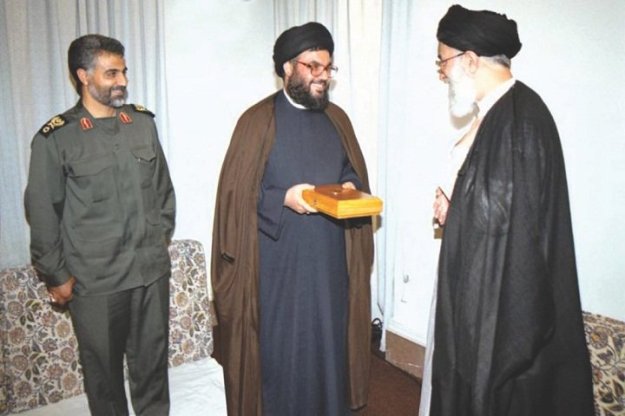
Qassem Sulaymani, Hassan Nasrallah, Ali Khamene’i (c. 2000)
The leader of the Quds Force, the expeditionary unit of Iran’s Islamic Revolutionary Guard Corps (IRGC), Qassem Sulaymani, sent a public letter to Iran’s Supreme Leader, Ali Khamene’i, on 21 November. Sulaymani’s letter followed the apparent expulsion of the Islamic State from its last urban stronghold in Syria, al-Bukamal, on 19 November, by Quds Force-led troops—foreign Shi’a jihadists and the battered remnants of Bashar al-Asad’s army. Sulaymani informs Khamene’i that in overcoming the Islamic State and its caliphate, a “U.S.-Zionist-made” terrorist entity has been defeated. Sulaymani’s letter is reproduced below, with some noteworthy sections highlighted in bold. Continue reading →




 Kyle Orton's Blog