Tag Archives: Muhammad al-Bahaya

The Islamic State’s Official Biography of the Caliph’s Deputy

By Kyle Orton (@KyleWOrton) on December 18, 2016
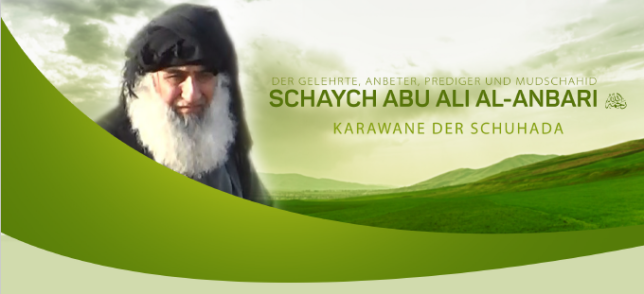
Obituary for Abdurrahman al-Qaduli in the German version of Rumiya, 11 November 2016

Obituary for Abdurrahman al-Qaduli in the German version of Rumiya, 11 November 2016

The forty-first edition of the Islamic State’s newsletter, al-Naba, released within the territory of the caliphate on 30 July 2016 and released online on 2 August, and the forty-third edition (released 13 and 16 August), contained a two-part obituary for Abd al-Rahman al-Qaduli (Abu Ali al-Anbari), the caliph’s deputy when he was killed on 24 March. The obituaries, entitled, “The Devout Scholar and Mujahid Preacher: Shaykh Abu Ali al-Anbari”,[1] make clear that al-Qaduli was one of the most consequential jihadists in the history of the Islamic State movement. Below is a translation, with some interesting and/or important sections highlighted in bold. The biography resolves some long-standing mysteries, and some of the claims are dubious in light of other evidence we have: these issues, and other points of context and explanation, are in the footnotes. The subheadings are mine, added to signpost the narrative and break it up into more manageable chunks.
Continue reading

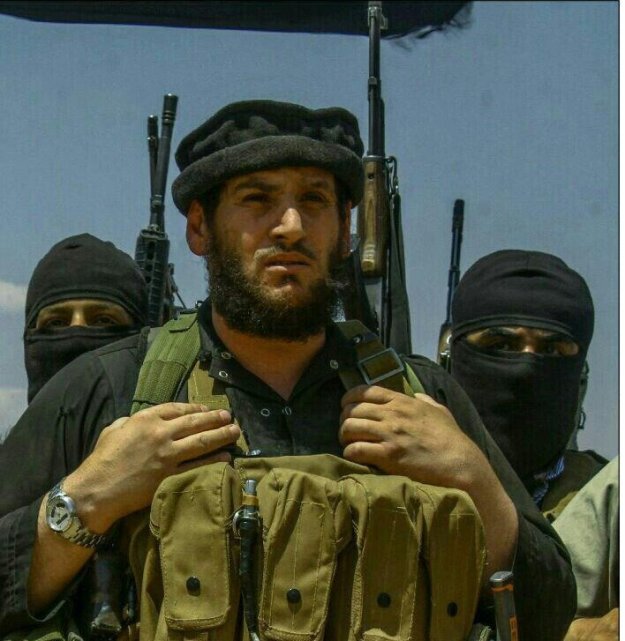
An Ideological Founder of Islamic State is Killed in Syria

UPDATE: It has subsequently become clear that the “Abu Abdullah al-Muhajir” who was killed in Syria on 18 November 2016 was not Muhammad al-Saghir, who is profiled below. The slain man, like al-Saghir a veteran of the war get the Soviets out of Afghanistan and an Egyptian jihadist with close links to al-Qaeda, also used the kunya “Abu Afghan al-Muhajir”.

By Kyle Orton (@KyleWOrton) on November 20, 2016

Abu Abdallah al-Muhajir (source)

A week ago, it became clear that the air war being waged by the U.S.-led Coalition, which primarily targets the Islamic State (IS), was going to expand its campaign against the leadership of Jabhat Fatah al-Sham (JFS), al-Qaeda’s rebranded branch in Syria. In the evening of 18 November 2016, the Coalition killed Abu Abdullah al-Muhajir, whose real name is Muhammad Ibrahim al-Saghir. Al-Saghir also uses the name Abd al-Rahman al-Ali. This killing would appear to be part of the Coalition’s new effort.

Al-Saghir has a long record as an important jihadi religious ideologue, though his exact relationship with al-Qaeda’s network remains unclear. Al-Saghir’s most lasting contribution to jihadi-salafism is as a key guide to the founder of IS, Ahmad al-Khalayleh. Continue reading

The Fall of the Islamic State’s Terrorism Director

By Kyle Orton (@KyleWOrton) on August 31, 2016

Taha Falaha (Abu Muhammad al-Adnani) in al-Naba

Taha Falaha (Abu Muhammad al-Adnani) in al-Naba

The Islamic State confirmed yesterday, via their “news” agency Amaq, that Taha Subhi Falaha had been killed in Aleppo. Falaha had gained global notoriety under his kunya, Abu Muhammad al-Adnani, after his September 2014 speech calling on Muslims in the West to “kill any disbeliever” in range, and to at least “spit in his face” if one was unable to find a knife or a car or a rock to do murder with.

Falaha was often referred to as the spokesman of IS, and so he was—the voice of the organization since 2011. He was also from the first generation of the organization, recruited before the invasion of Iraq, one of the few within the organization of that stature. But, as I explained recently in a paper for the Henry Jackson Society that compiled what is known of IS’s leadership, Falaha was much more than a figurehead.

Falaha was the governor of IS-held areas in Syria and the man who oversaw the external terrorist attacks. By now he was the caliph’s effective deputy. Heretofore, IS’s impressive bureaucracy has managed to replace individuals with minimal perturbation. IS will experience few perturbations quite like this.
Continue reading

The Structure of Al-Qaeda

By Kyle Orton (@KyleWOrton) on August 14, 2016

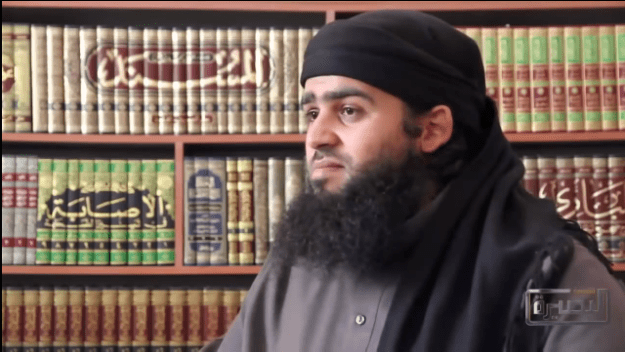
Screenshot of Mostafa Mahamed (Abu Sulayman al-Muhajir) during a video interview, 12 April 2014

Screenshot of Mostafa Mahamed (Abu Sulayman al-Muhajir) during a video interview, 12 April 2014

Mostafa Mahamed (Abu Sulayman al-Muhajir) is an Australian citizen who was born on 14 February 1984 in Port Said, Egypt. Mahamed currently occupies a “senior leadership position” within al-Qaeda in Syria—formerly Jabhat al-Nusra, now Jabhat Fatah al-Sham (JFS)—according to the sanctions levied against him in May by the U.S. Treasury. In an indication of Mahamed’s seniority, he moved from Australia to Syria in late 2012 and within a few months led the mediation efforts between al-Nusra and the then-Islamic State of Iraq and Syria (ISIS), now the Islamic State (IS), that began with a breach in April 2013 and ended with al-Qaeda expelling ISIS from its command structure in February 2014. Mahamed is also one of the public faces of al-Qaeda in Syria, now calling himself the “Director of Foreign Media Relations of JFS”. In this capacity, Mahamed has inter alia recently communicated with CNN to further the narrative that al-Nusra/JFS has “split” with al-Qaeda—something, let it be noted, neither the leader of al-Nusra/JFS nor Mahamed have actually said.

With regard to both the ongoing narrative war between IS and al-Qaeda over what their actual relationship was in the lead-up to the schism and al-Qaeda’s structure—the two things very much interlinked—Mahamed gave a very useful interview on 12 April 2014, about ten weeks before ISIS became IS when it declared its caliphate. Mahamed also touches on other interesting matters, such as those jihadi ideologues al-Nusra/JFS regards as guides, and—small point—al-Qaeda’s continuing claim that IS’s founder, Abu Musab al-Zarqawi would have sided with them. (This is matched on the other side by IS continuing to feature Usama bin Ladin in their propaganda as one of their forebears, while regarding Ayman al-Zawahiri as deviant.)

In watching the video back, I ended up taking notes, which turned into a partial (though fairly substantial) transcript that will perhaps be of use to others as well, so it’s posted below. Continue reading

Ahrar al-Sham and Al-Qaeda

By Kyle Orton (@KyleWOrton) on August 12, 2016

The Islamic State’s (IS) weekly newsletter, al-Naba, interviewed a high-ranking al-Qaeda defector, Abu Ubayda al-Lubnani, across two issues in February and March 2016. Abu Ubayda announced his defection from al-Qaeda to IS in April 2014 via al-Battar and Abu Ubayda’s name appeared on a list of prominent clerics supporting IS’s caliphate declaration that was circulated not long after the declaration. Abu Ubayda is described by al-Naba—as best as can be told accurately—as having been a member of al-Qaeda’s Shura or Consultation Council, a training officer in its Military Committee, and a counter-intelligence officer. Abu Ubayda is advertised as speaking about many secret aspects of al-Qaeda.

Among the topics Abu Ubayda covers is the alleged infiltration and manipulation of al-Qaeda by foreign intelligence services, specifically Pakistan’s Inter-Services Intelligence (ISI), which is not only a violation of jihadist doctrine by collaborating with an “infidel” and illegitimate state but led to the deaths of a number of senior al-Qaeda leaders.

Perhaps the most intriguing aspect of what Abu Ubayda has to say relates to al-Qaeda’s attempt to take advantage of the Syrian revolution. This persistent campaign has followed a pattern of disguising al-Qaeda’s presence and attempting to influence and eventually co-opt the rebellion against Bashar al-Assad’s regime. One lever al-Qaeda relied upon, according to Abu Ubayda, was Ahrar al-Sham, an organization that disclaims all connections to al-Qaeda and dissimulates about its ideology. Whatever Ahrar’s dominant ideology, it is simply a fact that it has served as the bridge between the foreign-led jihadists and Syrian Islamists, and its connections to al-Qaeda are evident enough. Abu Ubayda suggests Ahrar’s connections to al-Qaeda are even deeper than they appear. Continue reading

Al-Qaeda Rebrands, Marches on in Syria

By Kyle Orton (@KyleWOrton) on August 2, 2016

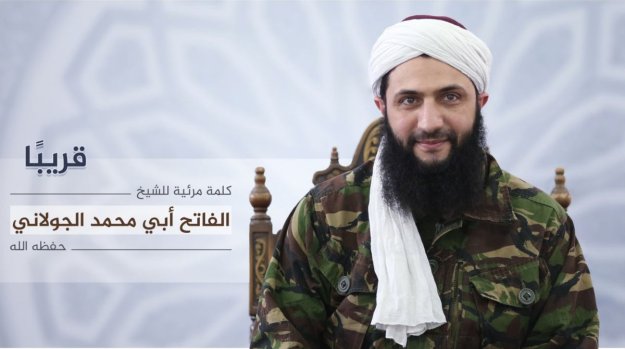
First ever picture of the leader of Jabhat al-Nusra (al-Qaeda in Syria), Ahmad al-Shara (Abu Muhammad al-Jolani), 28 July 2016

First ever picture of the leader of Jabhat al-Nusra (al-Qaeda in Syria), Ahmad al-Shara (Abu Muhammad al-Jolani), 28 July 2016

The leader of Jabhat al-Nusra (al-Qaeda in Syria), Abu Muhammad al-Jolani, whose real name is Ahmad al-Shara, ostensibly broke the link between his organization and al-Qaeda last week. This is another stage in al-Qaeda’s long-term strategy of embedding itself into local societies so that it can more effectively reshape the faith and shield itself from the international community. Continue reading

Al-Qaeda Leader Focuses on Main Enemies: Saudi Arabia and the Islamic State

By Kyle Orton (@KyleWOrton) on January 13, 2016

1

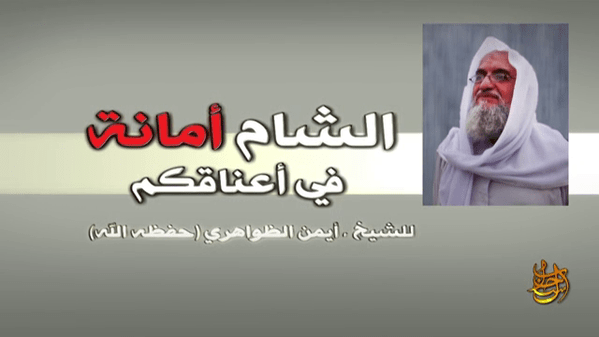
As-Sahab Foundation for Islamic Media Publication, al-Qaeda’s media outlet, produced an English translation of a speech by the organization’s leader, Ayman al-Zawahiri, on 13 January 2016. The speech was entitled, “Syria Is Entrusted Upon Your Necks”. The speech does focus on the West, particularly its de facto alliance with the pro-Assad coalition—namely Russia and Iran—and calls for the Syrian rebellion to unite with al-Qaeda to resist this conspiracy. What is more noticeable, however, is the two enemies on whom Dr. al-Zawahiri really focuses: Saudi Arabia and the Islamic State. The Saudis are accused—not without reason—of having been allied closely to the West and thwarting the jihadist projects at every turn. And al-Zawahiri makes a fierce ideological assault on the Islamic State, comparing them with the Khawarij and the Armed Islamic Group (GIA), whose conduct in Algeria in the 1990s and their justifications for it took Islamist extremism to new depths. The speech is reproduced below with some minor editions, to transliteration and punctuation, and some interesting and important sections highlighted in bold.
Continue reading

Al-Qaeda Central in Syria

By Kyle Orton (@KyleWOrton) on September 14, 2015

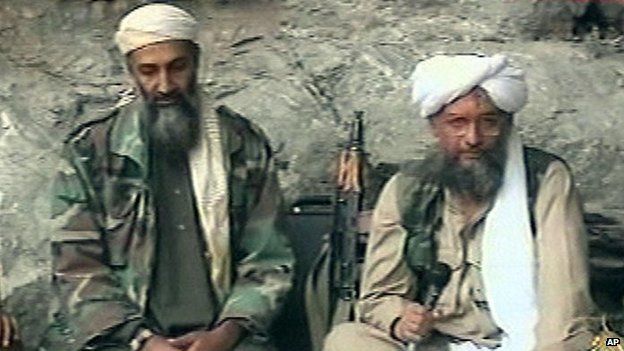
Osama bin Laden and Ayman az-Zawahiri (2001)

Usama bin Ladin and Ayman az-Zawahiri (2001)

A couple of days ago, a leader Jabhat an-Nusra issued a statement condemning Ahrar a-Sham. The statement is actually rather milder than initial reports suggested. Nusra is mostly annoyed at Ahrar for working with Turkey and Qatar to acquire money and weapons. Nusra is also displeased that Ahrar, at the instigation of Ankara and Doha, asked Nusra to publicly break its al-Qaeda link. Nusra also felt Ahrar was too willing to publicly distance itself from Salafi-jihadism to gain war materiel. This will no doubt help intensify the debate about Ahrar’s ostentatious “moderation” over the last eighteen months, and what the West should do about Ahrar.

In this post, however, I’d like to focus on the statement’s author, Abu Firas as-Suri, or more precisely on what he represents. Abu Firas is part of a group of (known) agents of al-Qaeda Central (AQC) who were sent into Syria in mid-2013 to mediate the dispute between Nusra and then-ISIS (now the Islamic State, I.S.), and when that failed the AQC veterans stayed, erected a veritable bureaucracy, and sought to forestall Nusra “going local”. Below are mini-profiles of these AQC veterans. Continue reading

WikiBaghdady Claims to Leak the Islamic State’s Secrets

By Kyle Orton (@KyleWOrton) on October 8, 2014

Before the account, first published in April 2014, by an ostensible Islamic State (IS) defector, “Abu Ahmad”, there was the Twitter account @WikiBaghdady, which released a lot of information in the same vein about the alleged impiousness of the jihadist organization. @WikiBaghdady’s testimony, as collected by Yousef Bin Tashfin, is republished below, with some editions for transliteration and syntax, to ensure its preservation. Continue reading

ISIS’s Spokesman Denounces Al-Qaeda’s Leader, Claims ISIS Is The Victim

By Kyle Orton (@KyleWOrton) on May 13, 2014

The spokesman of the Islamic State of Iraq and Syria (ISIS), Abu Muhammad al-Adnani, gave a speech via audio message on 11 May 2014, entitled “‘Adhr’a emir al-Qaeda” (Apologies, emir of al-Qaeda). Al-Qaeda’s leader, Ayman al-Zawahiri, disowned ISIS, al-Qaeda’s prior Iraqi branch, in February, and then gave an extended statement a few days ago that placed blame for the schism squarely on ISIS. Al-Adnani’s speech was a response to al-Zawahiri, and it was among ISIS’s most stern attacks on al-Qaeda so far. Al-Adnani denounced al-Zawahiri for allegedly deviating from the outlook of Usama bin Ladin. Al-Adnani called on al-Zawahiri to reverse his ruling that accepted Jabhat al-Nusra’s split from ISIS. Al-Nusra has rebelliously broken its pledge of allegiance to ISIS, al-Adnani says, and al-Zawahiri’s duty was to side with ISIS against this renegade—not to join in a campaign of sedition and conspiracy against ISIS. Most intriguingly, al-Adnani denied that ISIS had ever been, in a formal sense, subordinate to al-Qaeda. Rather, says al-Adnani, ISIS had placed itself in a position of voluntarily labelling themselves as al-Qaeda and accepting the advice of the “elders of jihad” in order to unite the ranks of the jihadists. But, says al-Adnani, this was not a command relationship for ISIS’s internal affairs: witness, al-Adnani says, ISIS’s refusal to listen to al-Qaeda’s order to cease attacking Shi’i civilians. Though, says al-Adnani, ISIS did obey al-Qaeda in external matters, specifically not targeting Iran, where al-Qaeda has an important facilitation network that serves as its supply line from Afghanistan-Pakistan to the Arab world. Al-Adnani’s speech was translated today by Musa Cerantonio, an Australian convert to Islam who is one of ISIS’s most important international propagandist-recruiters. Al-Adnani’s speech is reprinted below. Continue reading