By Kyle Orton (@KyleWOrton) on 22 January 2022
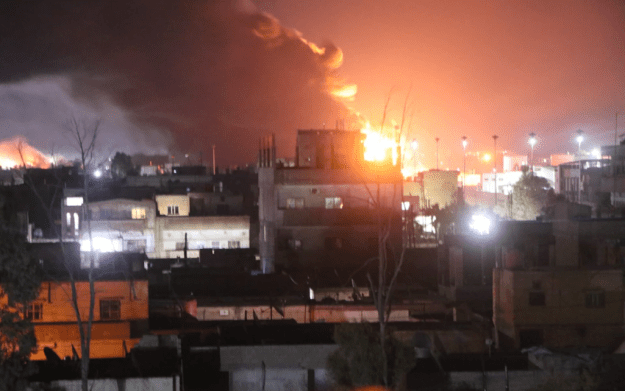
Islamic State car bombing against Al-Sinaa prison in Syria, 20 January 2022 [image source]
By Kyle Orton (@KyleWOrton) on 22 January 2022
Islamic State car bombing against Al-Sinaa prison in Syria, 20 January 2022 [image source]
By Kyle Orton (@KyleWOrton) on 7 September 2021

Anti-Taliban fighters watch U.S. airstrikes at Tora Bora, 16 December 2001 || REUTERS/Erik de Castro
The State Department spokesman Ned Price said, on 27 August, “The Taliban and the Haqqani Network are separate entities”. The next day, the Pentagon Press Secretary John Kirby slightly modulated this, having first tried to dismiss the question, by conceding there was “a certain amount of … commingling … there’s a marbling … of Taliban and Haqqani”, before saying he was “pushing back … [on] the relevance of that discussion”.
What these officials were trying to do was two-fold: (1) to refute press reports that U.S. officials in Kabul had shared “a list of names of American citizens, green card holders, and Afghan allies” with the Taliban, amounting to having “put all those Afghans on a kill list”, as one “defense official” put it; and (2) to deny that the U.S. coordination with the Taliban to evacuate people the jihadists wanted to kill—a surreal enough situation—had involved the additional political and legal problems of coordinating with a formally registered Foreign Terrorist Organization (FTO), as the Haqqani Network is. Continue reading
By Kyle Orton (@KyleWOrton) on 26 August 2021

Taliban patrol in Wazir Akbar Khan, Kabul, 18 August 2021 [image source]
By Kyle Orton (@KyleWOrton) on 25 June 2021

Writing recently about the first meeting between Adolf Hitler and Francisco Franco at Hendaye on 23 October 1940, where the Führer tried to enlist Spain into the Axis, I concluded, drawing on Franco: The Man and His Nation by George Hills, a former BBC journalist and Fellow of the Royal Historical Society:
By Kyle Orton (@KyleWOrton) on 12 March 2021

A nearly-22-minute video was released by As-Sahab, the media wing of Al-Qaeda, on 12 March 2021, entitled, “The Wound of the Rohingya is the Wound of the Umma” or “The Wound of the Rohingya is the Wound of the Islamic Nation”. More than anything actually said or presented, the video itself was the story since it comes after credible reports in November 2020 that Al-Qaeda’s emir, Ayman al-Zawahiri, had died a month earlier. The only question was whether the video would provide proof-of-life for Al-Zawahiri, and it pointedly did not. Continue reading
By Kyle Orton (@KyleWOrton) on 21 February 2021
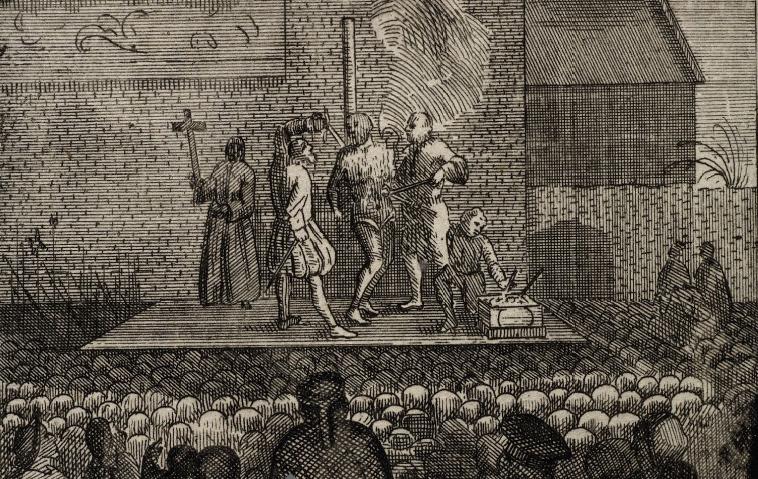
Execution of Jan Beuckelszoon // Illustration in a book by Lambertus Hortensius
In 1534, shortly after the onset of the Protestant Reformation, a radical sect from this new movement, the Anabaptists, seized the city of Munster in Germany and governed it for sixteen months as a millenarian cult in a manner so alarming it managed to bring together Catholic and Lutheran forces to put it down. The experience had a profound influence not only on the development of Anabaptism thereafter, but on the manner in which the Reformation more generally unfolded. Continue reading
By Kyle Orton (@KyleWOrton) on 12 June 2020

Ismail Nazlikul (Kasim Engin) [image source]
By Kyle Orton (@KyleWOrton) on 29 May 2020
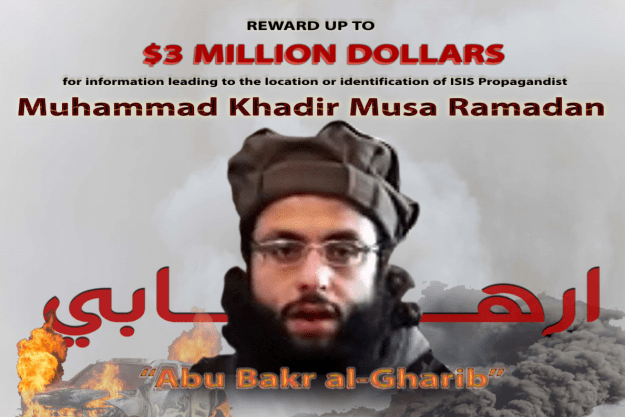
Last night the State Department’s Rewards for Justice Program announced that it would pay $3 million for information leading to the capture or killing of Muhammad Khadr Musa Ramadan, described as “a senior leader of and key propagandist for the Islamic State”. Continue reading
By Kyle Orton (@KyleWOrton) on 28 December 2019

In a long article last week, I looked at why the U.S. ran a formal occupation of Iraq for fourteen months after the fall of Saddam Husayn in April 2003, given that there had been an explicit pre-invasion decision not to have an occupation government. The short answer is that the occupation was installed through deception by the State Department, supported by the Central Intelligence Agency (CIA). State and CIA had argued for a protracted occupation in the Situation Room debates in 2002, but President George W. Bush had sided with the Pentagon, which advocated a rapid transfer of power to Iraqis. Having lost in the formal inter-agency process, the State Department succeeded by subversion in getting its way on the ground in Iraq. The disaster this caused in the mismanagement of post-Saddam Iraq was, as the article explained in detail, only the most serious impact of the toxic schism between State/CIA and the Pentagon, a factor whose import is difficult to overstate when examining how the Bush administration functioned. (This feud also at times drew in the Vice President’s Office, which tended to support the Pentagon.)
A version of this article was published in The Arab Weekly
By Kyle Orton (@KyleWOrton) on 24 November 2019
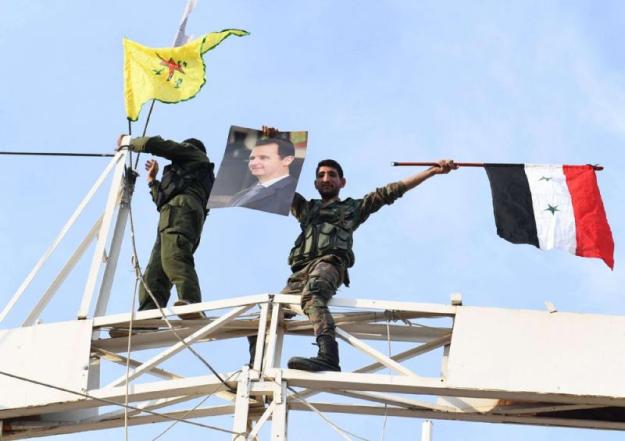
Solider from the Syrian regime holds up a portrait of Bashar al-Asad and a Syrian national flag, another stands by the Kurdish YPG/PKK flag, in Kobani, 18 October 2019. (AFP)
Mustafa Bali, head of the press office for the Syrian Democratic Forces (SDF), the coalition partner against the Islamic State (ISIS) in Syria, sent a tweet on November 14 showing Turkey’s Arab proxies engaged in “ISIS chants.” By this, he meant the takbir, “God is Great,” an expression used by Muslims every day. When criticised, Bali doubled down and blocked many critics. This was a microcosm of one of the darker threads in an SDF messaging strategy that is among the most effective propaganda campaigns on record. Continue reading
 Kyle Orton's Blog