Tag Archives: provokatsiya

Russia Teams Up With Islamic State Against Syria’s Rebels

By Kyle Orton (@KyleWOrton) on October 11, 2015

Devastation of the Ibrahim al-Khalil mosque in Tareeq al Bab after Assad's barrel bombs, Aleppo, April 2015 (source)

Devastation of the Ibrahim al-Khalil mosque in Tareeq al Bab after Assad’s barrel bombs, Aleppo, April 2015 (source)

The main intention of Russia’s intervention in Syria is to prop up the dictatorship of Bashar al-Assad and to do that Russia is seeking to ensure that the Islamic State (I.S.) is the only alternative to Assad’s regime. If the conflict becomes binary—Assad or I.S.—nobody can support I.S., and by default it will be accepted that Assad has to stay; even if international help is not given to put down the insurgency at that point, tacit support and political legitimacy will be extended to Russia’s effort to keep its client regime alive. In service of this mission, Moscow has consistently targeted the moderate rebels and even some non-moderate rebels, while avoiding I.S., in the conscious hope that the rebel positions it destroys will be replaced by I.S. fighters. In northern Syria in the last few days, Russia got its wish in a major way. Continue reading
In Syria, Russia and Iran Reap the Harvest of Obama’s Failed Foreign Policy

By Kyle Orton (@KyleWOrton) and James Snell on October 1, 2015

Published at National Review.

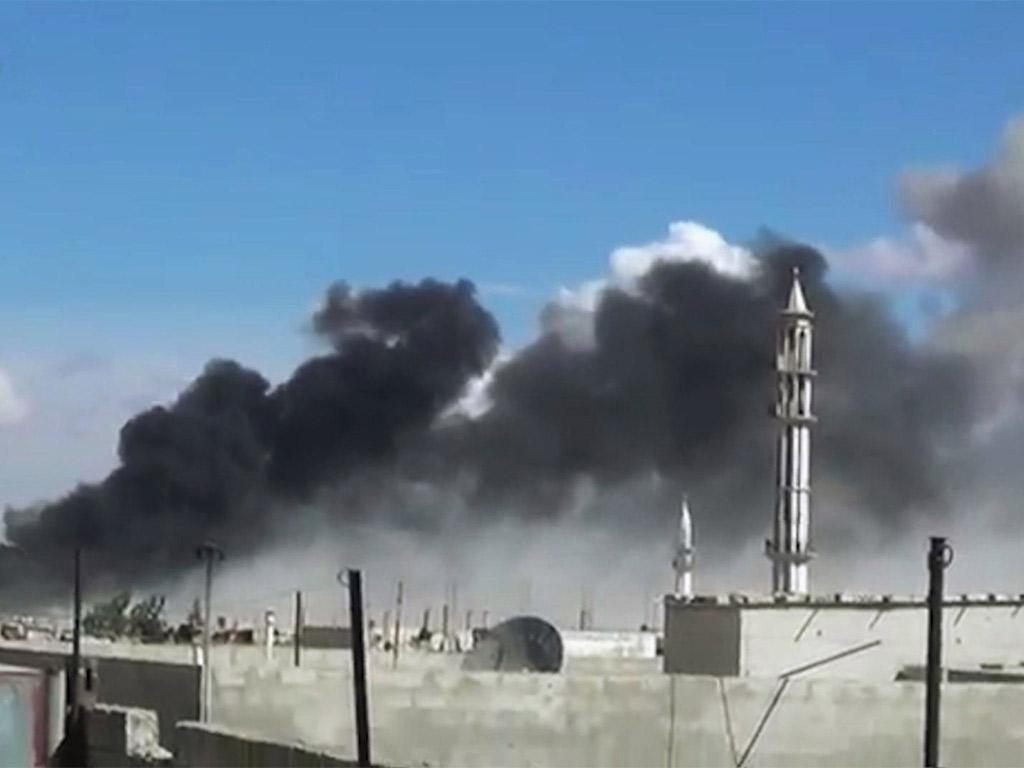
Aftermath of a Russian airstrike against U.S.-supported moderate rebels in Talbiseh, Homs (AP)

Aftermath of a Russian airstrike against U.S.-supported moderate rebels in Talbiseh, Homs (AP)

The situation in Syria could hardly get more desperate. With more than half the population displaced and 300,000 people dead, the civil war in Syria is the greatest humanitarian disaster of our time. But Syria is also a profound challenge to the American-underwritten geopolitical order that aspires toward free institutions and representative rule. As a direct consequence of policies pursued by the Obama administration, Iran and Russia, two enemies of this order, have taken their chance to assert their dominance. Continue reading

Iran’s Partnership with al-Qaeda and Unanswered Questions

By Kyle Orton (@KyleWOrton) on September 19, 2015

Imad Mughniyeh and Osama bin Laden

Imad Mughniyeh and Osama bin Laden

The Islamic Republic of Iran released five senior al-Qaeda terrorists in March, ostensibly as part of a prisoner exchange for an Iranian diplomat kidnapped in Yemen by al-Qaeda in the Arabian Peninsula (AQAP). But the murky circumstances in which al-Qaeda’s leaders were “held” in Iran and other inconsistencies cast some doubt on this version of events, and draw attention to some old questions about Iran’s support for al-Qaeda and its affiliates and offshoots. Continue reading

Is Le Pouvoir Losing Its Grip on Algeria?

By Kyle Orton (@KyleWOrton) on September 15, 2015

A rare picture of DRS chief Mohamed Mediène (a.k.a. Toufik)

A rare picture of DRS chief Mohamed Mediène (a.k.a. Toufik)

Yesterday, Algeria’s elderly president, Abdelaziz Bouteflika, removed from office Mohamed Mediène (a.k.a. Toufik), the head of DRS (Le Département du Renseignement et de la Sécurité), the spy agency that is the real power behind the throne in Algeria. There is some suggestion this is Bouteflika trying to prepare the way for a civilian government as his time in office—and on the planet—draws to a close. There is little reason to believe, however, that Algeria’s government will be much reformed by Toufik’s departure.
Continue reading

Britain’s New Syria Policy Concedes to Iran and Russia—and Keeps Assad in Power

By Kyle Orton (@KyleWOrton) on September 11, 2015

Published at Left Foot Forward

1

On 9 September the British government announced a new plan for dealing with Syria and the Islamic State (ISIS):

  1. Airstrikes when necessary into Syria to destroy the leadership of ISIS;
  1. Buttressing the Iraqi government in its fight with ISIS;
  1. Dropping the demand that Syrian dictator Bashar al-Assad step aside immediately and instead allowing Assad to lead a transition, in order that Russia and Iran will agree to Assad going at all.

All three parts of this plan push in a pro-Iran direction, and strengthen Assad. Continue reading

How Russia Manipulates Islamic Terrorism

By Kyle Orton (@KyleWOrton) on September 8, 2015

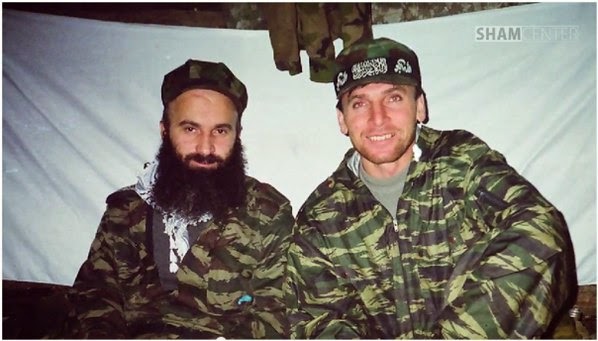
Shamil Basayev and Murad Margoshvili (a.k.a. Muslem al-Shishani)

Shamil Basayev and Murad Margoshvili (a.k.a. Muslem a-Shishani)

Last year I wrote about the murky role Russia was playing in the Syrian war, bolstering the Bashar al-Assad tyranny while facilitating the rise of the Islamic State (ISIS) and other Salafi-jihadists as a means of dividing and discrediting the Syrian opposition. This strategy and the associated tactics—infiltrating the insurgency, facilitating the arrival of al-Qaeda and other global jihadists to displace the nationalists, and in general driving the rebellion into the political dead-end of extremism and barbaric atrocities—has worked in other States where the intelligence services were trained by Moscow, and it worked internally to defeat the separatist movement in Chechnya. In Syria, Russia is reinforcing an old client regime, which has staked its life on the proposition that it is the last line of defence against a terrorist takeover and a genocide against the minorities, a policy now largely directed on-the-ground by Iran, to whom Assad surrendered sovereignty some time ago. New evidence has emerged to underline these points. Continue reading

Islam’s First Terrorists

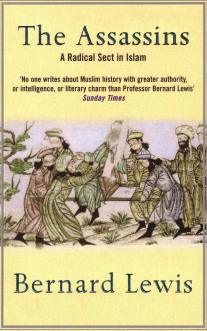
By Kyle Orton (@KyleWOrton) on August 24, 20151. The Assassins (book)

Book Review: The Assassins: A Radical Sect in Islam (1967) by Bernard Lewis

This review can be read in six parts: one, two, three, fourfive, and six.

Abstract

The fourth Caliph, Ali, was assassinated during a civil war that his supporters, Shi’atu Ali (Followers of Ali), lost to the Umayyads, who thereafter moved the capital to Damascus. The Shi’a maintained that the Caliphate should have been kept in the Prophet’s family; over time this faction evolved into a sect unto themselves, which largely functioned as an official opposition, maintaining its claim to the Caliphate, but doing little about it. Several ghulat (extremist) Shi’a movements emerged that did challenge the Caliphate. One of them was the Ismailis. Calling themselves the Fatimids, the Ismailis managed to set up a rival Caliphate in Cairo from the mid-tenth century until the early twelfth century that covered most of North Africa and western Syria. A radical splinter of the Ismailis, the Nizaris, broke with the Fatimids in the late eleventh century and for the next century-and-a-half waged a campaign of terror against the Sunni order from bases in Persia and then Syria. In the late thirteenth century the Nizaris were overwhelmed by the Mongols in Persia and by the Egyptian Mameluke dynasty which halted the Mongol invasion in Syria. The Syrian-based branch of the Nizaris became known as the Assassins, and attained legendary status in the West after they murdered several Crusader officials in the Levant. Attention has often turned back to the Assassins in the West when terrorist groups from the Middle East are in the news, but in the contemporary case of the Islamic State (ISIS) the lessons the Nizaris can provide are limited. Continue reading

Islam’s First Terrorists, Part 6

By Kyle Orton (@KyleWOrton) on August 22, 2015

This is the final part of a six-part series. Read parts one, two, three, four, and five, or read the whole essay.

Masyaf fortress, the headquarters of the Nizari Ismailis (The Assassins) in Syria

Masyaf fortress, the headquarters of the Nizari Ismailis (The Assassins) in Syria

Conclusion

The Nizari Ismailis did not invent assassination, of course; only lent it their name. The Ismailis were “part of a long tradition that goes back to the beginnings of Islam … of popular and emotional cults in sharp contrast with the learned and legal religion of the established order.” Still, the Nizaris did rely on the Holy Law. The ideal of Islamic governance might be authoritarian, but it is not arbitrary; if a ruler crosses the shari’a it becomes a duty to resist. This element became gradually more marginal as the religion formed into a State and Empire, but it was there and many other sects had called on it in their opposition to the prevailing regimes. The Nizaris were the first to call up this tradition of righteous rebellion and combine it with an effective opposition organization.

In their use of conspiracy, assassination, and even the ceremonial nature of the murders and the weapon-cult, the Assassins were hardly unique. But they might well be the first terrorists: those who, at an overwhelming disadvantage in conventional terms, used unconventional means in a planned, long-term campaign of targeted violence as a political weapon with the intention of overturning the established order. Continue reading

Islam’s First Terrorists, Part 3

By Kyle Orton (@KyleWOrton) on August 19, 2015

This is the third of a six-part series. Read parts one and two.

Masyaf fortress, eastern Hama, the headquarters of the Assassins (1141-1270)

Masyaf fortress, eastern Hama, the headquarters of the Assassins (1141-1270)

The death of Hassan-i Sabbah and The Resurrection

Rashid ad-Din Sinan

Rashid ad-Din Sinan

Hassan-i Sabbah, the Nizaris’ first and most successful leader, died in May 1124. Hassan-i Sabbah was a fanatic who sternly imposed the Holy Law—even executing one of his own sons for drinking wine and another son (mistakenly) for an unauthorized assassination. An extreme ascetic and recluse, Hassan-i Sabbah left his house twice in the thirty-five years after taking Alamut. Hassan-i Sabbah’s great skill was in weaponizing the discontents of the dispossessed and refining the doctrine of al-dawa jadida (the new preaching).

Hassan-i Sabbah never claimed to be the Imam, merely the only one who knew what the Imam wanted. Hassan-i Sabbah confirmed the Ismaili doctrine as essentially authoritarian, where the believer must follow an Imam, the only source of truth, who has been appointed by god (unlike the Sunni view where the believer can choose an Imam).

The Nizaris’ history divides into essentially four parts after this: Continue reading

Russia’s Secret Police

By Kyle Orton (@KyleWOrton) on August 1, 20151

Charles Ruud’s and Sergei Stepanov’s Fontanka 16: The Tsar’s Secret Police traces the evolution of political policing in Russia, focusing on the Okhranka, the final incarnation of the secret police before the Russian Revolution in 1917, and along the way puts paid to a whole array of myths about the pre-Bolshevik Russian government, especially as regards the Jewish Question.

The growth of the Russian political police occurred in four major stages. The first phase lasted from the founding of the Russian State by Ivan the Terrible (1533-84) after the expulsion of the Tatars to the opening of the “Third Section” in 1826 as a reaction to the Decembrist revolt the previous year—the first time the Imperial State security services were housed at Fontanka 16 in St. Petersburg—which intended to (and succeeded in, as 1848 would demonstrate) extirpate the liberal spirit that challenged the autocracy. The third phase saw the Third Section become the Department of Police at the onset of a crackdown after the assassination of Alexander II in 1881, who had enacted broad liberal reforms on censorship and serfdom. The elite secret police force grew out of the palace guard, becoming known as the Okhranka (though this is more usually rendered in English as Okhrana). The final phase began in 1906, after the 1905 revolution, when the Okhranka worked to stop a liberal-radical coalition building. Continue reading