By Kyle Orton (@KyleWOrton) on 15 August 2023

By Kyle Orton (@KyleWOrton) on 21 August 2022
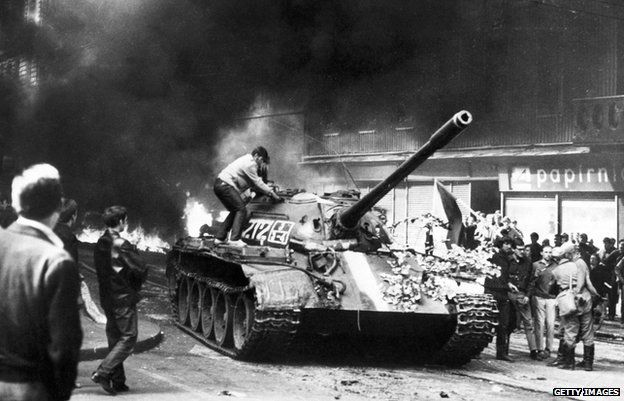
It was on this day in 1968, fifty-four years ago, that the Soviet Union invaded Czechoslovakia, one of its colonies in the “Warsaw Pact”, which had embarked on a program of liberalising reforms. The Czech leadership did not intend to depart from the socialist path, merely to soften its edges—and ran into the brute fact that this was not possible. Continue reading
By Kyle Orton (@KyleWOrton) on 25 June 2021

Writing recently about the first meeting between Adolf Hitler and Francisco Franco at Hendaye on 23 October 1940, where the Führer tried to enlist Spain into the Axis, I concluded, drawing on Franco: The Man and His Nation by George Hills, a former BBC journalist and Fellow of the Royal Historical Society:
By Kyle Orton (@KyleWOrton) on 17 June 2021

By the autumn of 1940, the entirety of Western Europe except Spain and Portugal lay under Nazi control, as did much of the Centre and parts of the East: Austria, Czechoslovakia, Poland, Denmark, Norway, the Netherlands, Belgium, Luxembourg, and France had all fallen without serious resistance, and Britain’s refusal to take the German offer of leaving the Continent to the Nazis and the Nazis would leave the British with India had incurred the wrath of the Luftwaffe with night after night of air-raids.
It was in this context that a meeting was held, on 23 October 1940, between Adolf Hitler and Spain’s ruler, Francisco Franco. The meeting, taking place at the railway station in Hendaye, within conquered France, on the western-most point of the Franco-Spanish border, was also attended by the foreign ministers, Ramón Serrano Súñer (Spain) and Joachim von Ribbentrop (Germany). The Germans arranged the meeting to try to get Spain into the war, and General Franco attended the meeting intent on refusing—politely. Continue reading
By Kyle Orton (@KyleWOrton) on 7 June 2021

The Idea of Central Europe: Geopolitics, Culture and Regional Identity (2018), by Otilia Dhand, is an engaging and rather ambitious book, a work of intellectual history. Dhand’s core argument is that from the introduction of the term “Central Europe” in the nineteenth century, it did not describe a set geographical zone and the definition was always contested since the term was an attempt to construct local identities, a self separate from some other, as an instrument in the pursuit of geopolitical interests, always revisionist: these were attempts to will something into existence by influencing political behaviour. Continue reading


 Kyle Orton's Blog