Tag Archives: sectarianism

Ahrar al-Sham and Al-Qaeda

By Kyle Orton (@KyleWOrton) on August 12, 2016

The Islamic State’s (IS) weekly newsletter, al-Naba, interviewed a high-ranking al-Qaeda defector, Abu Ubayda al-Lubnani, across two issues in February and March 2016. Abu Ubayda announced his defection from al-Qaeda to IS in April 2014 via al-Battar and Abu Ubayda’s name appeared on a list of prominent clerics supporting IS’s caliphate declaration that was circulated not long after the declaration. Abu Ubayda is described by al-Naba—as best as can be told accurately—as having been a member of al-Qaeda’s Shura or Consultation Council, a training officer in its Military Committee, and a counter-intelligence officer. Abu Ubayda is advertised as speaking about many secret aspects of al-Qaeda.

Among the topics Abu Ubayda covers is the alleged infiltration and manipulation of al-Qaeda by foreign intelligence services, specifically Pakistan’s Inter-Services Intelligence (ISI), which is not only a violation of jihadist doctrine by collaborating with an “infidel” and illegitimate state but led to the deaths of a number of senior al-Qaeda leaders.

Perhaps the most intriguing aspect of what Abu Ubayda has to say relates to al-Qaeda’s attempt to take advantage of the Syrian revolution. This persistent campaign has followed a pattern of disguising al-Qaeda’s presence and attempting to influence and eventually co-opt the rebellion against Bashar al-Assad’s regime. One lever al-Qaeda relied upon, according to Abu Ubayda, was Ahrar al-Sham, an organization that disclaims all connections to al-Qaeda and dissimulates about its ideology. Whatever Ahrar’s dominant ideology, it is simply a fact that it has served as the bridge between the foreign-led jihadists and Syrian Islamists, and its connections to al-Qaeda are evident enough. Abu Ubayda suggests Ahrar’s connections to al-Qaeda are even deeper than they appear. Continue reading

Islamic State Prepares for Retreat, Calls for Foreign Terrorism

By Kyle Orton (@KyleWOrton) on May 23, 2016

1

Taha Falaha (Abu Muhammad al-Adnani) is the governor Islamic State-held territory in Syria and oversees the foreign attacks, a roster of duties which indicates that Falaha so powerful that he is effectively the caliph’s deputy after the demise of Abd al-Rahman al-Qaduli (Abu Ali al-Anbari) in March. Falaha is also IS’s official spokesman, and on 21 May 2016 he gave a very significant speech entitled, “That They Live By Proof”. The speech, released by Al-Hayat Media Centre, is reproduced below with some minor alterations in transliteration, some important sections highlighted in bold, and some notes added for explanation.

Falaha made three major points. First, Falaha was especially adamant that territorial control by IS should not be considered a measure of IS’s success: it lost all urban holdings and went into the deserts last time, after the strategic defeat in 2008, but it held to its cause and America withdrew, and this ideological cohesiveness and determination led it to be more powerful than ever within five years. Second, Falaha made use of the savage conduct of the coalition made up of the Assad regime, Iran, and Russia—and the Western indifference to same—to argue for Sunnis to see IS as a protective barrier against such sectarian foes. And, third, Falaha called for foreign attacks by Western Muslims, saying that if IS’s loyalists were unable to journey to IS-held areas this should not be considered a problem since attacks in the West are “more beloved to [IS] than the biggest act done [within the caliphate]”. Continue reading

Saddam Hussein Prepared the Ground for the Islamic State

By Kyle Orton (@KyleWOrton) on April 26, 2016

This essay, written to tie together my work on the relationship between the Saddam Hussein regime and the Islamic State, was completed last summer and submitted to an outlet, where it entered a form of development hell. After giving up on that option late last year, the opportunity arose to get a shorter version published in The New York Times in December. But I procrastinated too long over what to do with the full essay and a recent change in my work situation means I no longer have the bandwidth to go through the process of finding it a new home, so here it is.

“Abu-Bakr al Baghdadi is a product of the last decade of Saddam’s reign,” argues Amatzia Baram, a scholar of Iraq. He is correct in at least three ways. First, in its last decade in power, the Iraqi Ba’ath regime transformed into an Islamist government, cultivating a more religious, sectarian population on which the Islamic State (ISIS) could draw. Part of Saddam Hussein’s “Faith Campaign” also involved outreach to Islamist terrorists, including al-Qaeda, which meant that the synthesis of Ba’athism and Salafism that fused into the Iraqi insurgency after the fall of Saddam was already well advanced by the time the Anglo-American forces arrived in Baghdad in 2003. Second, the ISIS leadership and military planning and logistics is substantially reliant on the intellectual capital grown in the military and intelligence services of the Saddam regime. And finally, the smuggling networks on which ISIS relies, among the tribes and across the borders of Iraq’s neighbours, for the movement of men and materiel, are directly inherited from the networks erected by the Saddam regime in its closing decade to evade the sanctions. The advantages of being the successor to the Saddam regime make ISIS a more formidable challenge than previous Salafi-jihadist groups, and one that is likely to be with us for some time.

Continue reading

Islamic State Denounces Those Who Make Palestine the Foremost Muslim Cause

By Kyle Orton (@KyleWOrton) on April 2, 2016

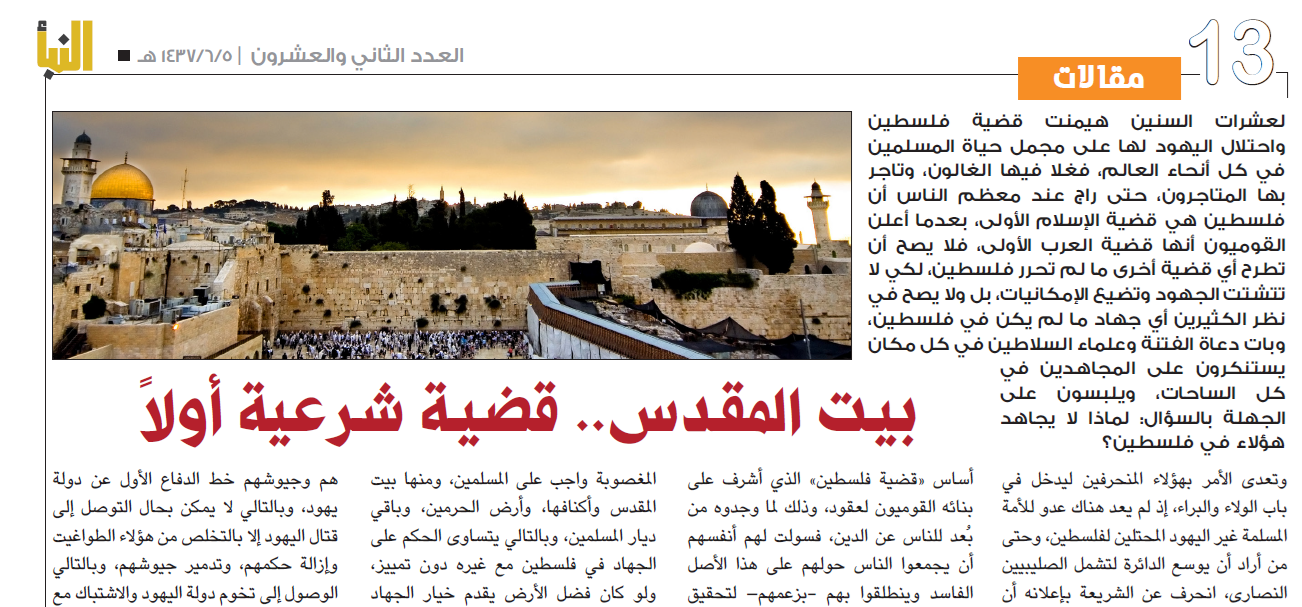
An article in the twenty-second edition of al-Naba, the Islamic State’s (IS) newsletter, released on 15 March 2016, explained why the group has not made fighting Israel a priority.

Continue reading

Assad and Academics: Disinformation in the Modern Era

By Kyle Orton (@KyleWOrton) on February 22, 2016

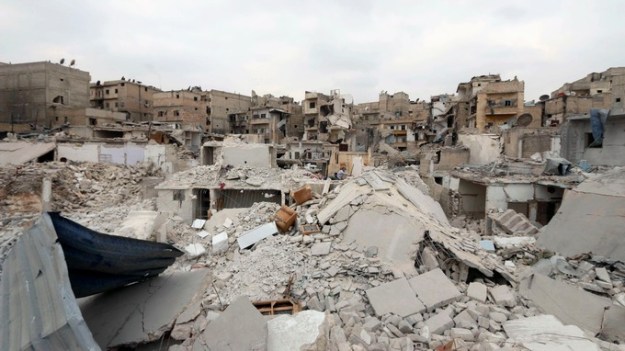
Aleppo City

Aleppo City after the destruction of the Asad regime, Iran, and Russia

Introduction

From the beginning of Syria’s war, the regime of Bashar al-Assad, enabled by Iran and Russia, has run a very elaborate media war to portray itself as the victim of an international conspiracy, wherein its only opponents are terrorists from al-Qaeda and its offshoots who are being used by foreigners—namely the Gulf States, Turkey, Israel, and the United States—to overthrow a defiant “resistance” State.

The other part of this strategic messaging is aimed at the West, which Assad otherwise accuses of supporting jihadi-Salafist terrorism against him: Assad is the only alternative to the terrorists, it says, so the West should support him. War criminal he might be, he will protect the minorities—his role in endangering them by starting a sectarian war against the Sunni majority and bolstering the takfiris within the insurgency to cannibalize all legitimate or engageable armed opposition, notwithstanding—and has no immediate plans to fly planes into Western skyscrapers. (That the leading edge of Assad’s ground forces are made up of radically sectarian, foreign Shi’a jihadists under Iran’s control, some of them Iraqis responsible for killing a quarter of the 4,000 U.S. soldiers who fell in Mesopotamia, and are integrated into a State-run terrorist network that has struck Western and Jewish targets the world over, gets left out.)

For Assad and his allies, it helps if this propaganda is not only delivered by regime spokesman but independent analysts, journalists, academics, and politicians. In the last ten days two salient examples have emerged: Stephen Kinzer, a veteran journalist, including for The New York Times, who wrote in The Boston Globe, and Jeffrey Sachs, an academic economist working at Columbia University, who wrote in The Huffington Post. Mixing together conspiracy theories, half-truths, and outright lies—disinformation, to give it an old name—both Kinzer and Sachs told a version of the regime’s narrative. Why they did this is best-known to them. Continue reading

How Russia and Iran Took Advantage of Syrian Peace Talks to Choke Aleppo

By Kyle Orton (@KyleWOrton) on February 16, 2016

Published at The Independent, submitted February 12.

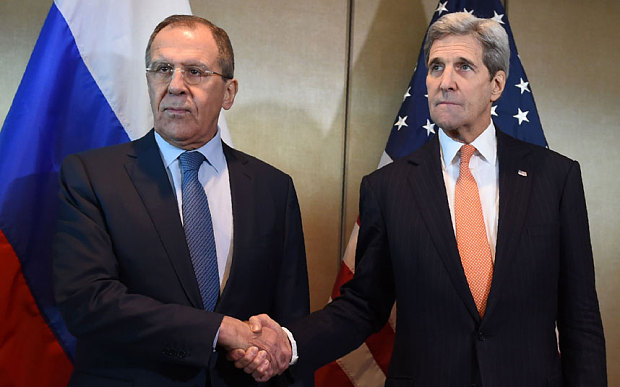
Kerry-Lavrov 'ceasefire'

In the coming days and weeks many people will weep for the fate of Aleppo. Many of these people will also continue to support the nuclear deal, which has facilitated this U.S.-Iran détente and supplied Iran the resources to make war. They will still consider it a triumph of diplomacy over military action—and never be called to account for the obvious contradiction.

The Geneva III peace process is the most immediate cause for this latest offensive against Aleppo, led on the ground by Iran’s Islamic Revolutionary Guard Corps (IRGC) and its proxies, as well as Russian airstrikes. The regime and Russia have used it as a cover to gain ground. Continue reading

Response to Response: Yes, Saddam Laid the Groundwork for the Islamic State

By Kyle Orton (@KyleWOrton) on January 12, 2016

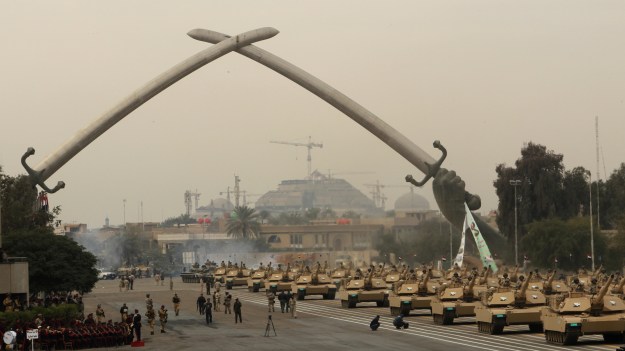
Iraqi army MIA1 Abrams tanks march under the victory Arch landmark during a parade to mark the 91st Army Day in Baghdad on January 6, 2012, weeks after US troops completed their pullout. The Armed Forces Day display by the fledgling 280,000-strong security force completely reformed after the US-led invasion of 2003. AFP PHOTO/ALI AL-SAADI (Photo credit should read ALI AL-SAADI/AFP/Getty Images)

The “Victory Arch,” which Saddam built after the war with Iran. (January 2012)

About three weeks ago I wrote a piece for The New York Times explaining the evolution of Saddam Hussein’s regime away from the hard-secularism of its Ba’athist origins, and how this had prepared the ground for the Islamic State (IS). I received much positive feedback, but the social media reaction was inevitable: little thought and much anger, particularly from people who view Iraqi history through a political prism and felt I was trying to exculpate George W. Bush. With rare exceptions, the critique could hardly be called thoughtful. So it is nice to finally have such a critique to deal with, from Samuel Helfont and Michael Brill in today’s Foreign Affairs. Continue reading

Why Solely Backing the PYD Against the Islamic State is a Mistake

By Kyle Orton (@KyleWOrton) on October 20, 2015

Published at NOW Lebanon.

1

The Pentagon-run train-and-equip (T&E) program had intended to take Syrian rebels, stop them from being rebels by preventing them from fighting the Assad regime, and repurpose them into an American-directed strike force against the Islamic State (ISIS). Unsurprisingly, there were few takers and the program ended in disaster and humiliation. In the wake of this failure, President Barack Obama has turned away from the Arab rebels and looked to the Syrian Kurds to fight ISIS. This is a strategy that is not only doomed to fail—since Sunni Arabs taking responsibility for their local security is the only way to sustainably defeat ISIS—but would, if implemented, make the ISIS problem worse. A report from Amnesty International this week documenting crimes, including ethnic cleansing, by the armed Kurdish forces against Arabs and Turkmens in northern Syria also provides an occasion to look more closely at a force with a history of regime collaboration, political extremism, and terrorism. Continue reading

Saddam, Sanctions, and Religious Solace in Iraq

By Kyle Orton (@KyleWOrton) on October 18, 2015

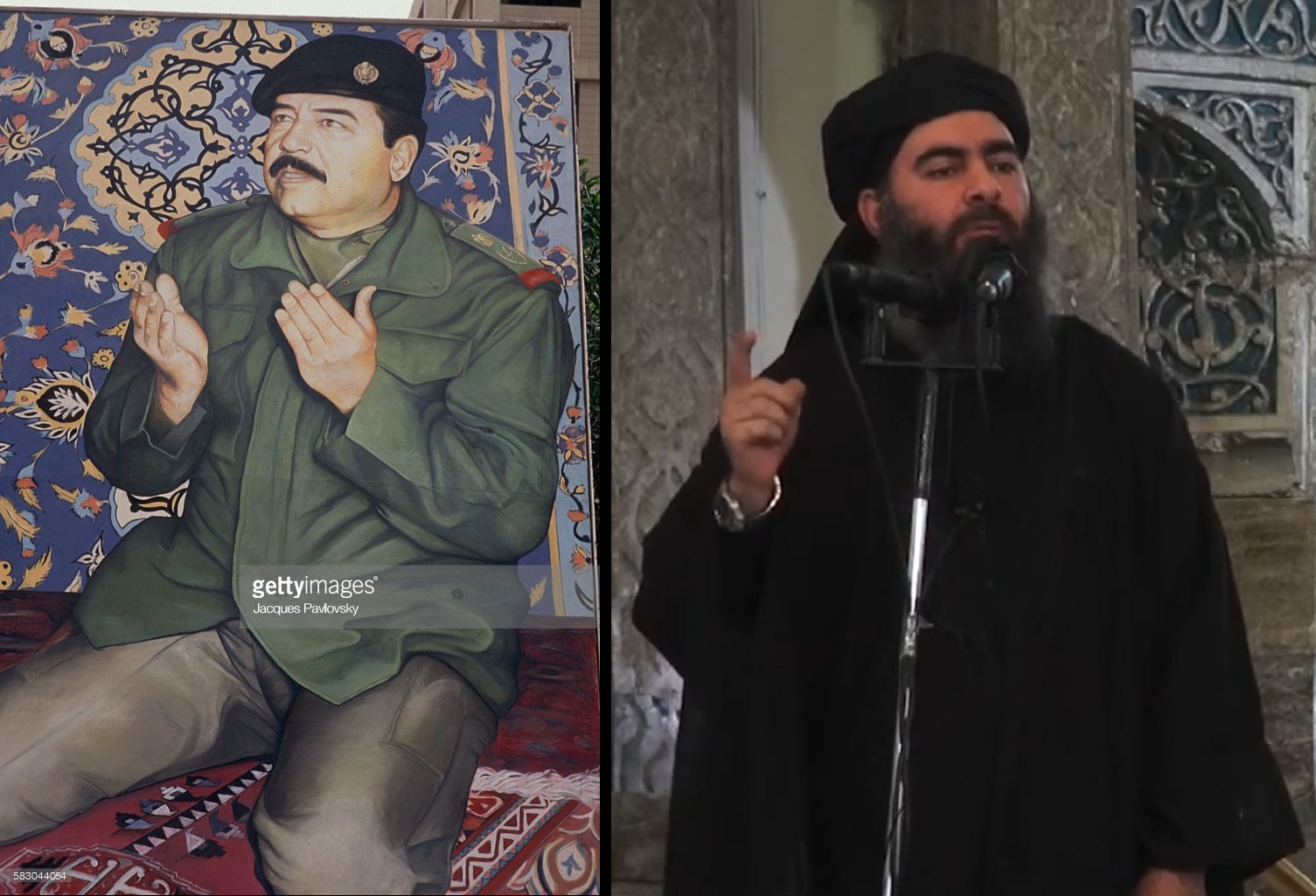
Mural of Saddam Hussein at prayer on Al-Kadhimiya Mosque

Mural of Saddam Hussein at prayer on Al-Kadhimiya Mosque

In the 1990s, the combination of the sanctions and Saddam Hussein’s predatory regime debauched Iraq, ushering in a period of chaos, scarcity, and corruption as the regime gradually broke down. With a religious revival already underway, the population turned to faith for succour, and the regime encouraged this in a way that—in the wake of the brutal repression of the Shi’a rebellion after the first part of the Gulf War—hardened sectarian identities. The security services were deeply affected by the Saddam regime’s Islamization and the Salafists exploited their newfound freedom, and the regime’s increasing lack of capacity, to plot a future after Saddam. By 2003, these various organized Islamist strains, part in and part out of the regime, stood ready to succeed Saddam and had a more zealous and sectarian population to draw on. Saddam had set the stage for the emergence of something like the Islamic State long before Coalition troops invaded Iraq. Continue reading

Saddam’s Faith Campaign and the Islamic State

By Kyle Orton (@KyleWOrton) on September 28, 2015

A version of this article was published at NOW Lebanon and syndicated at Business Insider

1

American intelligence analysts have been pressured into giving a more positive assessment of the progress of the war against the Islamic State (ISIS), it has been reported, confirming what was obvious to everyone not subject to influence from the White House: the anti-ISIS campaign is failing. To devise an effective strategy involves understanding where ISIS came from, and that involves examining the Saddam Hussein regime.

Saddam is commonly regarded as the quintessential secularist, and he was initially. But over its last fifteen years the Saddam regime Islamized, effectively creating a religious movement under Saddam’s leadership, giving additional space and power to the non-governmental Salafi Trend, and hardening the sectarian differences in Iraq—paving the way for something like ISIS in its aftermath. Continue reading