Tag Archives: Syria

Islamic State Spokesman Addresses Coronavirus, Expansion in Africa, and Qatar

By Kyle Orton (@KyleWOrton) on 28 May 2020

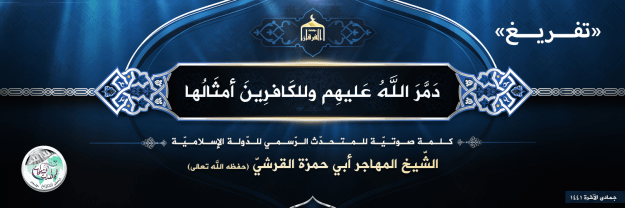
After trailing the release yesterday, an audio statement from the Islamic State (IS) spokesman, Abu Hamza al-Qurayshi, was published by Al-Furqan Foundation today. It is entitled, “And the Disbelievers Will Know Who Gets the Good End”, i.e. heaven. The title is taken from a sura of the Qur’an [Ra’d (13):42]. The speech gloated about the damage the coronavirus has done to the West, presenting it as God’s revenge for the Coalition dislodging IS from the cities it had occupied in Iraq, Syria, Libya, and elsewhere. There is the usual focus on anti-IS Sunnis in Iraq and Syria, who are warned that the U.S. is pulling back, thus those who bet on the U.S. for protection need to reassess or they will be killed. The two most significant parts of the speech are: (1) its focus on IS’s expansion in Africa, a visible fact for some time now, and the competition with Al-Qaeda in that area; and (2) the closing few minutes where Abu Hamza agitates against Qatar, a state that IS has never bothered with before in its messaging.
Continue reading

Coalition Eliminates Senior Islamic State Official Haji Tayseer

By Kyle Orton (@KyleWOrton) on 26 May 2020

Islamic State Wilayat al-Anbar, October 2017

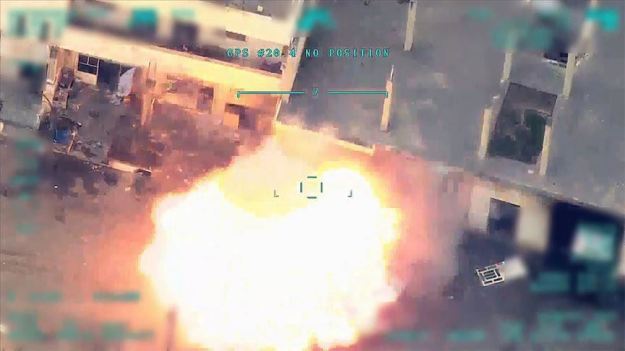
This morning, the Iraqi government announced that Moataz Numan al-Jaburi (Haji Tayseer), a senior member of the Islamic State (IS), had been killed in Deir Ezzor in eastern Syria by an airstrike from the U.S.-led Coalition, utilising intelligence supplied by Iraq’s Counter-Terrorism Service (CTS, Jihaz Mukafahat al-Irhab). Continue reading

Tunisia and Jihadism

By Kyle Orton (@KyleWOrton) on 26 May 2020

Early in his new book, Your Sons Are At Your Service: Tunisia’s Missionaries of Jihad, The Washington Institute’s Aaron Zelin quotes a pair of sociologists who note that ‘where theories are plentiful … ideas are vacuous’. The book is in many ways the antithesis of this approach. It is not without theoretical content; where social movement theory arises as a means of understanding jihadism, say, the author gives an overview of the literature to contextualise it for the reader. But the general approach is historical, empirical, and detail-rich, so that by the time Zelin summarises his findings in the various sections there can be no doubt about the evidentiary basis. Continue reading

Former Head of Islamic State Executive Committee Speaks

By Kyle Orton (@KyleWOrton) on 23 May 2020

Abd al-Nasir, who claims his real name is Taha al-Ghassani (image sources 1 & 2)

There is now, with various caveats, a general agreement that the Islamic State (IS) is on the upswing—in Iraq, particularly, but also in the Badiya, the desert regions of eastern Syria, and more recently in the south of Syria around Deraa. Still, there have been some recent notable gains against the terrorist group. Continue reading

Syria and Coronavirus

By Kyle Orton (@KyleWOrton) on 6 April 2020

The first quarter of 2020 saw a serious escalation of combat in Syria, albeit without much alteration in the political trends, and the arrival of the novel coronavirus (COVID-19) has exacerbated a fraught situation. Continue reading

Islamic State Spokesman Vows Revenge Against Enemies, Plays the Israel Card

By Kyle Orton (@KyleWOrton) on 21 February 2020

The Islamic State’s (IS) spokesman, Abu Hamza al-Qurayshi, gave his second speech on 27 January 2020. The speech was entitled, “Allah Destroyed Everything Over Them, and for the Kafireen is Something Comparable”, by IS’s official English translation. The title is drawn from the Qur’an, the Surah of Muhammad (47), verse 10. The verse can be rendered as, “God Destroyed Them Completely, and a Similar Fate Awaits the Disbelievers”. Below is a copy of the transcript of Abu Hamza’s speech, with some editions for transliteration and translation, and some interesting sections highlighted in bold. Continue reading

Iran Admits Collaborating with Al-Qaeda in Bosnia

By Kyle Orton (@KyleWOrton) on 5 February 2020

The Mujahideen Battalion (El-Mudžahid) in Bosnia in the early 1990s [image source]

The clerical regime in Iran established a relationship with Al-Qaeda shortly after its foundation thirty years ago. One of Tehran’s and Al-Qaeda’s first joint projects was in Bosnia during the war (1992-5), where Iran helped to make Al-Qaeda a truly global phenomenon—with a foothold in Europe. For various reasons—some well-intended, some not—this fact has been either unknown or (shall we say) “controversial” in the West in the decades since. It is, therefore, important to note that there have been several recent revelations from in and around the Iranian regime itself that confirm the Islamic Republic’s involvement in the Balkans in the early 1990s. Continue reading

Russia Closes the St. Petersburg Metro Case, Doubts Remain

By Kyle Orton (@KyleWOrton) on 23 January 2020

Abror Azimov in detention // Source: Alexey Kudenko

In July 2019, I co-wrote an article for Haaretz about the Russian legal case relating to the alleged suicide bombing of the St. Petersburg metro on 3 April 2017 as it then stood. To make a long story short: none of the “facts” derived from the Federal Security Service (FSB) investigation could be taken at face value—literally none. A key assertion from the Kremlin was that the Petersburg attack was directed from outside by an Al-Qaeda-linked group in Syria, for which no evidence was provided, but the issues with the case went much deeper. As fundamental a fact as the identity of the alleged suicide bomber was in question. Indeed, it was worse than that: the Russian state refused, when questioned, to say whether this “suicide bomber” was dead, raising a question about whether the Petersburg atrocity was a suicide-attack at all. Last month, the Russian government in effect closed the book on this case by sentencing eleven people it claims were implicated in it; none of the questions raised during the trial have been answered, and nor are they ever likely to be now. Continue reading

The CIA and Iraq: Intelligence Failures, Media Successes

By Kyle Orton (@KyleWOrton) on 28 December 2019

In a long article last week, I looked at why the U.S. ran a formal occupation of Iraq for fourteen months after the fall of Saddam Husayn in April 2003, given that there had been an explicit pre-invasion decision not to have an occupation government. The short answer is that the occupation was installed through deception by the State Department, supported by the Central Intelligence Agency (CIA). State and CIA had argued for a protracted occupation in the Situation Room debates in 2002, but President George W. Bush had sided with the Pentagon, which advocated a rapid transfer of power to Iraqis. Having lost in the formal inter-agency process, the State Department succeeded by subversion in getting its way on the ground in Iraq. The disaster this caused in the mismanagement of post-Saddam Iraq was, as the article explained in detail, only the most serious impact of the toxic schism between State/CIA and the Pentagon, a factor whose import is difficult to overstate when examining how the Bush administration functioned. (This feud also at times drew in the Vice President’s Office, which tended to support the Pentagon.)

Continue reading

Why Was There Ever An American Occupation of Iraq?

By Kyle Orton (@KyleWOrton) on 22 December 2019

Douglas Feith was the U.S. Under Secretary of Defense for Policy from 2001 to 2005, one of the most senior positions at the Pentagon during one of the most consequential periods in recent history, covering the 11 September 2001 atrocities and early phase of the U.S.-led response. Feith later wrote a highly illuminating memoir, War and Decision: Inside the Pentagon at the Dawn of the War on Terrorism, which tried to drain some of the hysteria out of the public “debate” about the Iraq dimension of the U.S. policy in particular by explaining the internal arguments in the Bush administration leading up to the decision to finish with Saddam Husayn in 2003, and trying to set those arguments in their proper historical context, both in relation to Iraq—where “the war” had begun twelve years earlier—and the altered American threat perceptions in the shadow of 9/11. Unlike a lot of the gossipy tomes that emerged from former officials, Feith’s book is notably light on opinion and contains reams of declassified documents so readers can check his analysis against the source material. One of Feith’s key judgments is that “the chief mistake was maintaining an occupation government in Iraq for over a year”.[1] As Feith explains in great detail in the book, this was never supposed to happen. So how did it?

Continue reading