Whatever one thinks about the decision in 2003 to finish the war Saddam Hussein started by annexing Kuwait, serious people should be able to agree that the way the country was abandoned by the United States—first politically after 2009 and then militarily—was deeply irresponsible, not least because of the motives of this decision. Continue reading →
Flowers left outside Jewish Museum in Brussels after ISIS holy warrior murdered three people last week
On the evening of May 23, a deranged 22-year-old boy, Elliot Rodger, went on a shooting spree in California and murdered six people. Continue reading →
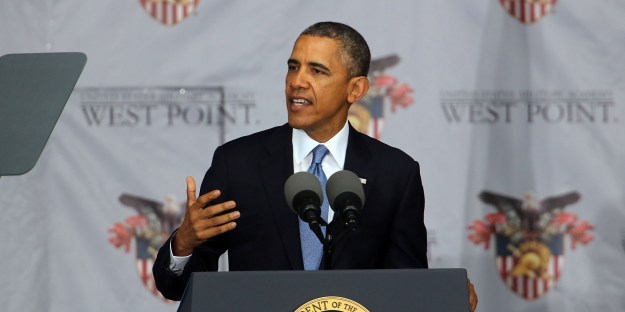
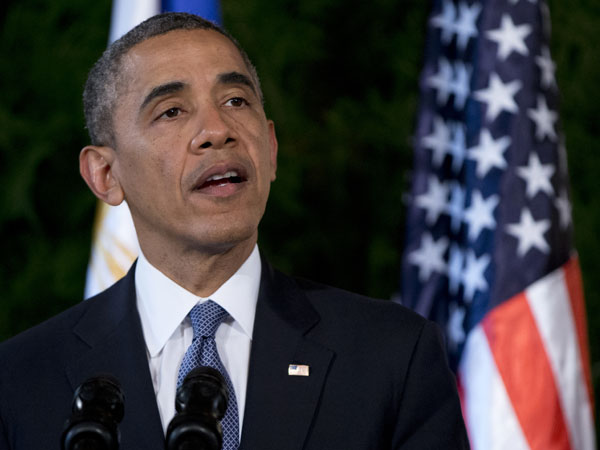
It was to be expected that this would be a bad speech. Attacked from all sides President Barack Obama was going to have to push back and that was always going to make the speech defensive. As usual, the President ploughed bravely into a battalion of straw men: positing extremes then selecting a cool middle way. But it was so much worse than that. The tone was not the problem; the content was. Continue reading →
A little over a week ago, President Obama was asked in the Philippines about his foreign policy. It was a rather complex question that asked for Obama’s “vision,” “doctrine,” and “guiding principle“—and also how he “answer[s] those critics who say they think the doctrine is weakness.” The President gave a 949-word answer. To say that it was defensive, disingenuous, and wrong-headed would be to say the least of it. Continue reading →
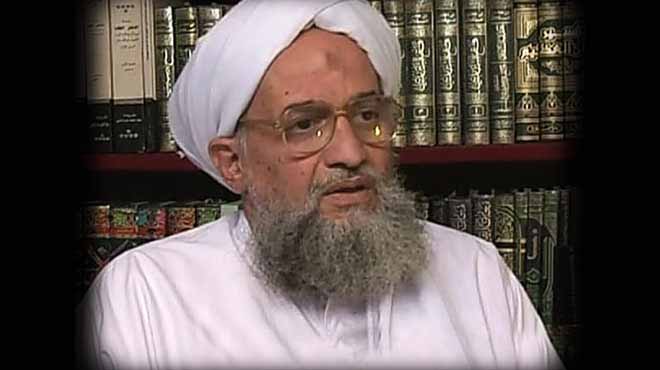
As-Sabah Media released a video on 2 May 2014 that contained a speech from Ayman al-Zawahiri, the leader of al-Qaeda, responding to the ferocious statement by Abu Muhammad al-Adnani, the spokesman of the Islamic State of Iraq and Syria (ISIS), which denied that ISIS was ever under al-Qaeda’s command and thus al-Zawahiri’s expulsion of ISIS from al-Qaeda in February was a meaningless gesture. Al-Zawahiri presents a compelling case to the contrary, drawing on documents sent by ISIS’s leaders, past and present, to al-Qaeda, some of which are public—taken in the raid that killed Usama bin Laden. Al-Zawahiri concludes with a call for ISIS to return to the fold, to accept al-Zawahiri’s order that ISIS leave Syria and return to Iraq—even if they think it is unjust—for the sake of jihadi unity and avoiding the shedding of Muslim blood. The speech is entitled, “Testimony to Preserve the Blood of the Mujahideen in Syria” (Shahada li-Haqn Dima al-Mujahideen bil-Sham). A rough translation is given below with some important sections highlighted in bold. Continue reading →
These rows of murdered children are just some of the 1,400 people massacred with sarin on the morning of Aug. 21, 2013 by the Assad regime
President Obama said on April 28, in Manila: “we’re getting chemical weapons out of Syria without having initiated a strike.” This was by way of defending not launching airstrikes to punish the Assad regime after the massive gas attack near Damascus last August. Put aside the clear evidence that the regime has simply switched the using chlorine gas. This seemed dubious on its own terms. Under the deal orchestrated by the Russians, Assad became a partner in disarmament; as soon as that process comes to an end, the Western interest in keeping Assad’s regime in place is eliminated. And so it proved. Continue reading →
Bashar az-Zoubi, leader of Liwa al-Yarmouk, the biggest brigade in Deraa and one of the biggest on the Southern Front. He is one of the main people President Obama’s ostensible switch to focussing on the south of Syria is supposed to benefit.
It takes more than a grin and a pint to run a country
With a poll showing the U.K. Independence Party leading the pack heading into the European Elections next month, much attention has been turned on them. This is the culmination of a surge in publicity and—if the polls are correct—support. This extra attention has not gone exactly swimmingly. Continue reading →
There’s a case to be made that Tony Blair is the most important figure in the development of the concept of “humanitarian intervention” since the end of the Cold War. When adumbrating his doctrine at the Chicago Economics Club in April 1999, Blair made very clear that this was no wild-eyed utopianism. Continue reading →
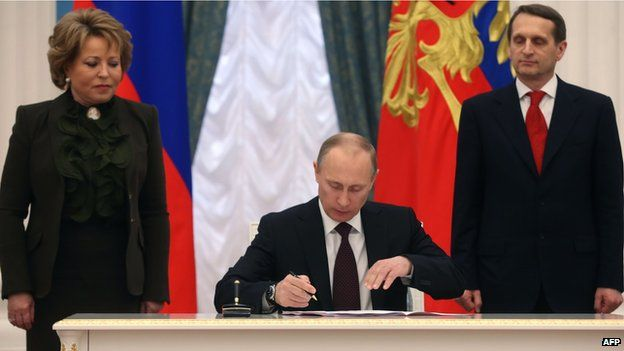
In the wake of Russia’s annexation of Crimea last month, The New York Times has reported on the tactics of subversion and provocation the Kremlin used to destabilise and ultimately conquer parts of Ukraine: