By Kyle Orton (@KyleWOrton) on 11 January 2025
By Kyle Orton (@KyleWOrton) on 3 September 2022
By Kyle Orton (@KyleWOrton) on 8 May 2021
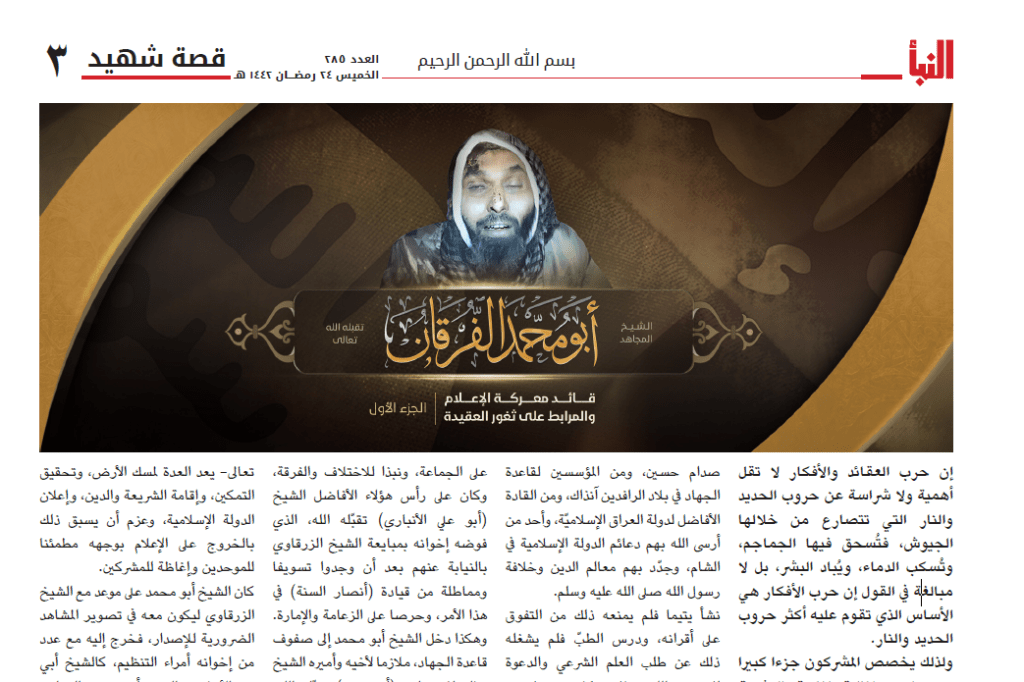
Wael al-Ta’i (Abu Muhammad al-Furqan), Al-Naba 285, p. 3
The 285th edition of Al-Naba, the weekly newsletter of the Islamic State (IS), released on 6 May, had a biography of Abu Muhammad al-Furqan, one of the most important IS leaders, the head of its Central Media Department and its operational ruler when he was killed in September 2016. Continue reading
By Kyle Orton (@KyleWOrton) on 24 October 2020
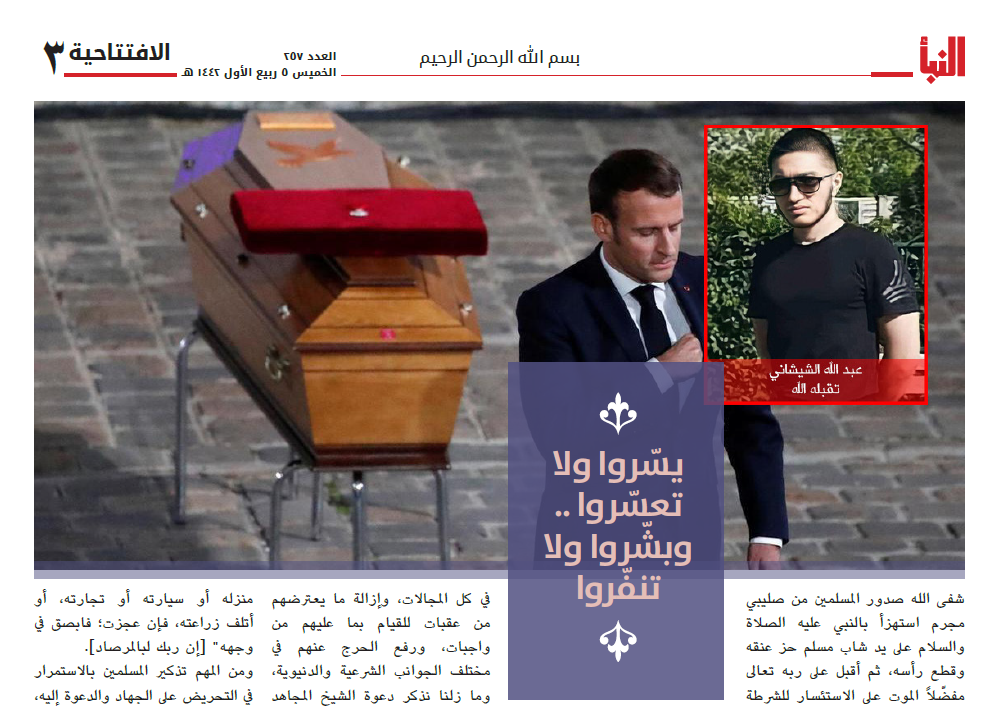
Al-Naba 257, page 3
The 257th edition of Al-Naba, the weekly newsletter of the Islamic State (IS), was released on 22 October. Al-Naba 257 contains an article praising the 16 October murder of French schoolteacher Samuel Paty by an Islamist who accused him of blasphemy for showing the Charlie Hebdo cartoons of Islam’s prophet Muhammad during a class on free speech, but the article does not claim that the Chechen refugee who carried out the assassination, Abdoullakh Anzorov, was an IS operative. Among other things, this is a reminder that IS’s claims of responsibility are not indiscriminate, even if it is believed there have been a couple of incidents of high-profile deception. Continue reading
By Kyle Orton (@KyleWOrton) on 10 November 2019
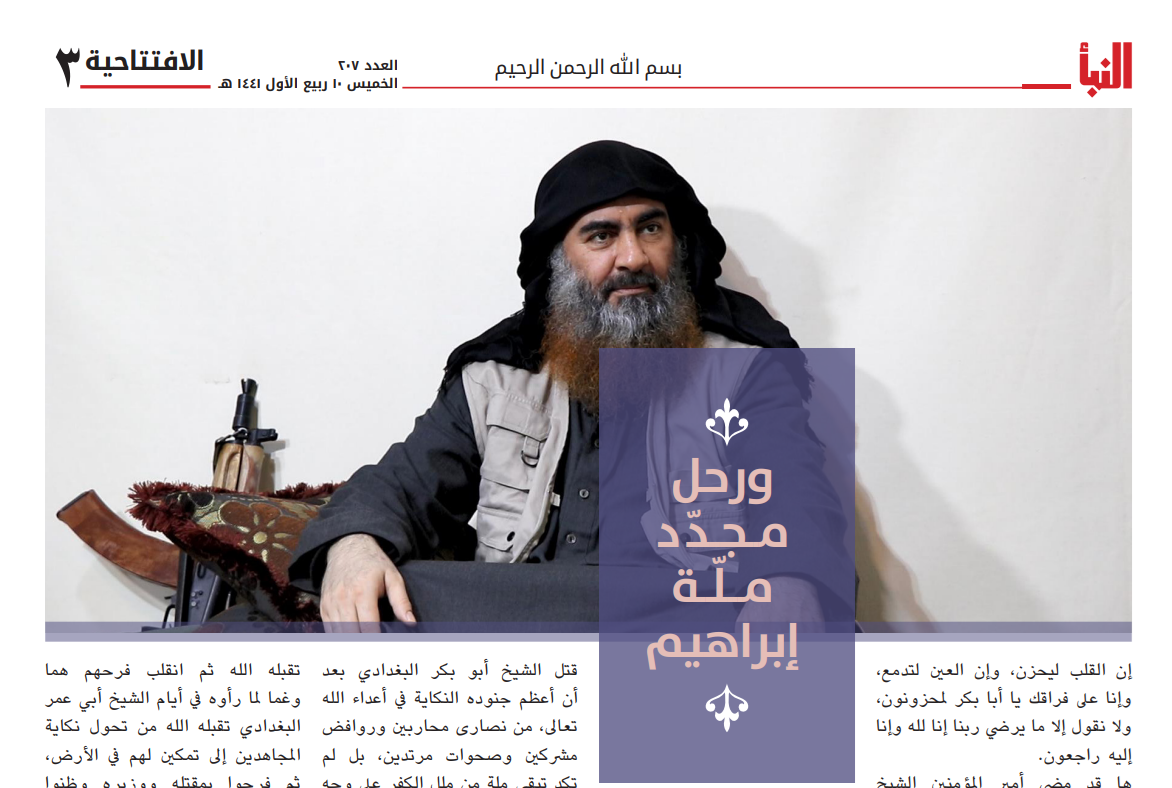
The 207th edition of Al-Naba, the weekly newsletter of the Islamic State (IS), published on 7 November 2019, devotes its main editorial to Ibrahim al-Badri (Abu Bakr al-Baghdadi), the first “Caliph” when the “Caliphate” was declared in June 2014, who was killed on 27 October 2019.
By Kyle Orton (@KyleWOrton) on 7 November 2019

Taha Falaha (Abu Muhammad al-Adnani) [right] appearing in an Islamic State video alongside Tarkhan Batirashvili (Abu Umar al-Shishani, 3 June 2017, displaying a scene from 2014 when IS demolished the borders between Iraq and Syria. Falaha was killed in August 2016. It is common for IS to hold back pictures and footage of its leaders for time-spans that can reach over a decade.
By Kyle Orton (@KyleWOrton) on 31 October 2019
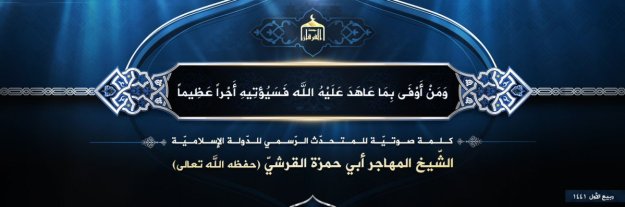
Earlier today, the Islamic State (IS) released a speech through Al-Furqan Media by its new spokesman, Abu Hamza al-Qurayshi. The statement was brief, just under eight minutes, and entitled, “Whosoever Fulfils That Which He Has Promised God, On Him Will He Bestow A Great Reward” (drawn from Qur’anic verse, 48:10). Abu Hamza confirmed that IS’s caliph, Ibrahim al-Badri (Abu Bakr al-Baghdadi), was dead, killed in the American raid in Idlib in the early hours of the morning [Syria time] on 27 October, and that his predecessor, Abu Hassan al-Muhajir, was also deceased, killed in an airstrike the day after Al-Baghdadi’s demise. The new IS leader was announced as Abu Ibrahim al-Hashemi al-Qurayshi. IS released a transcript of the speech, which is reproduced below with some editions for transliteration and interesting sections highlighted in bold. Continue reading
By Kyle Orton (@KyleWOrton) on 2 December 2018
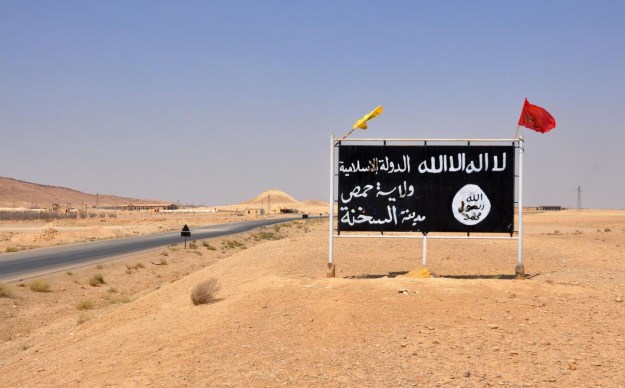
An Islamic State poster near al-Sukhna in the eastern Homs desert, Syria, August 2017 (source)
Over the past week, two members of the Islamic State (IS) have been arrested—a rarity in itself during the Coalition campaign against the group—and both in different ways give a glimpse of archetypes that have made up the organisation, from its inception to its expansion into Syria. Continue reading
By Kyle Orton (@KyleWOrton) on 9 September 2018
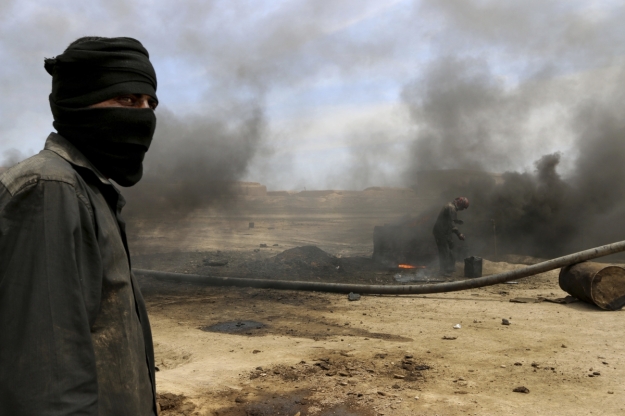
The United States has launched at least five raids into Syria to date, all of them against the Islamic State (IS).[1] The second such raid, on 15 May 2015, killed Fathi al-Tunisi (Abu Sayyaf al-Iraqi, Abu Muhammad al-Iraqi, or Abd al-Ghani), who oversaw critical revenue-generating criminal schemes for the group. Al-Tunisi was primarily responsible for the oil industry in eastern Syria, in which capacity he collaborated with Bashar al-Asad’s regime, and he worked as head of the Antiquities Division of IS Diwan al-Rikaz, which translates literally as the “Department of Precious Things That Come Out of the Ground”, usually given as the “Department of Natural Resources”. Al-Tunisi was what is sometimes termed a “middle manager”: the connective tissue between the most senior levels of the leadership and local administrators, ensuring smooth coordination between the two by inter alia keeping the books. In short, the kind of terrorist operative that keeps an organisation going. Continue reading

 Kyle Orton's Blog