Tag Archives: Turkey

Islamism in Syria

By Kyle Orton (@KyleWOrton) on October 23, 2020

A chapter about Islamism in Syria I wrote for the American Foreign Policy Council’s (AFPC) ‘World Almanac of Islamism’ was published today. Do check it out, and the broader site, which is a great, accessible resource. The format of the website necessitated that the chapter as I submitted it was edited, condensed, and split up to fill out the various categories. In case it is of any interest, the original version of the chapter is reproduced below.

Continue reading

The Current Condition of Al-Qaeda

By Kyle Orton (@KyleWOrton) on October 4, 2020

A chapter about Al-Qaeda I wrote for the American Foreign Policy Council’s (AFPC) ‘World Almanac of Islamism’ was published today. Do check it out, and the broader site, which is a great, accessible resource. The format of the website necessitated that the chapter as I submitted it was edited, condensed, and split up to fill out the various categories. In case it is of any interest, the original version of the chapter is reproduced below.

Continue reading

Al-Qaeda Has Never Been More Dominated by States

By Kyle Orton (@KyleWOrton) on September 11, 2020

In writing a chapter earlier this year about the current status of Al-Qaeda, part of the process was reviewing the organisation’s history since its formation in the late 1980s. What really struck me was how extensively Al-Qaeda is now manipulated, under the influence of, and in places even controlled by state powers. To mark the nineteenth anniversary of 9/11, I thought I could give a brief sketch of this development.

Continue reading

Losing in Yemen, Winning in Afghanistan, Islamic State Weighs in on Arab-Israeli Peace

By Kyle Orton (@KyleWOrton) on 22 August 2020
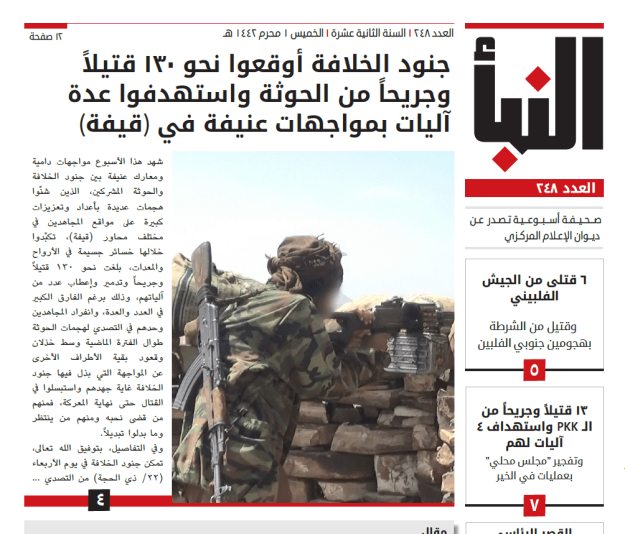
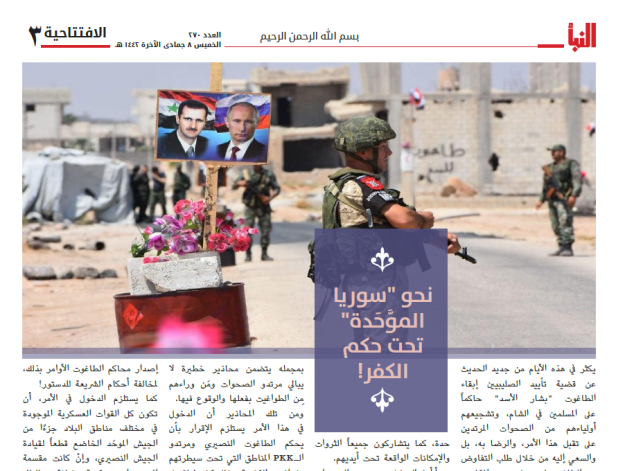
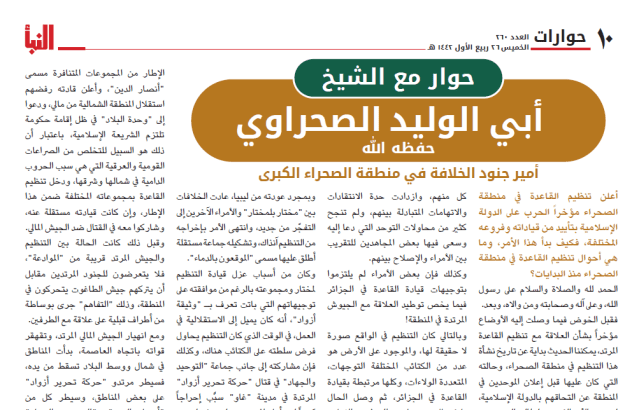
Al-Naba 248

The Islamic State (IS) produced the 248th edition of Al-Naba, its newsletter, on 20 August. The front page was devoted to recent events in Yemen, which had not gone well for IS—although one could easily miss that fact when reading a story that a focuses almost entirely on enemy casualties and the failures of others. IS is, of course, not pleased about the Israeli normalisation of relations with the United Arab Emirates, but Al-Naba makes clear that it is more perturbed that Muslims should believe Turkey or Qatar are any better than the U.A.E., despite their different approach to Islamists. Al-Naba 248 documents IS’s continuing advances in Afghanistan—and, indeed, Iraq, Syria, Africa (the Sahel), and Egypt. There is also a report of insurgent activity in the Philippines. Continue reading

Islamic State is Resurging in Libya

By Kyle Orton (@KyleWOrton) on 13 June 2020

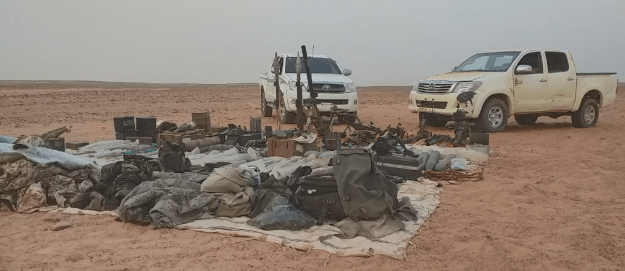
Ghanima (war spoils) captured by Islamic State in Sabha, Libya [Al-Naba 181, 9 May 2019]

After nearly a year of lying low, the Islamic State (IS) has begun reactivating—and advertising its reactivation—in Libya. Continue reading

Turkey Increases the Pressure on the PKK Headquarters in Iraq

By Kyle Orton (@KyleWOrton) on 12 June 2020

Ismail Nazlikul (Kasim Engin) [image source]

The Kurdistan Workers’ Party (PKK) announced earlier this week that one of its senior commanders, Ismail Nazlikul (who used the codename “Kasim Engin”) had been killed on 27 May in a Turkish airstrike in Iraqi Kurdistan. Continue reading

Tunisia and Jihadism

By Kyle Orton (@KyleWOrton) on 26 May 2020

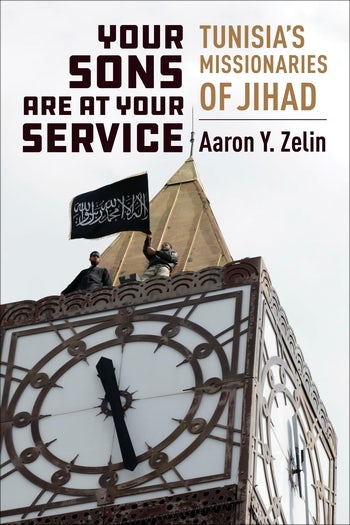
Early in his new book, Your Sons Are At Your Service: Tunisia’s Missionaries of Jihad, The Washington Institute’s Aaron Zelin quotes a pair of sociologists who note that ‘where theories are plentiful … ideas are vacuous’. The book is in many ways the antithesis of this approach. It is not without theoretical content; where social movement theory arises as a means of understanding jihadism, say, the author gives an overview of the literature to contextualise it for the reader. But the general approach is historical, empirical, and detail-rich, so that by the time Zelin summarises his findings in the various sections there can be no doubt about the evidentiary basis. Continue reading

Syria and Coronavirus

By Kyle Orton (@KyleWOrton) on 6 April 2020

The first quarter of 2020 saw a serious escalation of combat in Syria, albeit without much alteration in the political trends, and the arrival of the novel coronavirus (COVID-19) has exacerbated a fraught situation. Continue reading

Russia Closes the St. Petersburg Metro Case, Doubts Remain

By Kyle Orton (@KyleWOrton) on 23 January 2020

Abror Azimov in detention // Source: Alexey Kudenko

In July 2019, I co-wrote an article for Haaretz about the Russian legal case relating to the alleged suicide bombing of the St. Petersburg metro on 3 April 2017 as it then stood. To make a long story short: none of the “facts” derived from the Federal Security Service (FSB) investigation could be taken at face value—literally none. A key assertion from the Kremlin was that the Petersburg attack was directed from outside by an Al-Qaeda-linked group in Syria, for which no evidence was provided, but the issues with the case went much deeper. As fundamental a fact as the identity of the alleged suicide bomber was in question. Indeed, it was worse than that: the Russian state refused, when questioned, to say whether this “suicide bomber” was dead, raising a question about whether the Petersburg atrocity was a suicide-attack at all. Last month, the Russian government in effect closed the book on this case by sentencing eleven people it claims were implicated in it; none of the questions raised during the trial have been answered, and nor are they ever likely to be now. Continue reading

The Darker Side of the Western Enthusiasm for “The Kurds”

A version of this article was published in The Arab Weekly

By Kyle Orton (@KyleWOrton) on 24 November 2019

Solider from the Syrian regime holds up a portrait of Bashar al-Asad and a Syrian national flag, another stands by the Kurdish YPG/PKK flag, in Kobani, 18 October 2019. (AFP)

Mustafa Bali, head of the press office for the Syrian Democratic Forces (SDF), the coalition partner against the Islamic State (ISIS) in Syria, sent a tweet on November 14 showing Turkey’s Arab proxies engaged in “ISIS chants.” By this, he meant the takbir, “God is Great,” an expression used by Muslims every day. When criticised, Bali doubled down and blocked many critics. This was a microcosm of one of the darker threads in an SDF messaging strategy that is among the most effective propaganda campaigns on record. Continue reading