By Kyle Orton (@KyleWOrton) on 11 January 2025
By Kyle Orton (@KyleWOrton) on 8 May 2021
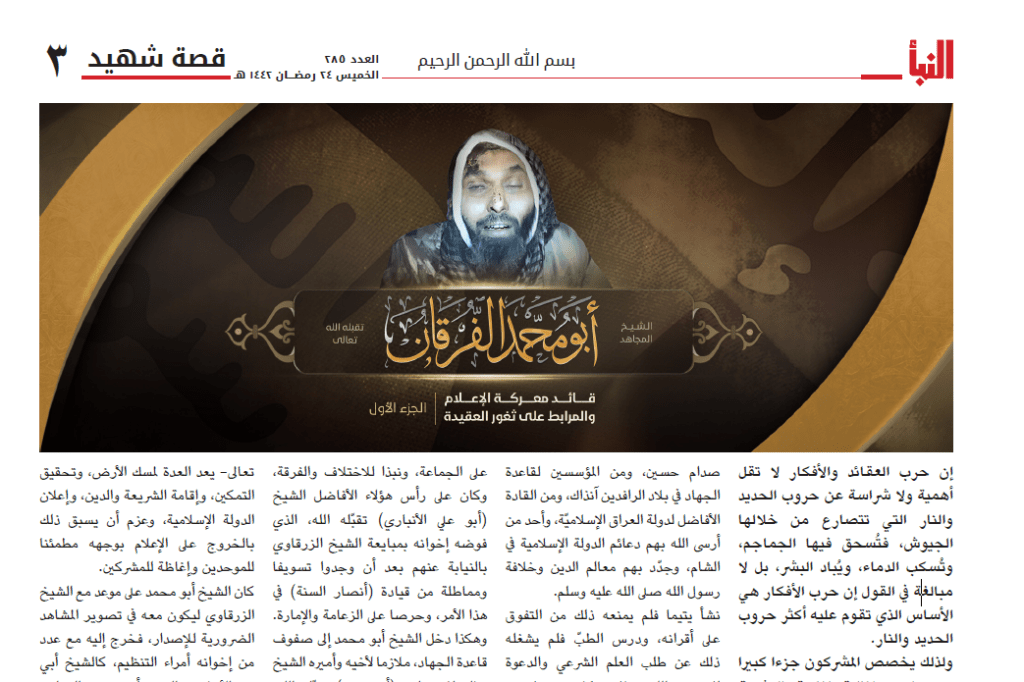
Wael al-Ta’i (Abu Muhammad al-Furqan), Al-Naba 285, p. 3
The 285th edition of Al-Naba, the weekly newsletter of the Islamic State (IS), released on 6 May, had a biography of Abu Muhammad al-Furqan, one of the most important IS leaders, the head of its Central Media Department and its operational ruler when he was killed in September 2016. Continue reading
By Kyle Orton (@KyleWOrton) on 21 August 2020
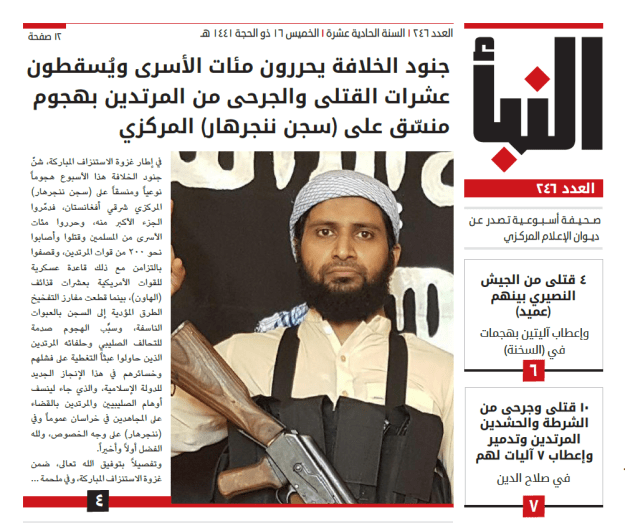
Al-Naba 246, front page, 6 August 2020
The Islamic State (IS) published the 246th edition of its newsletter, Al-Naba, on 6 August, which highlighted the 2-3 August prison break in the Nangarhar province of Afghanistan, a massive IS operation lasting twenty-plus hours, and proclaimed that freeing IS jihadists from prisons will now be a priority for the group. In 2012, shortly after the American withdrawal from Iraq, IS announced Operation BREAKING THE WALLS, which went on for a year, breaking open Iraqi prisons. The narrative of the IS’s “defeat” by the Surge and Awakening of 2007-08 is problematic in some of its fundamentals, but among the reasons it proved to be so fleeting in practice was this prison-break campaign that restored to the battlefield key IS operatives who planned the caliphate project in 2014. It is, therefore, alarming to see the arrival of such a campaign in Afghanistan at the moment the U.S. is headed, heedlessly, for the exit. Continue reading
By Kyle Orton (@KyleWOrton) on 7 November 2019

Taha Falaha (Abu Muhammad al-Adnani) [right] appearing in an Islamic State video alongside Tarkhan Batirashvili (Abu Umar al-Shishani, 3 June 2017, displaying a scene from 2014 when IS demolished the borders between Iraq and Syria. Falaha was killed in August 2016. It is common for IS to hold back pictures and footage of its leaders for time-spans that can reach over a decade.
By Kyle Orton (@KyleWOrton) on 6 April 2019

Islamic State flag in front of the main gate of Saddam Husayn’s palace in Tikrit, 5 April 2015 // AFP PHOTO / MOHAMMED SAWAF
A lengthy document—roughly sixty pages and 12,000 words—was published online on 21 February 2019 containing biographies of twenty-seven senior Islamic State (IS) officials, past and more recent. Those bios that are dated were written between October 2018 and the time of publication, with one exception that was written in the summer of 2018. The author claims to be an IS veteran. While longevity is difficult to prove, the fact that the author provides heretofore unseen images of some of the IS leaders suggests that at a minimum he is an IS operative. Continue reading
By Kyle Orton (@KyleWOrton) on 2 December 2018
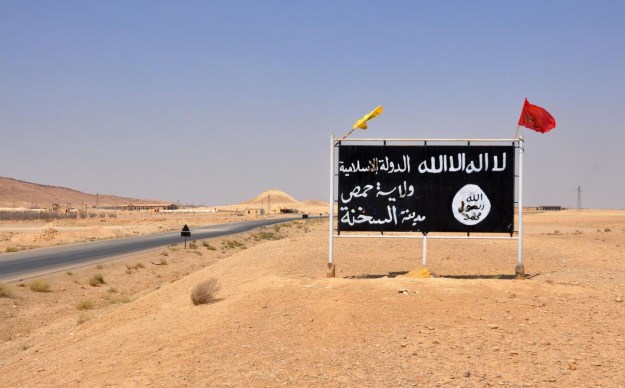
An Islamic State poster near al-Sukhna in the eastern Homs desert, Syria, August 2017 (source)
Over the past week, two members of the Islamic State (IS) have been arrested—a rarity in itself during the Coalition campaign against the group—and both in different ways give a glimpse of archetypes that have made up the organisation, from its inception to its expansion into Syria. Continue reading
By Kyle Orton (@KyleWOrton) on 16 March 2018

The predecessor organization to the Islamic State (IS), the Islamic State in Iraq (ISI), used to run a “Prominent Martyrs” or “Distinguished Martyrs” series: essentially obituaries for important members of the IS movement. In the forty-sixth edition, on 18 August 2010, ISI profiled Abu Maysara al-Iraqi, the first official spokesman and the deputy of the Media Department until he was killed in 2006. A translation of Abu Maysara’s biography was issued by Ansar al-Mujahideen forum and is reproduced below with some minor editions for transliteration and some interesting points highlighted in bold. Continue reading
By Kyle Orton (@KyleWOrton) on 12 November 2017

The forty-fifth edition of the Islamic State’s “Distinguished Martyrs” series, published by al-Furqan Media in Rajab 1431 (June/July 2010), profiled Abu Zahra al-Issawi, the media emir or information minister of the organization between some point after July 2007, when Khalid al-Mashadani (Abu Zayd al-Mashadani) was arrested, and some point before September 2009, when Ahmad al-Ta’i was announced as holding the position. [UPDATE: Al-Ta’i turned out to be Abu Muhammad al-Furqan, and his real name was Wael al-Ta’i.] Continue reading

 Kyle Orton's Blog