Tag Archives: Usama bin Ladin

Profile of a 9/11 Planner: Muhammad Atef

By Kyle Orton (@KyleWOrton) on 5 February 2018

Al-Qaeda’s military leader Muhammad Atef at a press conference in Afghanistan, 26 May 1998 (image source: CNN)

Muhammad Atef, best-known as Abu Hafs al-Masri, but who also went by the names Taseer Abdullah or Taysir Abdullah and Subhi Abu Sitta, was al-Qaeda’s military leader between 1996 and 2001, and one of the three people most responsible for the terrorist attack in the United States on 11 September 2001. Continue reading

Al-Qaeda’s First Military Emir

By Kyle Orton (@KyleWOrton) on 5 February 2018

Moments after the bombing of the U.S. Embassy in Kenya on 7 August 1998 (picture source: UPI)

Ali Amin al-Rashidi (Abu Ubayda al-Banshiri or Abu Ubayda al-Panjshiri) was the first head of al-Qaeda’s military committee until his death in an accident in 1996. Continue reading

When Iran Saved Al-Qaeda

By Kyle Orton (@KyleWOrton) on 24 January 2018
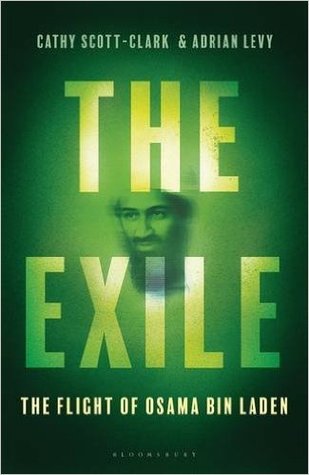
The new book by the investigative journalists Adrian Levy and Catherine Scott-Clark, The Exile: The Flight of Osama bin Laden, charts the career of al-Qaeda’s founder, Osama bin Laden, up to the day he became a household name—11 September 2001—through his downfall in 2011, to the end of 2016, when al-Qaeda was more powerful than ever. It is a thoroughly absorbing account, bringing to light vast tranches of new facts, including many intricate details of how al-Qaeda operated on a human, day-to-day level, and of those states and para-states that shielded the terror network, collaborated with it, and enabled it—and still do.

The gathering of the Bin Laden network in Sudan and then in the Taliban-held areas of Afghanistan in the 1990s is a familiar story, but the splits and debates among the Arab jihadists around Bin Laden, including the opposition of significant numbers of them to the 9/11 massacre, is perhaps less well known. The authors trace out how Bin Laden manipulated his own quasi-institutions to get his way. First, Bin Laden took on the plan of a man, Khalid Shaykh Muhammad (KSM), who was not even a member of al-Qaeda, and then, ahead of the crucial vote, packed the shura (consultation) council with ultra-zealous Egyptians by engineering a merger between al-Qaeda and Islamic Jihad, led by Ayman al-Zawahiri. Continue reading

Al-Qaeda Encourages Jihadi Unity, Says Syria Is The Central Front In Its War

By Kyle Orton (@KyleWOrton) on 11 January 2018

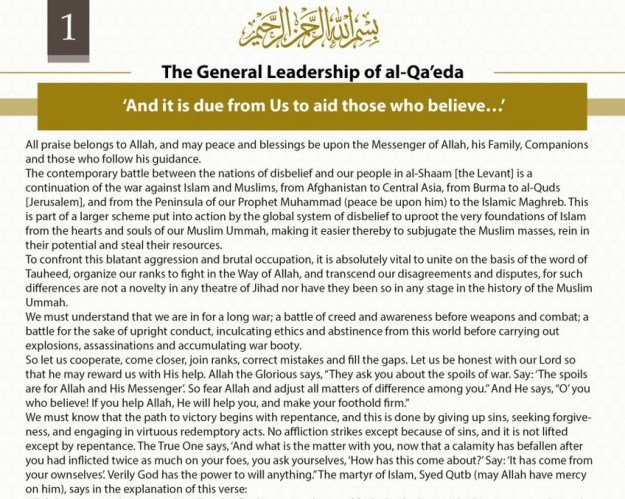
Al-Qaeda’s General Command issued a statement on 8 January 2018, entitled, “And it is Due from Us to Aid Those Who Believe”. The statement is reproduced below. Continue reading

Hamza Bin Ladin Statement on Death of His Son

By Kyle Orton (@KyleWOrton) on 3 January 2018

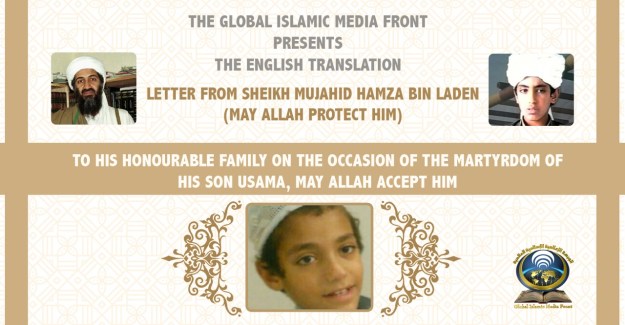
Earlier today, Hamza bin Ladin, the son of al-Qaeda’s founder, Usama bin Ladin, released a letter, “To His Honourable Family on the Occasion of the Martyrdom of His Son Usama, May Allah Accept Him”. An English translation was released on a pro-al-Qaeda Telegram channel and is reproduced below. Continue reading

The Official Declaration that Made Abu Bakr al-Baghdadi Leader of the Islamic State

By Kyle Orton (@KyleWOrton) on 30 December 2017

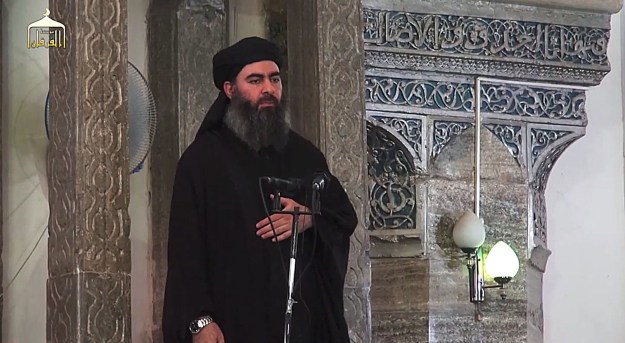
The leader of the Islamic State, Ibrahim al-Badri (Abu Bakr al-Baghdadi), speaking at the Zengi Mosque in Mosul, 4 July 2014 // AP Images

The current leader of the Islamic State (IS), Ibrahim al-Badri (Abu Bakr al-Baghdadi), was appointed as al-amir al-mu’mineen (the commander of the faithful or prince of the believers) on 16 May 2010, after his predecessor, Hamid al-Zawi (Abu Umar al-Baghdadi), was killed on 18 April 2010 in the company of his deputy and “war minister”, Abdul Munim al-Badawi (Abu Hamza al-Muhajir). The official statement appointing al-Badri is reproduced below. Continue reading

Further Details Emerge of Obama’s Failed Iran Policy

Published at The New Arab.

By Kyle Orton (@KyleWOrton) on 21 December 2017

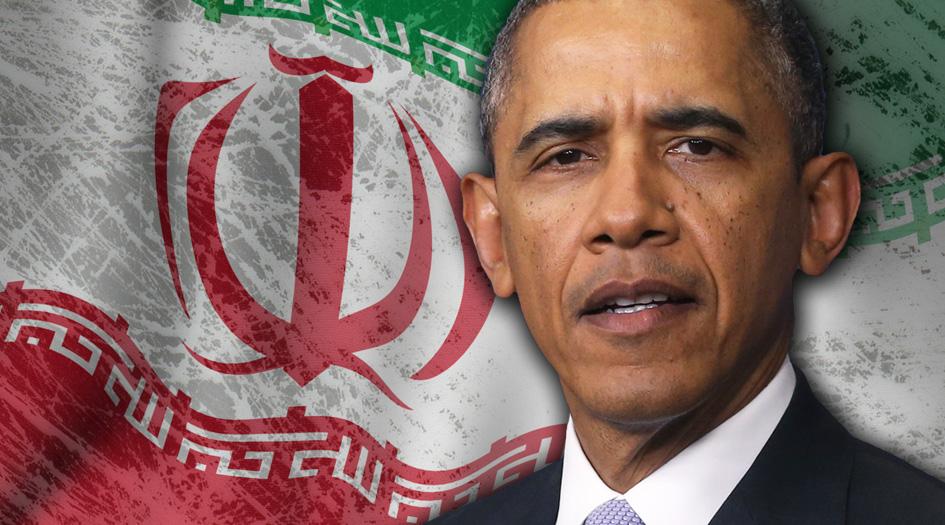
A widely reported, 15,000-word article by Josh Meyer in Politico on Sunday moves us another step closer to finding out the actual terms of President Barack Obama’s nuclear deal with the Islamic Republic of Iran.

Though the Obama administration sold the Iran deal on the narrowest possible terms as an arms control agreement, the reality was that this agreement was intended to facilitate a strategic tilt in Iran’s favour—against traditional allies—that left a regional balance requiring less American commitment.

Because the administration wanted the paper agreement, Iran had the leverage to threaten to walk away, and was therefore appeased on multiple fronts ostensibly unrelated to the nuclear issue.

Continue reading

Another Product of “Londonistan”: Abdullah Ibrahim al-Faisal

By Kyle Orton (@KyleWOrton) on 8 December 2017

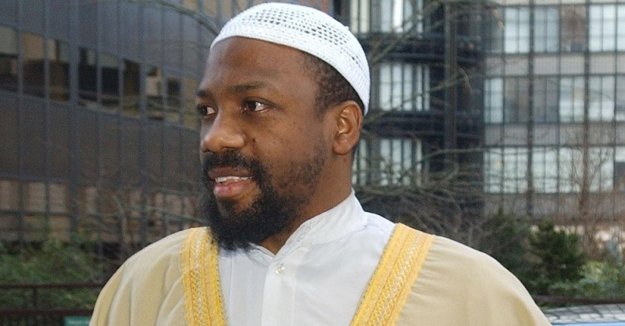
Abdullah al-Faisal

The U.S. Treasury Department sanctioned Abdullah Ibrahim al-Faisal (born: Trevor William Forrest), a Jamaican cleric who supports the Islamic State (IS) on 5 December. This was long overdue. Al-Faisal’s record of disseminating jihadist ideology, and influencing and/or interacting with terrorists, goes back several decades. And since 2014, al-Faisal has been one of IS’s influential English-language propagandist-recruiters. Continue reading

Ayman al-Zawahiri Finally Addresses the Problems with Al-Qaeda’s Syrian Branch

By Kyle Orton (@KyleWOrton) on 4 December 2017

The leader of al-Qaeda, Ayman al-Zawahiri, gave a thirty-five-minute speech on 28 November 2017, entitled: “Let Us Fight Them As A Solid Structure” (or “Let Us Fight Them As One Body” or “Let Us Fight Them With Solid Foundations”), dealing with the vexed question of al-Qaeda’s relationship with the Syrian jihadi group, Hay’at Tahrir al-Sham, a situation that escalated again in recent days. The mention of an impending Turkish intervention into Idlib—which began on 7 October—suggests that al-Zawahiri recorded this speech in the last days of September or the first few days of October. An English transcript of the speech was released by As-Sahab Media, and is reproduced below with some edits for syntax and transliteration. Continue reading

The Gulf Crisis and British Interests

By Kyle Orton (@KyleWOrton) on 4 December 2017

The decision by Saudi Arabia, the United Arab Emirates, Bahrain, and Egypt to impose a boycott on Qatar this summer was an out-of-character development for the Gulf, where all too much politics is conducted behind closed doors between the ruling families and elites. To go public, the schism between Qatar and the so-called Quartet must have been very serious.

It was the end-point of a dispute that began in the 1990s about Qatar’s foreign policy, which at that point became independent of the Saudi-led Gulf Cooperation Council (GCC), and indeed actively competitive with Saudi interests. Doha wanted to alter the Saudi-oriented status quo and did so by empowering groups—almost invariably Islamists—in its cause. Those Islamists not only had agendas running counter to the other Gulf states’ conception of regional order, but which the Quartet regarded as threatening to their internal security. Continue reading