By Kyle Orton (@KyleWOrton) on May 18, 2014
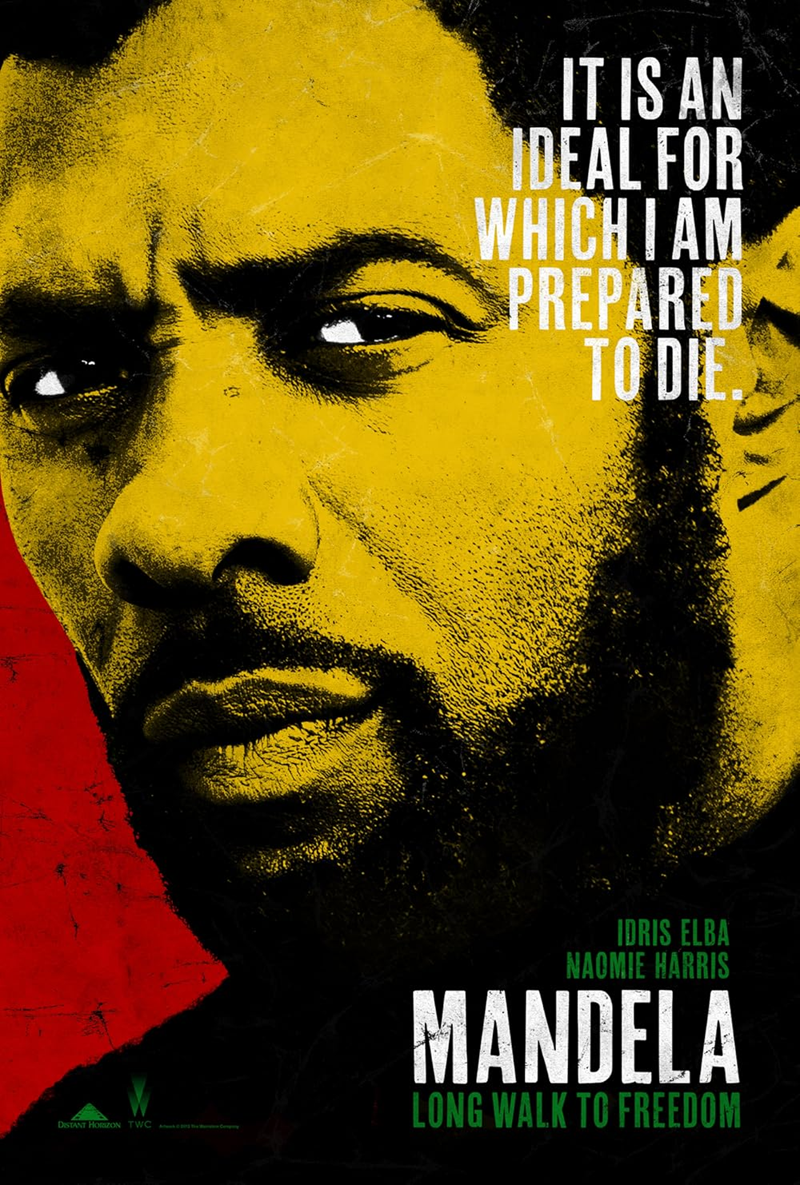
Let us stipulate that getting a thing like this correct is basically impossible: there will never be enough time in three hours—the most a film hoping for commercial success can last—to adequately cover in proper detail and nuance the facts of such an inherently complicated and contested period in history. And if effort is made to go even some of the way to doing a proper job on this score, it only underlines all the things that were left out and alienates the section of the audience that has no interest in the history and wants an entertaining movie. Caveats in place …
It’s not a terrifically entertaining flic. Indeed at times it is outright boring. In theory, the nearly 150-minute runtime is eminently justifiable. In practice, the script sets itself on a hiding-to-nothing by choosing to cover Nelson Mandela so personally, meaning that after his induction into the violent resistance to apartheid, which lasted (for him) only a couple of years in the early 1960s, he is then imprisoned.
Having your lead cast member in prison for half the film—and growing progressively older, doing less and less—doesn’t sound like a recipe for success. And it isn’t. What the script drags out—as really there is no choice to—is the only vaguely active part of Mandela’s life in that period, from the time in the late 1980s until February 1990 when the apartheid regime is negotiating with Mandela in prison and then finally release him.
Some films—12 Angry Men (1957) is probably the best of them—have made a decent motion picture out of dry source material (though the best overall is actually a TV series: Yes, (Prime) Minister.) But most have not, and the talks between Frederik de Klerk and Mandela portrayed here fall into the unsuccessful category.
Idris Elba has received great praise as Mandela. This is baffling. Even the voice—the most central part of imitating an historical figure, as Meryl Streep showed when playing Mrs. Thatcher in The Iron Lady (2011)—is not all that good. Naomie Harris’ portrayal of Winnie Mandela—really the only other figure in the film who receives any substantial attention—was, by contrast, really rather impressive, as was the film’s general portrayal of this woman, whose media image is much too benign. One senses that it is her utility in deflecting blame from our great hero, rather than a strict commitment to objectivity, that induces the filmmakers to show Winnie’s dark trajectory, moving from a young woman infatuated with a rising star of the African National Congress (ANC) to the elder woman of the party, giving inciting speeches to violent mobs and having “collaborators” (blacks deemed insufficiently loyal to the ANC) “necklaced”. But this is, as they say, the compliment vice pays to virtue.
The display of the March 1960 Sharpeville massacre, the catalysing event for the anti-apartheid movement and the radicalising trigger that allowed the birth of the armed wing of the ANC that Mandela led, uMkhonto weSizwe (MK), is excellently dramatic, and narratively deft. The resistance to that point is shown as all peaceful, and the opposition takes up arms in the aftermath because “there is violence now”. As the audience, we can see the force of the point: the landscape is a heavily-armed State against innocent and unarmed people; surely to reduce anti-apartheid casualties and begin inflicting some pain on those whose business is repression is just? It brings to mind Martin Luther King’s Letter From a Birmingham Jail, where he objects to the “obnoxious negative peace”—i.e. the time when there is no resistance to injustice—and defends resisters from the charge they are troublemakers: “[They] are not the creators of tension. [They] merely bring to the surface the hidden tension that is already alive.”
Of course, there is a complication: King was defending those who “engage in nonviolent direct action”, and we are being invited to see this event as a licence for violence. Moreover, the implication that Sharpeville was standard behaviour from the National Party government is simply wrong: this was the presentation of the episode in the political warfare of the ANC and its allies, but it was in fact a contingent and isolated mistake by one inexperienced young policemen in a confrontational situation engineered by an anti-apartheid movement whose leadership was consciously hoping to provoke State repression for propaganda purposes. With the exception of the Soweto rebellion in 1976, there were no further cases of police firing on volatile crowds until the 1980s, when the ANC’s terrorist campaign was at its height.
A similar ambivalence hovers over the image of the July 1988 celebration of Mandela’s 70th birthday at Wembley, a powerful emotional pull and an intellectual recognition that there’s something not quite right. To see the people in that stadium is to have a glimpse of how good it must have felt to be an anti-apartheid activist, to feel you were making a difference, putting the rulers in Pretoria on notice that they were under our gaze. It can also make even a hardened cynic about Mandela and the ANC just a little bit proud that the liberal West could summon a reaction of this kind when no one else did. The shadow is knowing that this scale and intensity of feeling was never shown for those in the Captive Nations or Tibet or even elsewhere in Africa, where Communism had reduced the peoples of Angola, Rhodesia/Zimbabwe, and Ethiopia to a form of slavery more pitiless than anything ever envisioned, let alone implemented, by the National Party.
South Africa under the old regime allowed oppositionists in the Parliament and margins of freedom in the press unheard of in the Soviet Union, Red China, and their totalitarian colonies. In the Communist systems, there was not only apartheid-like discrimination, but active persecution and massacre of class enemies, notably kulaks and religious believers. This attracted no mass protest in the West, and it cannot be that there is some special horror about discrimination on a racial basis because the Soviet Union had deported and slaughtered entire nations—Chechens, Tatars, Volga Germans, Balkars—and was at this very moment carrying out unmerciful domestic repression of Jews, while leading a global campaign of antisemitic vilification under the thin guise of “anti-Zionism”.
It might be said that most people engaged in anti-apartheid activism didn’t know about all this, and that is surely true, but it qualifies the nobility of their activism: they were engaged on South Africa because they had been activated on the subject, and the people activating them—the ANC exiles like Joe Slovo, Ronnie Kasrils, Ruth First, and Brian Bunting, British figures like Ken Livingston and Tony Benn, and their counterparts in America like Gus Hall and Angela Davis—were dedicated supporters of the Soviet Union. Indeed, most of these people were members of KGB-run Communist Parties.
Where the film most surprised me was by laying such heavy stress, toward the end, on the intra-black street violence, which was so extreme it overtook the white minority regime as a threat to black lives. The film used the intra-coloured mayhem as a backdrop to show Mandela’s decency in calming a community at boiling point. There is a tendency to downplay this phase of South Africa’s transition because it is seen as playing into the argument of the apologists for the apartheid system that this street violence was proof that blacks couldn’t be trusted with power as they were all primitives who would kill each other and start targeting the white minority. In truth, the argument could be made the other way: that this terrible conflict, a near-civil war often between Zulus and blacks, was proof that apartheid had lasted far too long, with this chaos being the harvest of a gruesome divide-and-rule policy.
By far the best moment in the film comes fifteen minutes from the end and occurred in August 1993. In the film it is shown as a radio broadcast; in reality it was in a football stadium. This was the height of the mayhem and Mandela went to Katlehong, the township near Johannesburg, to try to calm things down. On the table next to Mandela’s microphone, a message had been scribbled, “We’ve had enough. Please, Mr Mandela, no peace. Give us weapons.” In the film this is presented as a letter sent to Mandela, and he begins his broadcast by reading it. Where fiction and reality come together is the film showing the white population holding its breath as Mandela begins to speak, knowing that this man is all that stands between them and a tidal wave of violence they will never be able to defend themselves from. And instead Mandela told his own population that they must drop the maximalist demands; they must cease the violence.
The apartheid regime’s cruelty and manipulation might have called up these furies, but at the very moment when the foundations of the apartheid regime were shaking, when the State’s authority was giving way and it could have ended in an apocalyptic internecine war, Mandela called off the storm. He is not light on criticisms of the regime, but he tells the crowd that they must “put [their] own house in order” and cease to “kill innocent people”. With heavy pressure to placate a crowd with an understandable desire for vengeance, he told them they were in error. Faced in real life with shouts from the crowd that are intimated in the film, he demanded of them whether he was still their leader. Having been reaffirmed he said: “I will tell you, always, when you are wrong.” The means of restitution would be peaceful, he said. It would be the election that ended this wretched tyranny, not a bloodletting. It can never be overstated the magnanimity of his decision to tame the ruinous temptations at play among South African blacks at that moment. There is almost no precedent in history for statesmanship of this kind. The pitch of this is perfect in the film—the only thing that does walk the line correctly between showing the enormity of the event, the respect for the man at the centre, and eschewing the treacly and superfluous praise.
As suggested above, the historical liberties taken in the film are quite severe, by omission and commission. To flesh out just a few:
The story told in the film, of the success of the anti-apartheid struggle as one wholly of Mandela and at a push the wider ANC, neglects the numerous whites who stood against apartheid. The most glaring omission is Helen Suzman, the extremely brave English-speaking Jewish MP who formed a one-woman resistance to the brutish Afrikaans-speaking Calvinist men in Parliament.
Suzman was regularly accused of being in league with foreigners to undermine the nation and so on, to which she famously replied: “It is not my questions that embarrass South Africa; it is your answers.” Hendrik Verwoerd, the ideological architect of apartheid, the Prime Minister from 1958 until he was murdered (on the floor of Parliament) by a Communist in 1966, once dismissed her, saying, “I have written you off,” and Suzman scarcely missed a beat in replying: “The whole world has written you off.” Lambasting Verwoerd’s successor, John Vorster, for never visiting the townships to see the practical impact of his escalating “separate development” policies, Suzman demanded he go, though recommended the precaution that he be “heavily disguised as a human being”.
The exclusion of Suzman from the film cannot be put down to carelessness. Nobody visited Mandela more than Suzman on Robben Island and in Pollsmoor Prison, and nobody did more to keep Mandela in the public mind. A lot of the clashes Suzman had in Parliament with the government were about Mandela—his legal processes, appeals, and prison conditions. It was a wilful decision to erase Suzman from the story, and the reason is almost certainly that she was a genuine liberal, thus later in life became a critic of the ANC for its arbitrary, authoritarian rule and its staggering incompetence and corruption. To have admitted the moral authority of Suzman would have been to concede the feet of the clay of the movie’s hero.
Suzman was not alone as a liberal white politician working against apartheid. There was Colin Eglin, the key author of South Africa’s democratic constitution, and the liberal Afrikaners, notably Frederik van Zyl Slabbert and Zach de Beer. There were white literary and journalistic figures, crucial in exposing abuses, such as Donald Woods and Alan Paton, and white lawyers like Sydney Kentridge, Albie Sachs, and George Bizos, Mandela’s own, who challenged the National Party government in court—often successfully, because, again, South Africa was not the Soviet Union.
The Protestant churches were an enormous locus of white anti-apartheid activity—and highly effective since they challenged the regime’s theological pretentions and had international links. A crucial Christian opponent of apartheid was Beyers Naudé, an Afrikaner minister of the Dutch Reformed Church, which the National Party instrumentalised to justify its policies. While the most famous leader of the Anglican Church to oppose apartheid was Desmond Tutu, archbishop of Cape Town (1986-96), and he was black, most of the rest of the Church leadership was white and had spearheaded the anti-apartheid struggle for many years before Tutu emerged, men like Trevor Huddleston, Ambrose Reeves, and Michael Scott.
All of these characters and more played a part in, inter alia, denying the National Party its claim to be a shield for the whites against a black majority, important psychologically within South Africa, but also outside, too, preventing too-automatic a granting of the sympathy of the underdog to the South African government. In terms of the external opposition to apartheid, the Anglican Church was a leading element and it is perhaps not coincidental that it was Britain, where the Church is integral to the State, which played the most decisive role. The British Government expelled the Apartheid State from the Commonwealth for its racialism and (contrary to popular belief) it was Mrs. Thatcher’s government that applied the final nails to the apartheid regime when—and this is the second big lacunae—it was finally determined that the Communist-dominated ANC was no longer a menace since the Soviet Union was gone.
To be fair, it is not really correct to say the South African Communist Party (SACP) “dominated” the ANC because that suggests they were—and are—two separate organisations, which they are not. In practice, the ANC was a vehicle for the Moscow-loyal SACP. All the ANC leaders were SACP operatives, including Mandela, who was on the executive committee of the SACP, a position not available without the most stringent ideological vetting by the KGB, and it was the slavish Stalinism of the ANC/SACP, in a world where South Africa was too strategically important to hand over to the U.S.S.R., which delayed by decades the West pulling the plug on the white-minority regime.
The film’s depiction of the Rivonia Trial (1963-64) evinces the determination to keep Communism out of the picture. Mandela is shown telling his lawyer, “I am admitting the charges,” but only because by the rules of procedure this will allow him to speak from the dock, where he gives his famous speech saying he was prepared to die for multiracial democracy in South Africa. The problem with this is that the prosecution’s charges as summarised in the film—“sabotage aimed at facilitating violent revolution and an armed invasion of this country with the intention of overthrowing the government”—are factually correct. Mandela was guilty as charged, of working to further the goals of world Communism, of conspiring with a hostile external power to enable a conquest that transformed South Africa into a Soviet colony, of using terrorism as part of this strategy, of recruiting for terrorism, and of receiving foreign funds.
The eradication of Mandela’s Communism and the Soviet milieu he worked in is also what is behind the gross misrepresentation of the nature of the ANC “armed struggle”. Mandela says in his trial speech he has no “love for violence” and the film shows Mandela’s MK killing civilians just once, in a botched operation where the guy also kills himself. But this is simply untrue: Mandela, committed in principle to violence as a means of revolution, led Umkhonto we Sizwe, which was a terrorist movement, its escalation and deceleration of activities driven by Moscow Centre, and it didn’t just attack whites but non-ANC blacks. The studiousness of this airbrushing is apparent in both directions.
Perhaps the most obvious instance is the complete absence from the film of the episode in early 1985 when the new State President, P.W. Botha, offered to release Mandela, and Mandela opted to stay in prison. Given how little activity the movie has to work with, this omission is superficially confusing. However, the difficulty for the narrative of the filmmakers is self-evident: to tell this story would mean admitting, first, that the National Party government was liberalising and dismantling apartheid many years before Mandela was freed, and, even more crucially, that the only condition for Mandela’s release was that he renounce terrorism—and he refused.
Another example comes in what the film does include, and how, namely the ANC “armed struggle” cadres being forced into exile. It is mentioned that they go to Angola, where they can receive training, and left at that. To have allowed it to be asked why Angola was chosen would have been to return the answer that the country was the hub of the Soviet international terrorist network in Africa, and any dwelling on the details of what this training entailed would disclose that the ANC attended KGB-supervised camps directly overseen by the East German secret police, with input from other murderous forces in the Soviet orbit like the Irish Republican Army (IRA), who passed on to the ANC methods of bomb-making and torture that were extensively used inside South Africa.
To have followed the thread through might also have led to explaining that the ANC/SACP terrorist campaign was all for nothing—that it was defeated on the battlefield by the South African government in the late 1980s, despite Mandela’s devotion to it—and what actually turned the ANC/SACP towards political negotiations in the early 1990s was having the option of violence removed from them by the implosion of the Soviet Empire, the same considerations that turned the Palestinians and Irish republicans at the same moment to peace talks, or more precisely to pursuing their objectives by talk of peace.
The anti-apartheid struggle was a worthy one, no matter how often it ended up as a Useful Idiot or outright front for the Soviet Union, and however callow many of its Western participants were, who suffered the bigotry of low expectations: expecting decent behaviour from a white government and making no protest whatever about persecution from black governments. The Mandela/ANC focus, however, is propagandistic to an unsettling degree, more unsettling still for getting this central character so wrong.
Long after the exigencies of the struggle against the National Party could serve as an excuse, Mandela allied with monsters, from Fidel Castro to Muammar el-Qaddafi and Ayatollah Khomeini, and was on hand at key moments to help Saddam Hussein. Mandela was a friend of Russia to his dying day, and Mandela’s admiration for the killers who rule China was requited. Mandela spoke well of terrorists like Ernesto Guevara and used his moral stature to burnish the image of Yasser Arafat in his war against Israel. Mandela never applied any pressure to Robert Mugabe, neither when he rampaged through Matabeleland nor when he savagely attacked the white farmers, though his influence could have been considerable, and only said the faintest word of criticism once it was too late to matter.
Every indication of Mandela’s life—his ideology, his commitment to violence, his allies—made it clear he was a Lenin in the making. That Mandela managed to do the right thing despite everything he stood for has to count for something—and to tell that story would have made a much more interesting film.

