By Kyle Orton (@KyleWOrton) on 27 June 2025
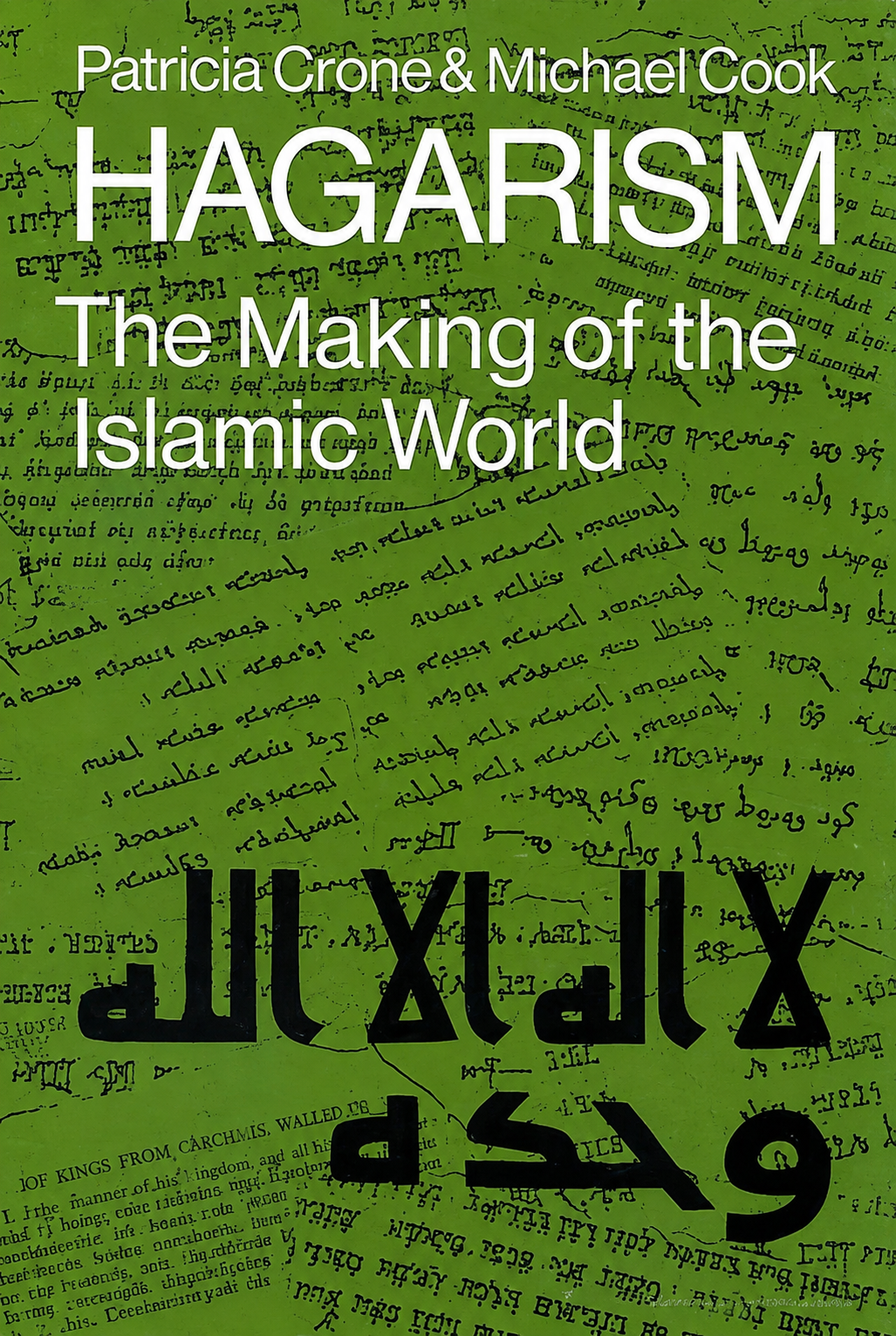
In 1978, shortly after Patricia Crone and Michael Cook published their book challenging the traditional story of Islam’s origins, Hagarism: The Making of the Islamic World, it was reviewed for the Bulletin of the School of Oriental and African Studies by John Wansbrough, their mentor and the most important figure in the “Revisionist” movement that arose in Islamic Studies in the 1970s. Wansbrough’s review is reproduced below.
* * * * *
The eccentricity of this monograph lies as much in its historical method as in its controversial thesis. The latter might be set out approximately:
(1) ‘Islam’ began as a messianic and irredentist movement called ‘Hagarism’ (pp. 3–38);
(2) the Middle Eastern sector of the ancient world generated a tripartite typology of Christian cultures: Coptic/peasant, Nestorian/aristocratic, Syrian/ascetic (pp. 41–70).
(3) in that environment ‘Islam’ evolved from (Hagarene) barbarian conquest to (Pharisaic) cultural pluralism (pp. 73–151).
The several arguments here are buttressed by three appendixes (apocalyptic imagery, epistemology, juridical adaptation), 85 pp. of notes, an impressive bibliography, and an eminently useful index. The authors’ erudition is quite extraordinary, their industry everywhere evident, their prose ebullient. No simple description could do it justice: in the manner of Pirandello or Symons the whole is formulated as a kind of quest, e.g.
‘The mutual understanding that “you can be in my dream if I can be in yours” may have provided a viable basis for an alliance of Jews and Arabs in the wilderness. But when the Jewish messianic fantasy was enacted in the form of an Arab conquest of the Holy Land, political success was in itself likely to prove doctrinally embarrassing. Sooner rather than later, the mixture of Israelite redemption and Ishmaelite genealogy was going to curdle’ (p. 10).
The religion of Abraham provided some sort of answer to the question how the Hagarenes could enter the monotheist world without losing their identity in either of its major traditions’ (p. 14).
‘The Hagarenes had thus found solutions to the most pressing problems they faced in the aftermath of the break with Judaism. Their religion of Abraham established who they were, their Christian messianism helped to emphasize who they were not, and their scriptural position, in addition to helping out with messianism, endowed them with a sort of elementary doctrinal literacy, a line to shoot. The trouble was that these solutions were utterly inconsistent with one another’ (p. 15).
‘But the root of the trouble was that the Hagarenes had not yet faced up to the basic dilemma of their religious predicament. They had begun with an uneasy combination of Israelite redemption and Ishmaelite genealogy; the specific content of each term might change, but the fundamental problem remained that of making an alien religious truth their own. There were really only two solutions. On the one hand they could proceed after the manner of the Ethiopian Christians, that is to say by themselves adopting Israelite descent. But in view of the play they had already made of their Ishmaelite ancestry, it is hardly surprising that they should have clung to it throughout their entire doctrinal evolution. On the other hand, if they would not go to the truth, the truth might perhaps be persuaded to come to them. On the foundation of their Ishmaelite genealogy, they had to erect a properly Ishmaelite prophetology. It was a daring move for so religiously parvenu a nation, but it was the only way out’ (p. 16).
The suspense is occasionally intolerable: will this parvenu nation make the right choice? Will the community survive? What price success? It seems, indeed, that the problem of identity in Islam is not exclusively a legacy of colonialism; it has been there all the time. Now comment upon the Islamic world picture sketched by the authors in the second and third parts of their exposition is beyond my competence. I am compelled to limit my remarks to their identification of Hagarism.
For that exercise a remarkable selection of sources has been marshalled: however disparate these might seem they do represent the cumulative witness of outsiders to that phenomenon later known as Islam. They also, it might be added, exhibit polemical stereotypes (apocalyptic, ‘dialogue devant le prince’) and most, if not all, have been or can be challenged on suspicion of inauthenticity. Whatever the verdict in each case, the entire corpus manifests a distinct literary type, a kind of ‘minority historiography’. Its documentary value is here virtually unquestioned. Such largesse could be born of desperation: ‘Islamic’ sources for the Umayyad century are admittedly meagre, and it is that period which the authors are concerned in the first part of their work to explore. Once into ‘Babylonia’ and the second half of the eighth century they appear to be satisfied with the notion of locally adjusted rabbinic calques. This even finds felicitous formulation, e.g. ‘One is tempted to say that the halakha of Iraq is as innocent of scripture as the scripture of Syria is innocent of halakha’ (p. 30), or ‘reduction of mishna to midrash’ (p. 31, three times), though in the light of those very passages, as well as of the paragraph on ‘naïve fundamentalism’ (p. 38), I cannot understand why the authors have to, or wish to, ‘assume Mu‘tazilism to have been in the first instance a style of theology and only secondarily an attitude to the sources of law’ (p. 181, n. 24).
More puzzling, however, is the non-halakhic scriptural period in Syria: the reconstructed entity had, apparently, to be given a name, but selection of ‘Hagarism’ might well be questioned. The pun (and could it ever have been more than that?) was elaborated, if not invented, by F. Nau in the course of his long and vituperative relationship with Islam (cf. Les Arabes chrétiens, Paris, 1933, 129–32, which really ought to have found a place in the bibliography here). The juxtaposition mahājir: Hagar, even if it were etymologically sound, cannot really support the messianic and irredentist superstructure erected here to explain the Arab expansion into the Fertile Crescent. The material is upon occasion misleadingly presented, e.g. Ephrem certainly did not prophesy an exodus of Hagarenes from the desert (p. 13), nor did Levond report Leo’s description of Ḥajjāj destroying old Hagarene writings (p. 18). The ‘Samaritan calques’ (pp. 21–8) are more interesting, but for all that not more compelling: it is not clear to me at least why Shechem rather than, say, Hebron, or for that matter, Jerusalem, had to provide a sanctuary model, nor that even the most radical concepts associated with the Islamic imāma (elitist, esoteric, gnostic, but N.B. never cultic) had to be derived from the Samaritan priesthood. Like ‘Moses redivivus’, rejection of the OT nēbi’im, prohibition of wine, and other confessional emblemata, concepts of sanctuary and of communal authority, if they had really to be borrowed, might or could have been found almost anywhere (the relevant literature is limitless: Schoeps on the Ebionites or Meeks on the Prophet-King would do).
My reservations here, and elsewhere in this first part of the book, turn upon what I take to be the authors’ methodological assumptions, of which the principal must be that a vocabulary of motives can be freely extrapolated from a discrete collection of literary stereotypes composed by alien and mostly hostile observers, and thereupon employed to describe, even interpret, not merely the overt behaviour but also the intellectual and spiritual development of the helpless and mostly innocent actors. Where even the sociologist fears to tread, the historian ought not with impunity be permitted to go. From the growing literature on rules of conduct for the latter I should like to cite a single valuable caveat: “‘Tradition’ did not merely transmit the past, it created it” (M. I. Finley, The use and abuse of history, 25).
J. WANSBROUGH

