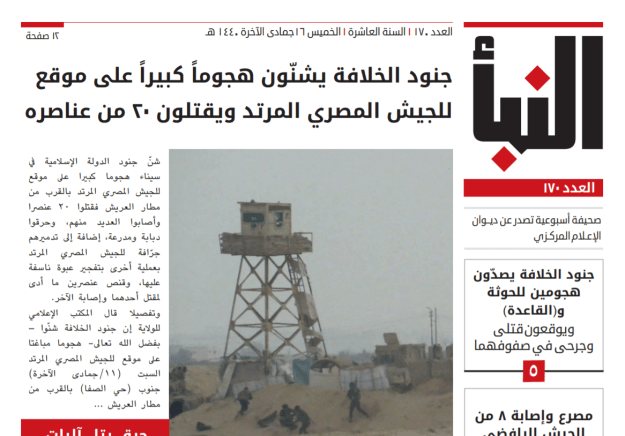
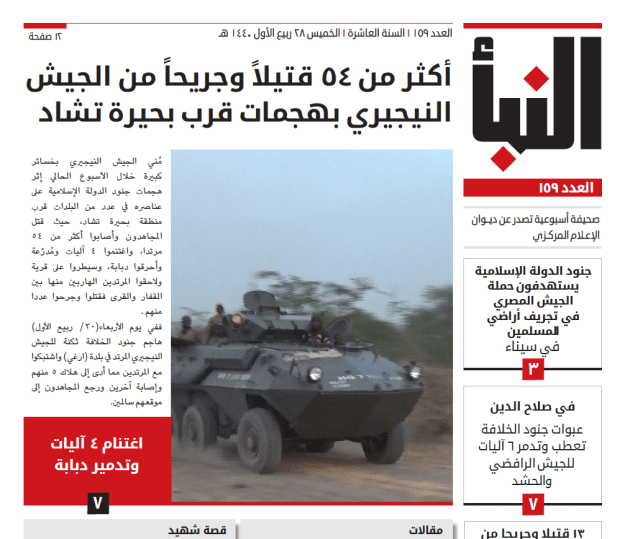
The 170th edition of Al-Naba, the Islamic State (IS) newsletter, was produced on 21 February 2019. Its main editorial on page 3 focused on the organisation’s apparent “inability to surrender”. Continue reading →
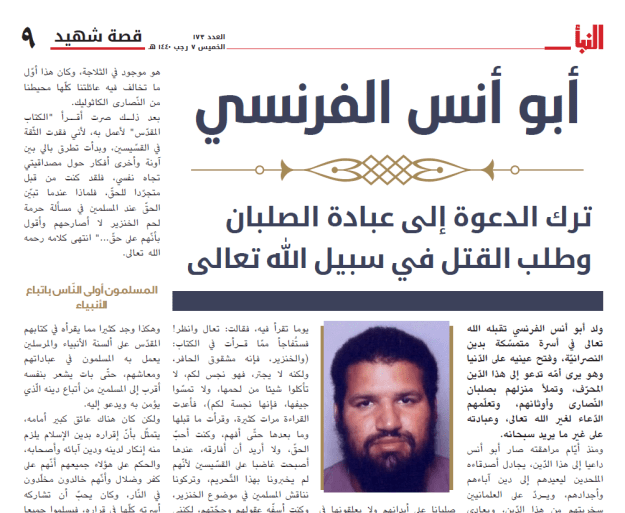
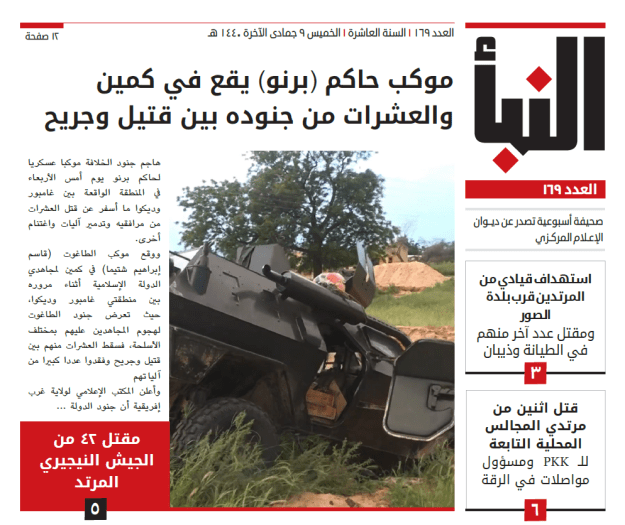
The Islamic State (IS) released the 169th edition of its newsletter, Al-Naba, on 14 February 2019. Al-Naba 169 leads with the attack on the governor of Borno in Nigeria by IS’s branch in that country. In terms of volume, much of the focus remains on the guerrilla campaign in Iraq and Syria, though there is an item on the last stand of the caliphate in Baghuz, the final village in eastern Syria. IS highlights its clashes with al-Qaeda in Yemen. There is a profile of a Russian-speaking atheist-turned-jihadist who was killed in Egypt. And perhaps most notable is an essay on Saudi Arabia, where IS has a terrorist infrastructure that is instructed to be patient. It is a question that likely is unanswerable until it is too late how strong IS is in Saudi Arabia. Continue reading →
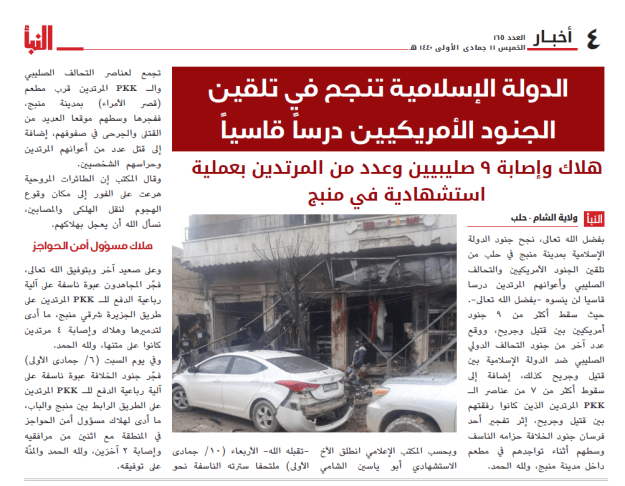
In the 165th edition of Al-Naba, the weekly newsletter of the Islamic State (IS), was released on 17 January 2019. Al-Naba 165 contained a description of the suicide bombing at the Qasr al-Omara restaurant in Minbij, northern Syria, on 16 January, which killed four Americans: Army Chief Warrant Officer Jonathan Farmer; Navy Chief Petty Officer Shannon Kent; Defence Intelligence Agency (DIA) civilian Scott Wirtz; and Pentagon contractor and linguist Ghadir Taher. At least ten other people were killed, eight civilians and two officials from the “Syrian Democratic Forces“ (SDF). The newsletter also contains an interview with an IS official operating in the Minbij area, who explains how the group’s sleeper cells and surveillance apparatus tracked U.S. movements and made prior attempts to attack the U.S. and its allies. Continue reading →
The 159th edition of Al-Naba, the Islamic State’s (IS) newsletter, released on 6 December 2018, had a very interesting story on pages nine and ten about three “repentant officers” (dubat al-tayibeen) from Egypt who joined IS in the Sinai. The two trendlines this story highlighted were: (1) the movement of trained military cadres from the Arab states into IS’s security apparatus, as has been seen with the elements of Saddam Husayn’s fallen regime; and (2) the radicalisation of those Islamists previously prepared to work through the democratic process by the 2013 putsch in Egypt, and the violent crackdown afterwards, which shut down all peaceful paths to change. Al-Qaeda has made this point a staple of its propaganda for some time. Continue reading →
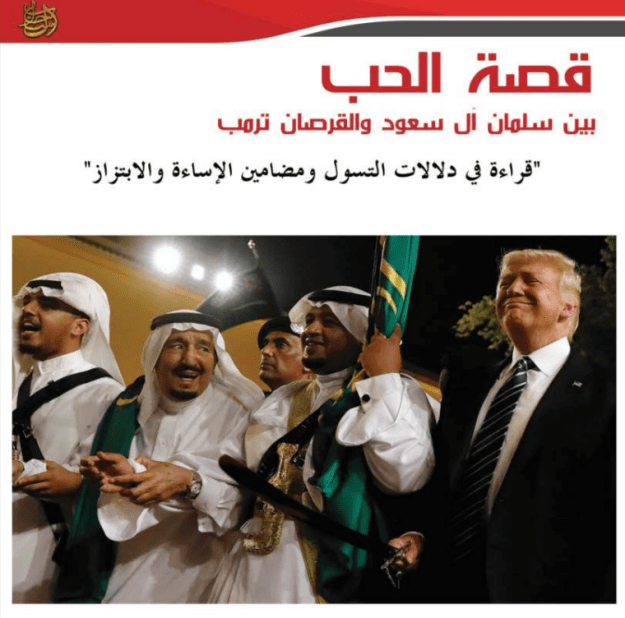
Al-Qaeda released a document on 23 October, “The Love Story Between Salman al-Saud and the Pirate Trump: A Reading of the Symptoms of Begging and the Significance of Wrong and Extortion”,[1] by Shaykh Awab Bin Hasan al-Hasni. Al-Qaeda’s Al-Sahab Foundation released an English translation of Al-Hasani’s essay on 26 November, which is reprinted below with some interesting sections highlighted in bold. Continue reading →
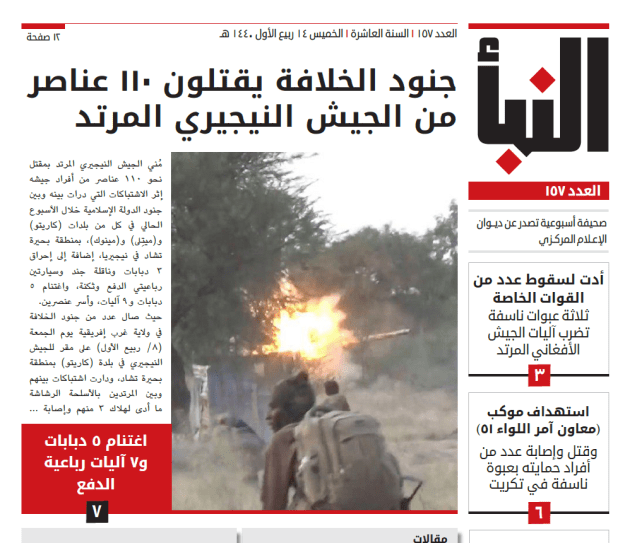
The Islamic State (IS) released the 157th edition of its newsletter, Al-Naba, on 22 November. The content was fairly standard, underlining IS’s ideology, particularly its belief that the current hardships are merely bumps on the road to a victory that has been pre-ordained by God. The bulk of the newsletter is devoted to the fierce insurgent campaign IS is waging in northern Iraq and parts of eastern Syria. Continue reading →
Attack in Melbourne, Australia, 9 November 2018 (image source)
In the latest edition of its newsletter, the Islamic State (IS) explained how it had some of the terrorist attacks committed in its name around the world, where it had not had prior contact with the killers. Continue reading →
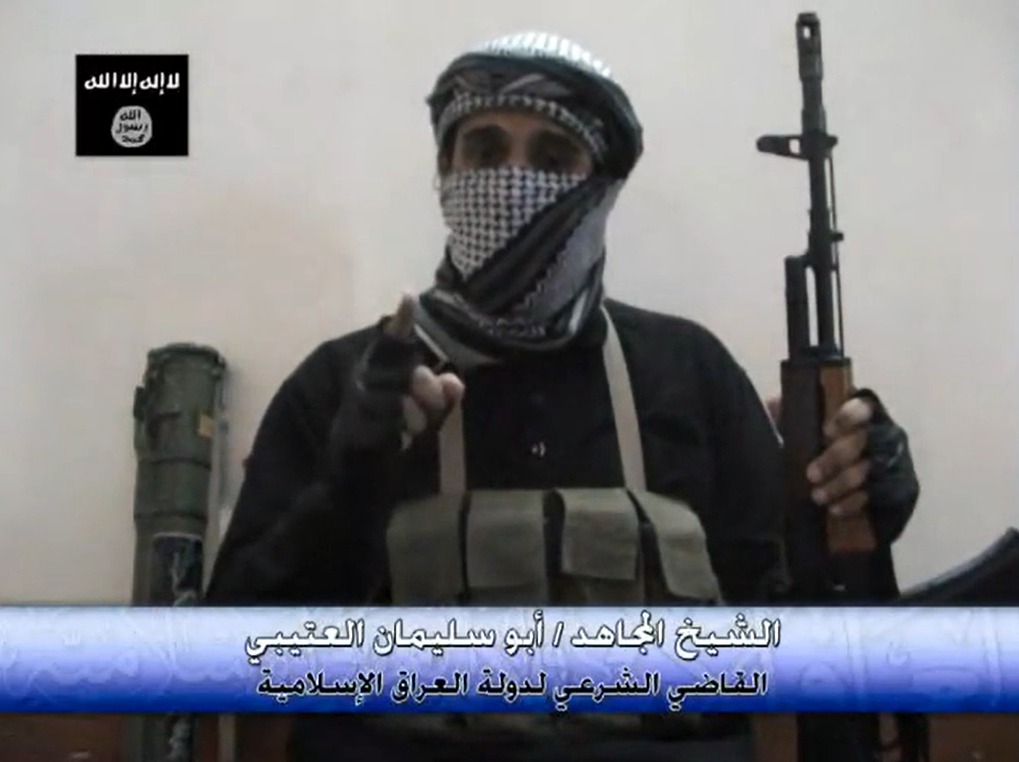
As explained in a previous post, Abu Sulayman al-Utaybi, the Chief Judge of the Islamic State of Iraq (ISI) from early April to late August 2007, has become an important character in many accounts of the history of the Islamic State movement because his abrupt removal from office was followed by his defection from ISI and a journey to Al-Qaeda’s central leadership in Pakistan, where he provided a testimony against his former bosses. If interested in an assessment of that testimony and the whole saga around how it has been used—by Western scholars, Al-Qaeda, and other critics of the Islamic State—check out the prior post. This post reproduces the transcript for what is, as far as I can tell, Abu Sulayman’s first media product for ISI, a twenty-minute video speech released by Al-Furqan Foundation for Media Production on 11 April 2007, entitled, “Why Do We Wage Jihad?”
On 24 November 2013, the day after Al-Qaeda leaked the full testimony of Abu Sulayman al-Utaybi, the chief judge of the Islamic State (IS) who made various charges against the leadership after he defected in 2007, a pro-IS response was issued, signed by one Mu’awiya al-Qahtani, entitled, “Refutation of the Letter Attributed to the Judge Abu Sulayman al-Utaybi—May God Accept Him—with Evidence and Proofs”. A translation of Al-Qahtani’s document is given below.