By Kyle Orton (@KyleWOrton) on 20 March 2026
By Kyle Orton (@KyleWOrton) on 20 January 2021

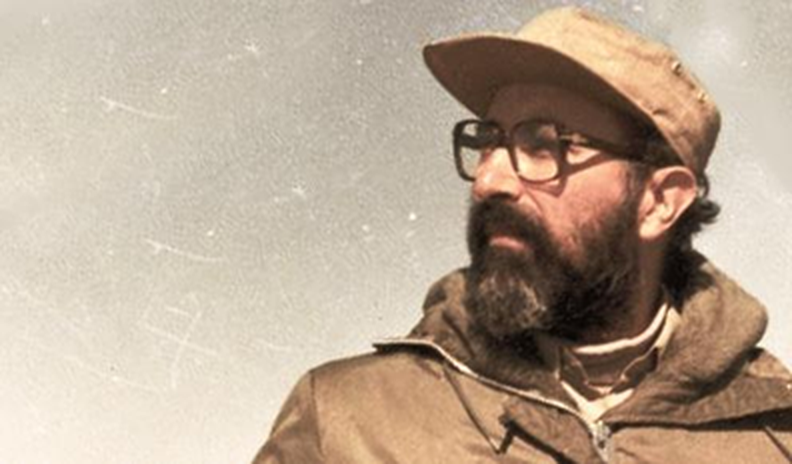
Last week, as one of his last acts in office, U.S. Secretary of State Mike Pompeo gave a speech about Iran’s collaboration with Al-Qaeda. It was unfortunate that Pompeo did this at this time and in this way, with such blatant political intent, because the factual content of Pompeo’s speech was unassailable: the Islamic Republic’s long relationship with Al-Qaeda does stretch back about three decades, the killing of Al-Qaeda’s deputy Abdullah Ahmed Abdullah (Abu Muhammad al-Masri) in Tehran in August 2020 is demonstrative of a shift in the strategic positioning of the organisation away from Pakistan to Iran, and even the part of Pompeo’s speech that got the most pushback—about Tehran’s contact with the 9/11 killers—is not controversial and is not new.
Unmentioned in Pompeo’s speech was one of the crucibles that forged this relationship, and forged Al-Qaeda into something more than a regional menace, namely the Bosnian war of 1992-5. Continue reading
By Kyle Orton (@KyleWOrton) on 28 December 2019

In a long article last week, I looked at why the U.S. ran a formal occupation of Iraq for fourteen months after the fall of Saddam Husayn in April 2003, given that there had been an explicit pre-invasion decision not to have an occupation government. The short answer is that the occupation was installed through deception by the State Department, supported by the Central Intelligence Agency (CIA). State and CIA had argued for a protracted occupation in the Situation Room debates in 2002, but President George W. Bush had sided with the Pentagon, which advocated a rapid transfer of power to Iraqis. Having lost in the formal inter-agency process, the State Department succeeded by subversion in getting its way on the ground in Iraq. The disaster this caused in the mismanagement of post-Saddam Iraq was, as the article explained in detail, only the most serious impact of the toxic schism between State/CIA and the Pentagon, a factor whose import is difficult to overstate when examining how the Bush administration functioned. (This feud also at times drew in the Vice President’s Office, which tended to support the Pentagon.)
By Kyle Orton (@KyleWOrton) on 22 December 2019
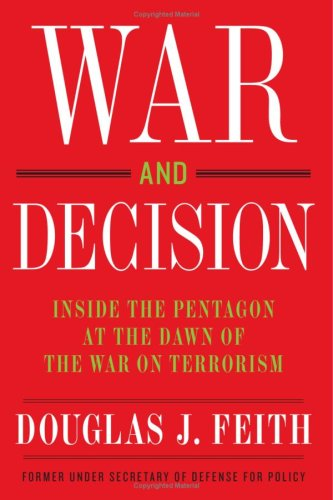
Douglas Feith was the U.S. Under Secretary of Defense for Policy from 2001 to 2005, one of the most senior positions at the Pentagon during one of the most consequential periods in recent history, covering the 11 September 2001 atrocities and early phase of the U.S.-led response. Feith later wrote a highly illuminating memoir, War and Decision: Inside the Pentagon at the Dawn of the War on Terrorism, which tried to drain some of the hysteria out of the public “debate” about the Iraq dimension of the U.S. policy in particular by explaining the internal arguments in the Bush administration leading up to the decision to finish with Saddam Husayn in 2003, and trying to set those arguments in their proper historical context, both in relation to Iraq—where “the war” had begun twelve years earlier—and the altered American threat perceptions in the shadow of 9/11. Unlike a lot of the gossipy tomes that emerged from former officials, Feith’s book is notably light on opinion and contains reams of declassified documents so readers can check his analysis against the source material. One of Feith’s key judgments is that “the chief mistake was maintaining an occupation government in Iraq for over a year”.[1] As Feith explains in great detail in the book, this was never supposed to happen. So how did it?
By Kyle Orton (@KyleWOrton) on 12 December 2018
© AP Photo / Jim Hollander, Pool
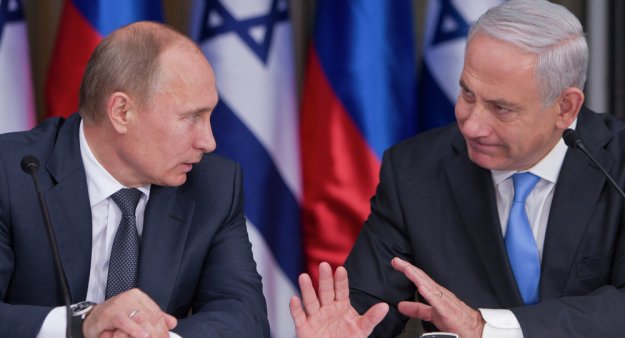
Essay: “Zionism is Making Us Stupid”: The Russian Relationship with Israel from the Soviets to Putin Continue reading
By Kyle Orton (@KyleWOrton) on 5 September 2018

In less than a week, it will be the seventeenth anniversary of al-Qaeda’s “Plane’s Operation”, the assault on the United States. It is a vertiginous enough reflection that many of us have been alive more years since 11 September 2001 than before it, and positively alarming that many of those who will soon move into the government, media, and other leading societal institutions will have been born after an event that still shapes so much of the international scene. As Anthony Summers and Robbyn Swan put it in The Eleventh Day: The Ultimate Account of 9/11 (2011), we are left with “the brief name ‘9/11’,” the context and meaning stripped away all this time later. The book is a useful overview of an event that should always be to some degree fresh in mind, though it is not without its problems in its analytical sections. Continue reading
By Kyle Orton (@KyleWOrton) on January 28, 2017
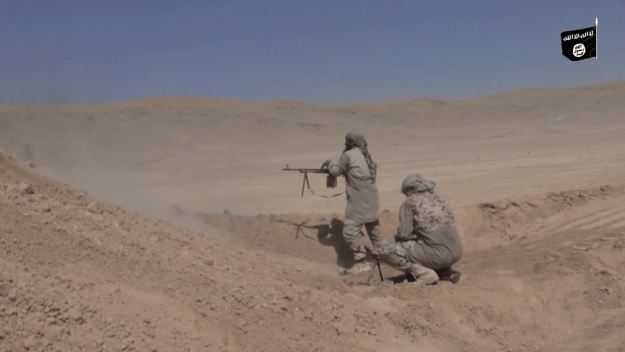
In his first speech as the then-Islamic State of Iraq’s (ISI’s) official spokesman in August 2011, Taha Falaha (Abu Muhammad al-Adnani) referred to several of the group’s “leaders” who had been killed. Among them was Abu Raghd, whose biography provides a glimpse of the role regional states—specifically Saddam Husayn’s Iraq and Bashar al-Assad’s Syria—played in facilitating the birth of the Islamic State (IS). Continue reading
By Kyle Orton (@KyleWOrton) on January 6, 2017
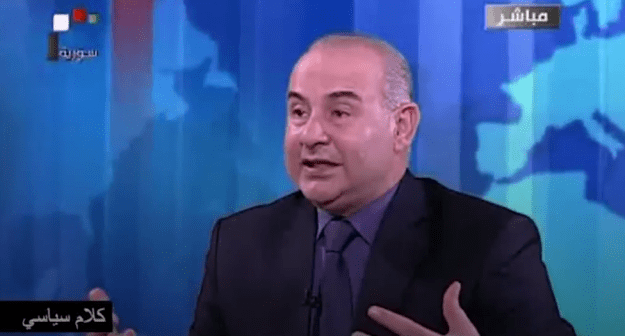
Khaled Abboud
From the beginning of the uprising in Syria in 2011, there have been accusations that Bashar al-Assad’s regime was in a de facto partnership with the Islamic State (IS) against the mainstream opposition. These accusations have a considerable basis in fact: during the entirety of the Anglo-American occupation of Iraq, Assad collaborated with IS jihadists in the destabilization of Iraq, killing thousands of Iraqi civilians and hundreds of American and British troops. Once the Syrian uprising was underway, the regime undertook various measures to bolster extremists in the insurgency. Assad and IS worked in tandem to leave Syria as a binary choice between themselves: Assad was sure this would rehabilitate him in the eyes of the world and transform his criminal regime into a partner of the international community in suppressing a terrorist insurgency, and IS wanted to rally Sunnis to its banner. The Secretary of the Syrian Parliament has now come forward to underline this. Continue reading
By Kyle Orton (@KyleWOrton) on July 6, 2016
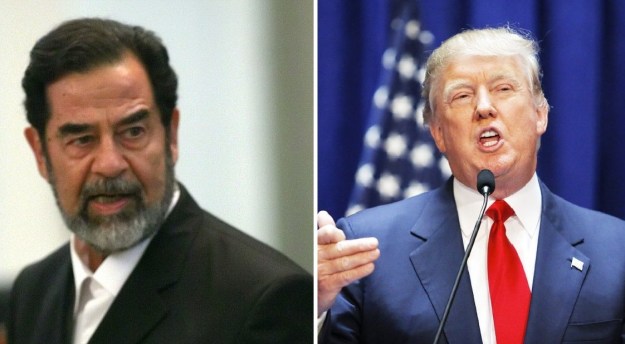
(source)
Last night Donald Trump unburdened himself of the view that Saddam Hussein was an efficient anti-terrorist operator. It is a statement Trump has made before, and it is one of such staggering ignorance—yet one which has such wide sympathy—that it seemed worth examining the multiple ways in which it was wrong. Continue reading
By Kyle Orton (@KyleWOrton) on June 7, 2016
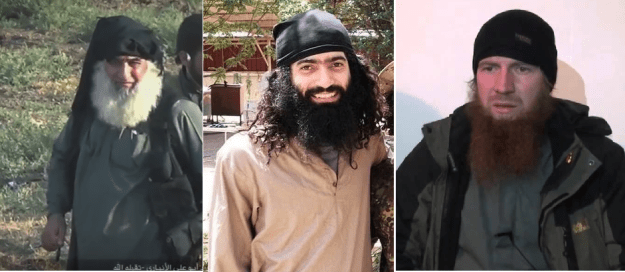
Abd al-Rahman al-Qaduli, Amr al-Absi, Tarkhan Batirashvili
The Associated Press reported on Sunday that after a senior Islamic State (IS) commander was struck down by the international coalition in March it set off a witch-hunt inside the organization that led to the killing of thirty-eight IS jihadists at the hands of their own leaders. By AP’s account, IS is now consumed with internal suspicion. The story has some problems, however. Continue reading
 Kyle Orton's Blog