Tag Archives: Britain

The End of the Line for “The Beatles” of the Islamic State

By Kyle Orton (@KyleWOrton) on 9 February 2018

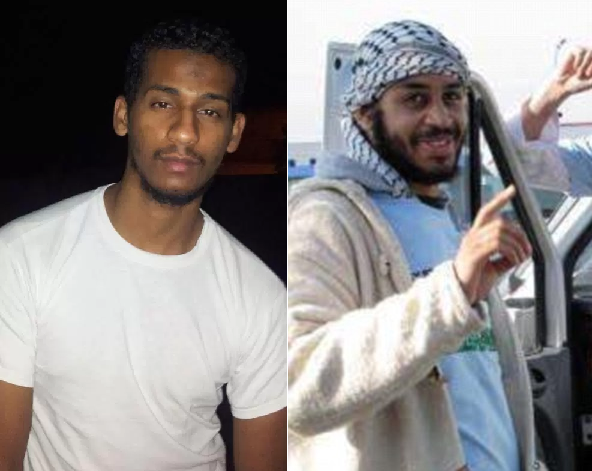
El Shafee Elsheikh (image source) and Alexanda Kotey (image source)

Last night, The New York Times reported and Reuters confirmed that two British Islamic State (IS) jihadists, El Shafee Elsheikh and Alexanda Kotey, both of them designated terrorists by the United States, have been arrested in Syria. Kotey and Elsheikh, along with the late Mohammed Emwazi (Abu Muharib al-Muhajir) and Aine Davis, formed a four-man cell that has become known as “The Beatles”—hence Emwazi being near-universally known as “Jihadi John”—that guarded, abused, and murdered hostages for IS from before the “caliphate” was founded in 2014. Continue reading

Al-Qaeda Attacks The Legitimacy of the Saudi Regime

By Kyle Orton (@KyleWOrton) on 18 January 2018

The son of al-Qaeda’s founder, Hamza Usama bin Ladin, released a short, twelve-minute speech earlier today, the fourth episode of “Sovereignty of the Best of Nations Is In the Uprising of the People of the Haram”. Hamza root-and-branch condemns the legitimacy of the Saudi monarchy as founded on a pact with a disbelieving state, Britain. An English translation of the speech was released by al-Qaeda’s as-Sahab Media and is reproduced below. Continue reading

The Gulf Crisis and British Interests

By Kyle Orton (@KyleWOrton) on 4 December 2017

The decision by Saudi Arabia, the United Arab Emirates, Bahrain, and Egypt to impose a boycott on Qatar this summer was an out-of-character development for the Gulf, where all too much politics is conducted behind closed doors between the ruling families and elites. To go public, the schism between Qatar and the so-called Quartet must have been very serious.

It was the end-point of a dispute that began in the 1990s about Qatar’s foreign policy, which at that point became independent of the Saudi-led Gulf Cooperation Council (GCC), and indeed actively competitive with Saudi interests. Doha wanted to alter the Saudi-oriented status quo and did so by empowering groups—almost invariably Islamists—in its cause. Those Islamists not only had agendas running counter to the other Gulf states’ conception of regional order, but which the Quartet regarded as threatening to their internal security. Continue reading

Islamic State Claims it Caused the Evacuation at Charles de Gaulle Airport, Reiterates Claim of Parsons Green Attack

By Kyle Orton (@KyleWOrton) on 23 September 2017

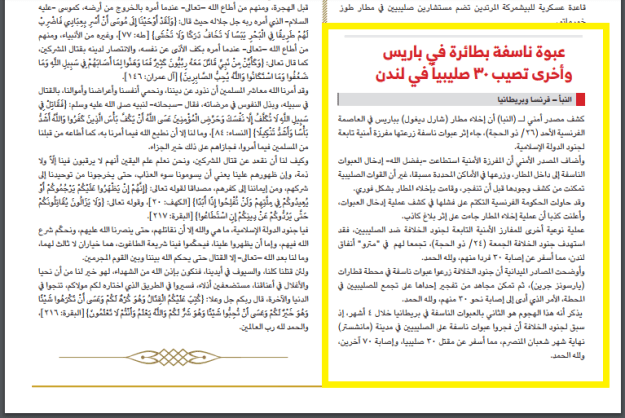
Al-Naba 98, 22 September 2017

The ninety-eighth edition of the Islamic State’s (IS) newsletter, Al-Naba, was released on 22 September 2017. This Charles de Gaulle Airport in Paris, France, was evacuated on 17 September due to a bomb scare, and later declared to be a “false alarm”. This edition of Naba claims that an IS operative in fact planted a bomb, causing the chaos at Charles de Gaulle. Al-Naba 98 also contained a further acknowledgement of the “bucket bombing” at Parsons Green tube station in London, Britain, which took place on the morning 15 September 2017. Continue reading

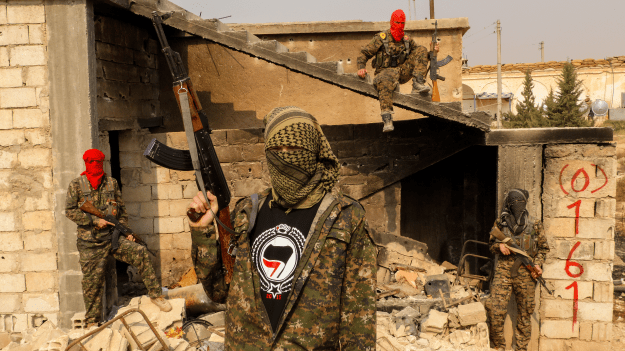
The Forgotten Foreign Fighters: The PKK in Syria

By Kyle Orton (@KyleWOrton) on 17 August 2017

I released a report today, published by the Henry Jackson Society, The Forgotten Foreign Fighters: The PKK in Syria. Continue reading

The Islamic State’s Newsletter on the London Bridge Attack and Melbourne Siege

By Kyle Orton (@KyleWOrton) on 8 June 2017

Al-Naba 84

The eighty-forth edition of Al-Naba (The News), released by the Islamic State on 8 June 2017, included a section on the terrorist attacks in Britain, on London Bridge, on 3 June, and in Australia, the siege of the apartment block in Melbourne, on 5 June. Continue reading

Islamic State Newsletter Says Manchester Bomber Was a “Soldier of the Caliphate”

By Kyle Orton (@KyleWOrton) on 25 May 2017

Article about Manchester Arena suicide-killer Salman Abedi, page 2 of Al-Naba 82

The Islamic State (IS) released the eighty-second edition of its newsletter, Al-Naba, on 25 May 2017. The first article in Al-Naba 82 was about the suicide attack on the Manchester Arena on 22 May, which IS claimed the next day. The article in Al-Naba provided very few details about the murderer, Salman Abedi, or IS’s role in the attack, mostly gloating over the allegedly panicky reaction of the British state. Continue reading

Jihadist Terror Remains a Significant Problem for Britain

By Kyle Orton (@KyleWOrton) on 4 May 2017

Khalid Mohamed Omar Ali being arrested (image source)

Over the past week, the authorities have disrupted two potential terrorist attacks in London. This follows the Westminster Bridge attack in March, which was claimed by the Islamic State (IS). Britain has been one of the most targeted states by IS’s campaign of global terror, and these latest incidents—whether or not they transpire to be IS-linked—underline the scale of the terrorist threat to Britain. Security forces prevented thirteen attacks in the U.K. between June 2013 and March 2017, and at any one time there are five-hundred live investigations into potential terrorist incidents, with 3,000 Britons believed to be capable of committing an act of domestic terrorism. Continue reading

Islamic State Claims the Westminster Attack

By Kyle Orton (@KyleWOrton) on 31 March 2017

Al-Naba 74, page 12, 30 March 2017

The seventy-fourth edition of al-Naba, the Islamic State’s newsletter, released online on 30 March 2017, reiterated the terrorist group’s 23 March claim via Amaq of the 22 March Westminster attack by Khalid Masood (born: Adrian Russell Ajao). The brief article is reproduced below.
Continue reading

America Sanctions Anjem Choudary and other British Islamic State Jihadists

By Kyle Orton (@KyleWOrton) on 30 March 2017

Anjem Choudary (image source)

The State Department designated five individuals on 30 March 2017 as Specially Designated Global Terrorists (SDGTs), imposing sanctions on them for having “committed, or [for] pos[ing] a significant risk of committing, acts of terrorism that threaten the security of U.S. nationals or the national security, foreign policy, or economy of the United States.” Four of those sanctioned are members of the Islamic State (IS), including two key British operatives in the group’s global network, and the other is a member of al-Qaeda. On the same day, the Treasury Department sanctioned two IS operatives involved in funding and guiding external IS operations in the Far East and Southeast Asia. Continue reading