By Kyle Orton (@KyleWOrton) on 28 January 2024

A version of this article was published at CapX
By Kyle Orton (@KyleWOrton) on 21 December 2018

President Trump in a Twitter video saying fallen soldiers agree with his plan to withdraw from Syria, 19 December 2018 [image source]
By Kyle Orton (@KyleWOrton) on 30 October 2018
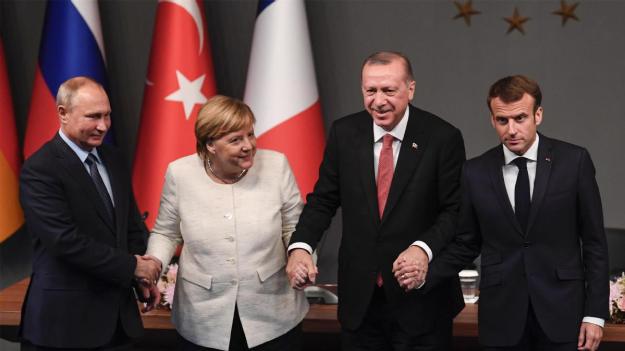
Istanbul summit, 27 October 2018 (image source)
At Saturday’s summit in Istanbul between Turkey, Russia, France and Germany, the focus was on extending the September 17 Turkey-Russia ceasefire agreement reached in Sochi that spared Idlib a full-scale offensive by Bashar al-Assad’s regime and his supporters, and to “progress” on the political track. Continue reading
By Kyle Orton (@KyleWOrton) on 14 May 2018
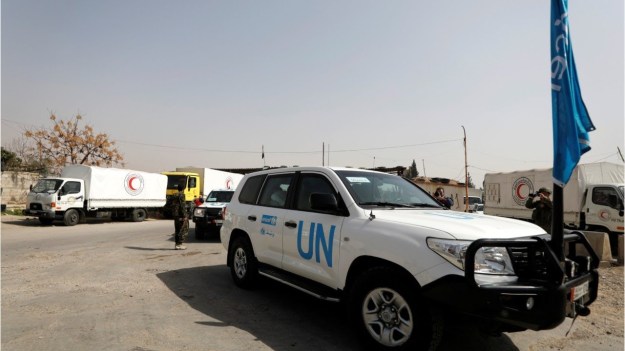
United Nations in East Ghouta, Syria (image source)
At best, the United Nations has been impotent as Syria was destroyed. But when the U.N.’s role is examined more closely it looks more like a collaborator, than a bystander, to that destruction. Continue reading
By Kyle Orton (@KyleWOrton) on 29 April 2018
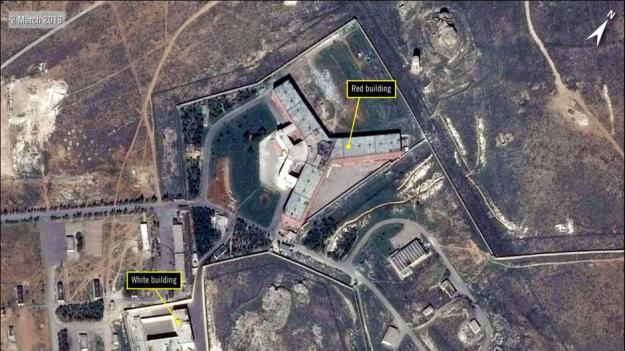
A satellite image of Sednaya prison, about 20 miles north-east of the presidential palace. CNES and ASTRIUM / Amnesty International via AFP
To accompany the release of “Syria’s Slaughterhouses”, a film by TRT World’s “Off The Grid”, I was asked to give an overview of the available evidence of the Assad regime’s crimes against humanity.
The launching of a limited punitive raid against the Syrian regime of Bashar al Assad for the use of poison gas has brought some attention to the regime’s crimes. The regime’s visible crimes are numerous and devastating.
In addition to using weapons of mass destruction, fighter jets have levelled ancient cities, sieges have starved populations into submission, and improvised explosives like barrel bombs have maimed thousands. These tactics are part of what UN investigators have called a “systematic and widespread attack against [the Syrian] civilian population”.
The UN commission recently noted that what the Assad regime has done amounts to crimes against humanity, including extermination, murder, rape, and torture.
What does not get enough attention is the part of Assad’s criminality that is most difficult to see: that which takes place in the prisons, a vast network of concentration camps where torture and murder is routine. Continue reading
By Kyle Orton (@KyleWOrton) on 16 March 2018
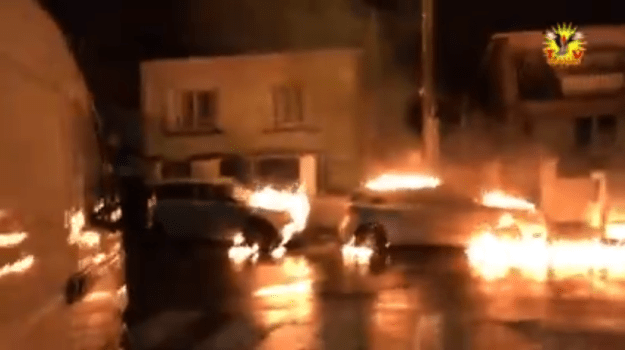
Screenshot from video of a PKK attack on Turkish diplomats in Paris, France (13 March 2018)
A wave of politically motivated violence has swept over Europe in the last few days, carried out by an extremist group and its sympathisers, accompanied by public statements threatening further attacks.
These attacks are intended to change western policy to one more suitable to the attackers.
The conventional term for this is “terrorism”.
These assailants are not Islamist, however; they are from the Kurdish PKK, and this seems to have both reduced the amount of attention this campaign has received, and to have dulled the reaction from some who suggest that perhaps the attackers have a point. Continue reading
By Kyle Orton (@KyleWOrton) on 8 March 2018

Kurdish YPG/PKK fighters (Rodi Said/Reuters)
The Independent International Commission of Inquiry (IICI) on the Syrian Arab Republic was set up in 2011 by the United Nations Human Rights Council to track human rights abuses in Syria.
Naturally, this has meant that most of the Commission’s work is focused on the industrial-scale crimes against humanity committed by Bashar al-Asad’s regime and his enablers in Russia and Iran. Later, as non-state terrorist and extremist groups intruded into Syria, the Commission documented the atrocities by the Islamic State (IS), al-Qaeda, and the Kurdistan Workers’ Party (PKK), which works under the label of the People’s Protection Units (YPG) in Syria and dominates the so-called Syrian Democratic Forces (SDF) that the U.S.-led Coalition works with against IS. The Commission has also recorded abuses by rebel groups.
The Commission’s latest report, released on 6 March 2018, “draws from more than 500 interviews and encapsulates the trends over the past six months in the Syrian Arab Republic, with particular focus on the impact of the offensive against [the Islamic State] and the use of siege warfare on the civilian population.” The report, therefore, has something of a focus on the SDF/PKK human rights violations, though IS’s horrific treatment of religious minorities and so on, plus the pro-Asad coalition’s ongoing campaign of massacre and displacement in areas such as East Ghuta, are given ample attention. Continue reading
By Kyle Orton (@KyleWOrton) on 2 March 2018
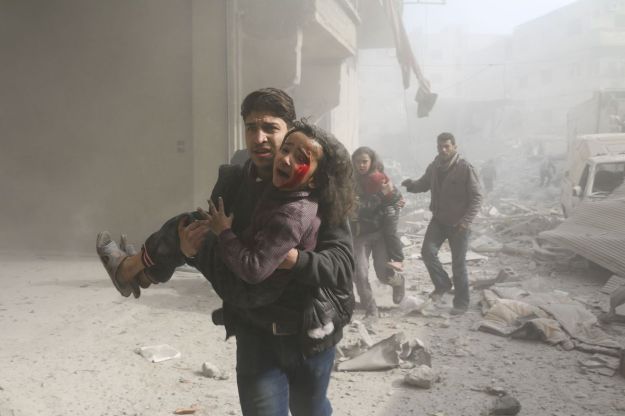
Aftermath of an Assad regime bombardment in Hamouriyah, Eastern Ghouta, 9 January 9, 2018. Samir Tatin/Anadolu Agency/Getty Images
The international community tried to impose a ceasefire in Syria on 24 February, passing resolution 2401 through the United Nations Security Council. The ceasefire never took hold and it is now clear it will not. This was inevitable.
Bashar al Assad’s regime, and the governments that support him in Iran and Russia, have repeatedly made use of ceasefires to sequence their war, taking advantage of the calm on some fronts to concentrate firepower on other areas. The only question is why Western diplomats gambled that this time would be any different. Continue reading
 Kyle Orton's Blog