Tag Archives: France

Islamic State, Afghanistan, and Replenishment Through Prison Breaks

By Kyle Orton (@KyleWOrton) on 21 August 2020

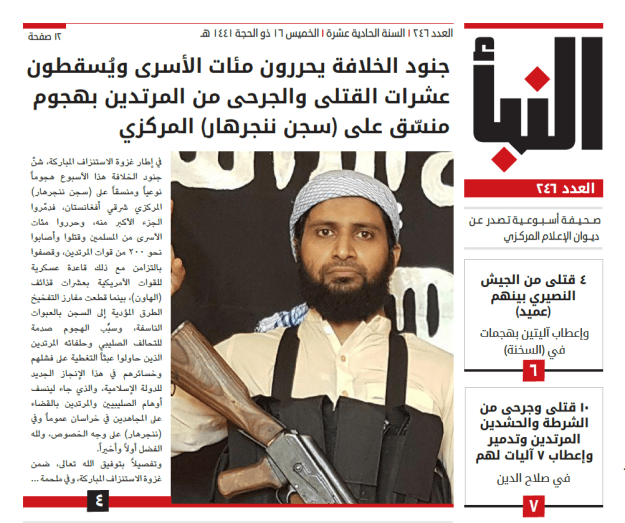
Al-Naba 246, front page, 6 August 2020

The Islamic State (IS) published the 246th edition of its newsletter, Al-Naba, on 6 August, which highlighted the 2-3 August prison break in the Nangarhar province of Afghanistan, a massive IS operation lasting twenty-plus hours, and proclaimed that freeing IS jihadists from prisons will now be a priority for the group. In 2012, shortly after the American withdrawal from Iraq, IS announced Operation BREAKING THE WALLS, which went on for a year, breaking open Iraqi prisons. The narrative of the IS’s “defeat” by the Surge and Awakening of 2007-08 is problematic in some of its fundamentals, but among the reasons it proved to be so fleeting in practice was this prison-break campaign that restored to the battlefield key IS operatives who planned the caliphate project in 2014. It is, therefore, alarming to see the arrival of such a campaign in Afghanistan at the moment the U.S. is headed, heedlessly, for the exit. Continue reading

France Kills Al-Qaeda’s Man in North Africa

By Kyle Orton (@KyleWOrton) on 11 June 2020

France announced last Friday that its forces in Mali had killed Abd al-Malek Drukdel (Abu Musab Abd al-Wadud), the emir of Al-Qaeda in the Islamic Maghreb (AQIM), which covers the North Africa and Sahel areas. Paris has sometimes been unreliable on these matters, but the United States independently confirmed Drukdel was gone, as have sources within AQIM. The French also announced that on 19 May they had arrested Mohamed Mrabat, a veteran jihadist and member of the Islamic State in the Greater Sahara (ISGS). Continue reading

Tunisia and Jihadism

By Kyle Orton (@KyleWOrton) on 26 May 2020

Early in his new book, Your Sons Are At Your Service: Tunisia’s Missionaries of Jihad, The Washington Institute’s Aaron Zelin quotes a pair of sociologists who note that ‘where theories are plentiful … ideas are vacuous’. The book is in many ways the antithesis of this approach. It is not without theoretical content; where social movement theory arises as a means of understanding jihadism, say, the author gives an overview of the literature to contextualise it for the reader. But the general approach is historical, empirical, and detail-rich, so that by the time Zelin summarises his findings in the various sections there can be no doubt about the evidentiary basis. Continue reading

The CIA and Iraq: Intelligence Failures, Media Successes

By Kyle Orton (@KyleWOrton) on 28 December 2019

In a long article last week, I looked at why the U.S. ran a formal occupation of Iraq for fourteen months after the fall of Saddam Husayn in April 2003, given that there had been an explicit pre-invasion decision not to have an occupation government. The short answer is that the occupation was installed through deception by the State Department, supported by the Central Intelligence Agency (CIA). State and CIA had argued for a protracted occupation in the Situation Room debates in 2002, but President George W. Bush had sided with the Pentagon, which advocated a rapid transfer of power to Iraqis. Having lost in the formal inter-agency process, the State Department succeeded by subversion in getting its way on the ground in Iraq. The disaster this caused in the mismanagement of post-Saddam Iraq was, as the article explained in detail, only the most serious impact of the toxic schism between State/CIA and the Pentagon, a factor whose import is difficult to overstate when examining how the Bush administration functioned. (This feud also at times drew in the Vice President’s Office, which tended to support the Pentagon.)

Continue reading

Why Was There Ever An American Occupation of Iraq?

By Kyle Orton (@KyleWOrton) on 22 December 2019

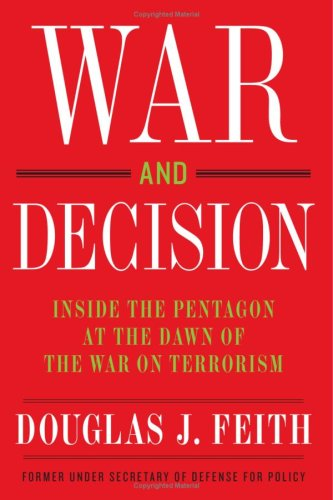
Douglas Feith was the U.S. Under Secretary of Defense for Policy from 2001 to 2005, one of the most senior positions at the Pentagon during one of the most consequential periods in recent history, covering the 11 September 2001 atrocities and early phase of the U.S.-led response. Feith later wrote a highly illuminating memoir, War and Decision: Inside the Pentagon at the Dawn of the War on Terrorism, which tried to drain some of the hysteria out of the public “debate” about the Iraq dimension of the U.S. policy in particular by explaining the internal arguments in the Bush administration leading up to the decision to finish with Saddam Husayn in 2003, and trying to set those arguments in their proper historical context, both in relation to Iraq—where “the war” had begun twelve years earlier—and the altered American threat perceptions in the shadow of 9/11. Unlike a lot of the gossipy tomes that emerged from former officials, Feith’s book is notably light on opinion and contains reams of declassified documents so readers can check his analysis against the source material. One of Feith’s key judgments is that “the chief mistake was maintaining an occupation government in Iraq for over a year”.[1] As Feith explains in great detail in the book, this was never supposed to happen. So how did it?

Continue reading

The West and its Foreign Terrorist Fighters

Published at The Arab Weekly

By Kyle Orton (@KyleWOrton) on 9 June 2019

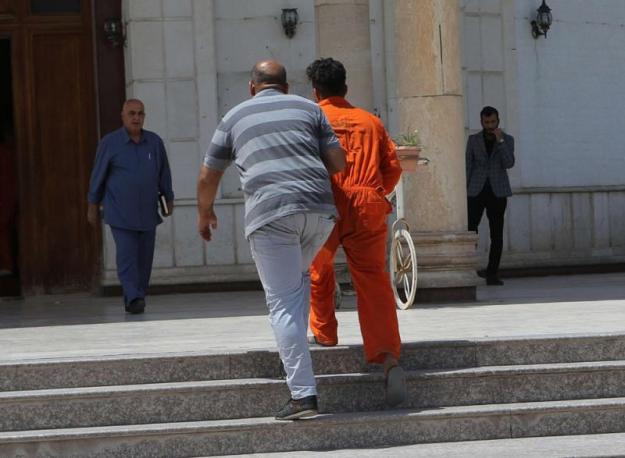
An Islamic State being led into the Iraqi Criminal Court in Baghdad, 5 May 2019 (AP)

From May 26 to June 3, Iraq’s government sentenced to death 11 Islamic State operatives who had been captured in Syria. The novelty in the cases was that the Iraqis said the militants were French and ten of them were. The other was Tunisian.

The French government has made a pro forma protest against the death sentences but did nothing to impede the process. This is of a piece with the general approach European countries, including Britain, have taken to their citizens who joined jihadi groups in the Levant. Continue reading

Al-Qaeda and Global Terror

This article was originally published at European Eye on Radicalisation

By Kyle Orton (@KyleWOrton) on 16 April 2019

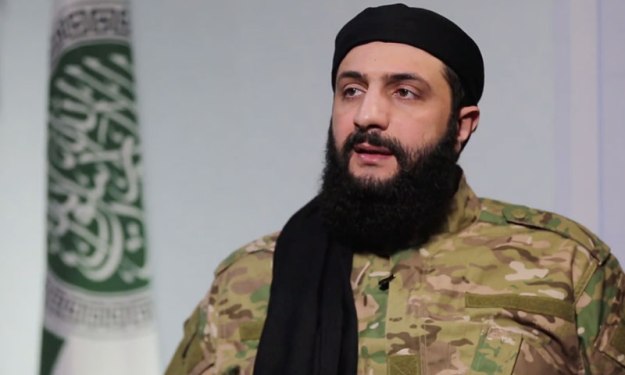
Ahmad al-Shara (Abu Muhammad al-Jolani) [image source]

Several years ago, Al-Qaeda made a strategic decision to refrain from foreign terrorist operations, refocusing away from these global spectaculars towards integrating more closely into local conflicts. The 2014 rampage across Iraq and Syria by Al-Qaeda’s rebellious former Iraqi branch, the Islamic State (ISIS), provided both the opportunity and additional incentive for a long-mediated rebranding effort. However, there have recently been signs of a shift back towards external terror operations, just as ISIS undergoes a setback and Al-Qaeda has a chance to reassert its dominance over the jihadi scene. Continue reading

Islamic State Claims the Killing of a Canadian Citizen

By Kyle Orton (@KyleWOrton) on 30 March 2019

Al-Naba 175, page 8

Kirk Woodman, a Canadian geologist working for a Vancouver-based mining company, Progress Minerals Inc., was found dead in Oudalan province, north-east Burkina Faso, on 16 January 2019. Woodman had been kidnapped the previous day from a mining camp. Ouagadougou announced that Woodman had been killed the following day. Woodman’s body was described as “bullet-riddled”. It was noted by one outlet that Woodman had been taken in “a border region infiltrated by jihadis”, but not very much more has been said of the case in the last two months. On 28 March, the Islamic State (IS) claimed responsibility for the murder in the 175th edition of its weekly newsletter, Al-Naba. Continue reading

Islamic State Obituary for French Jihadist Fabien Clain

By Kyle Orton (@KyleWOrton) on 16 March 2019

Fabien Clain, Al-Naba 173, page 9

The U.S.-led Coalition against the Islamic State (IS) announced on 28 February that it had killed Fabien Clain (Abu Anas al-Firansi), a French citizen. Clain and his brother, Jean-Michel (Abu Uthman), were targeted by a Coalition airstrike in Baghuz, the final pocket of the “caliphate” in eastern Syria, on 20 February. It was unclear what happened to Jean-Michel, though the 173rd edition of IS’s newsletter, Al-Naba, published on 14 March, says (pp. 9-10) that he was killed a few days after Fabien. Continue reading

Islamic State Urges Defiance as the Caliphate Collapses, Attacks Other Islamists

By Kyle Orton (@KyleWOrton) on 9 March 2019

Al-Naba 172 front page

The Islamic State (IS) released the 172nd edition of Al-Naba, its newsletter, on 7 March 2019. Continue reading