Tag Archives: Islamic State of Iraq

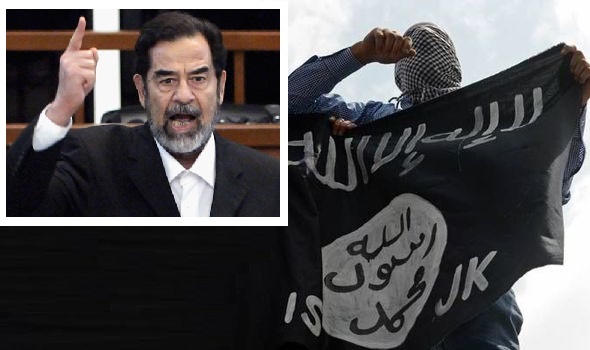
Saddam Hussein’s Regime Produced The Islamic State

By Kyle Orton (@KyleWOrton) on April 21, 2015
1

Having presented the evidence that Saddam Hussein Islamized his foreign policy and then Islamized his regime, above all with the Islamic Faith Campaign, beginning in June 1993 that tried to fuse Ba’athism with Salafism, encouraging (and keeping under surveillance) a religious revival in Iraq that redounded to the benefit of the regime’s legitimacy and support, I wanted to look at what this history means for Iraq and the wider region now.

I pointed out in October that the “military strength” of the Islamic State (ISIS) “comes from the remnants of Saddam Hussein’s military-intelligence apparatus and the Caucasus’ Salafi-jihadists.” Continue reading

Abu Bakr al-Baghdadi’s Second Speech as Islamic State Leader

By Kyle Orton (@KyleWOrton) on December 29, 2014

The current leader of the Islamic State (IS), Ibrahim al-Badri (Abu Bakr al-Baghdadi), released his first “proper” speech on July 21, 2012. But this was, in fact, his second public statement: Al-Badri had mourned Usama bin Laden in an audio message released on 9 May 2011 and vowed “blood for blood and destruction for destruction”. The 2012 speech, entitled, “Allah Will Not Allow Except That His Light Should Be Perfected”, was released by Al-Furqan Media and an English transcript—reproduced below—was issued by Fursan al-Balagh Media. Some key parts are highlighted in bold.
Continue reading

To Save Iraq from ISIS: Get Rid Of Maliki, Support The Kurds And Syrian Rebels

By Kyle Orton (@KyleWOrton) on June 20, 2014

The Peshmerga (those who face death): the people's army of Iraqi Kurdistan

The Peshmerga (those who face death): the people’s army of Iraqi Kurdistan

President Obama met with Congressional leaders on Wednesday to brief them on a “comprehensive approach” to Iraq, which for now will not include airstrikes against the Islamic State of Iraq and Syria (ISIS) inside Iraq, “in part because”—as previously reported—”U.S. military officials lack sufficient information to hit targets that would shift momentum on the battlefield.” Obama has let this drag out so long that the Sahwa (Awakening), the Sunni Arabs who rose up against ISIS’s previous incarnations, al-Qaeda in Iraq (AQI) and the Islamic State of Iraq (ISI), are now either eliminated or mixed back in with ISIS and—crucially—other locally-focussed Sunni Islamist insurgent groups, notably the Sufi-Ba’athist Jaysh an-Naqshbandi. Defensible as this is, there are stronger reasons why the decision not to strike is correct.

Continue reading

ISIS’s Spokesman Attacks Al-Qaeda’s Ruling That ISIS Should Leave Syria

By Kyle Orton (@KyleWOrton) on April 4, 2014

The spokesman of the Islamic State of Iraq and Syria (ISIS), Abu Muhammad al-Adnani, made a speech on 19 June 2013, a transcript of which is reproduced below. Al-Adnani’s speech was entitled, “Fadharhum wa-ma yaftarun”, variously translated as: “So Leave Them Alone With Their Devising”, “Leave Them Alone with their Fabrications”, and “Ignore Them and Their False Allegations”. Continue reading

The Announcement of the Islamic State of Iraq and Syria

By Kyle Orton (@KyleWOrton) on April 2, 2014

Al-Qaeda expelled the Islamic State of Iraq and Syria (ISIS) from its ranks on February 3, 2014. This was the culmination of a dispute that broke into the public eye with ISIS’s declaration in April 2013, an effort by ISIS’s emir, Abu Bakr al-Baghdadi, to formally subsume the secret Syrian wing of the then-Islamic State of Iraq (ISI), known as Jabhat an-Nusra, under his own banner, and the rejection of both al-Nusra’s leadership and al-Qaeda’s to this move. In truth, the schism between ISIS and al-Qaeda has its roots all the way back to the beginning, when ISIS became al-Qaeda’s Iraqi branch, al-Qaeda in Mesopotamia (AQM), in 2004.

Below is the transcript of the audio address by al-Baghdadi, released by al-Furqan on 8 April 2013, entitled, “Give Good News to the Believers: The Declaration of the Islamic State of Iraq and Syria”. Some transliterations have been altered, the syntax has been cleared up, and some interesting or important sections highlighted in bold. Continue reading