By Kyle Orton (@KyleWOrton) on 11 January 2025
By Kyle Orton (@KyleWOrton) on 8 May 2021
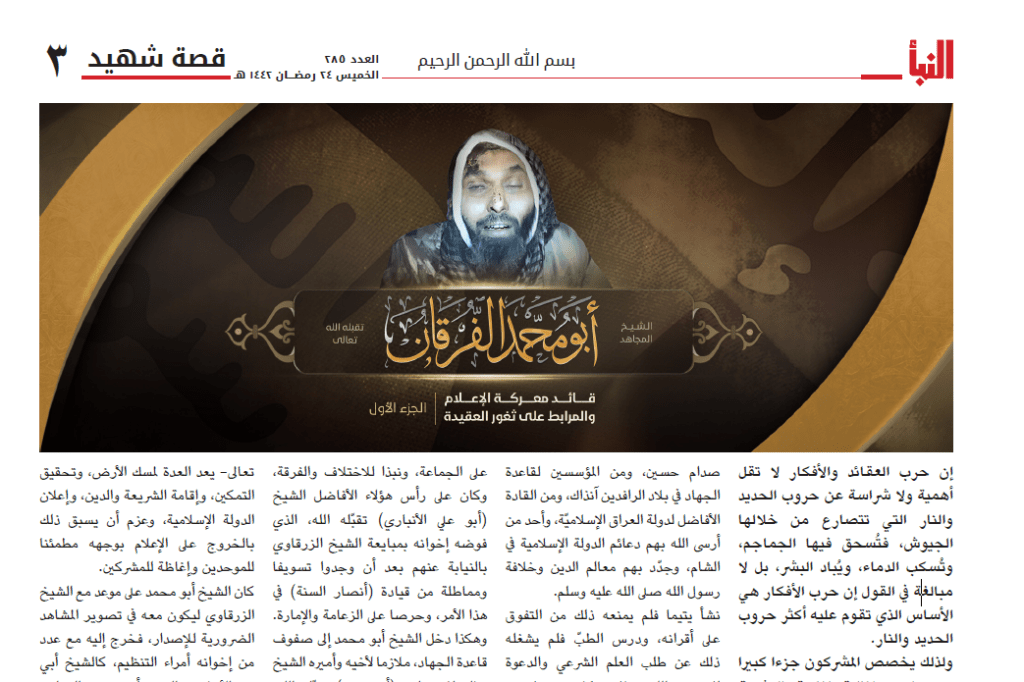
Wael al-Ta’i (Abu Muhammad al-Furqan), Al-Naba 285, p. 3
The 285th edition of Al-Naba, the weekly newsletter of the Islamic State (IS), released on 6 May, had a biography of Abu Muhammad al-Furqan, one of the most important IS leaders, the head of its Central Media Department and its operational ruler when he was killed in September 2016. Continue reading
By Kyle Orton (@KyleWOrton) on 9 March 2019
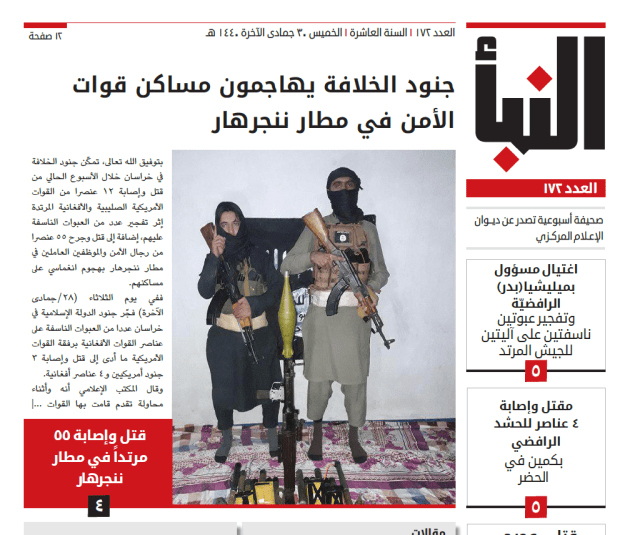
Al-Naba 172 front page
The Islamic State (IS) released the 172nd edition of Al-Naba, its newsletter, on 7 March 2019. Continue reading
By Kyle Orton (@KyleWOrton) on 4 December 2017

The leader of al-Qaeda, Ayman al-Zawahiri, gave a thirty-five-minute speech on 28 November 2017, entitled: “Let Us Fight Them As A Solid Structure” (or “Let Us Fight Them As One Body” or “Let Us Fight Them With Solid Foundations”), dealing with the vexed question of al-Qaeda’s relationship with the Syrian jihadi group, Hay’at Tahrir al-Sham, a situation that escalated again in recent days. The mention of an impending Turkish intervention into Idlib—which began on 7 October—suggests that al-Zawahiri recorded this speech in the last days of September or the first few days of October. An English transcript of the speech was released by As-Sahab Media, and is reproduced below with some edits for syntax and transliteration. Continue reading
By Kyle Orton (@KyleWOrton) on 24 November 2017

Abdul Munim al-Badawi (Abu Hamza al-Muhajir), the “war minister” of the Islamic State of Iraq, the predecessor to ISIS, made a brief five-minute speech on 30 April 2007, entitled “Nada ila Ulema al-Umma” (نِدَاءٌ إِلَى عُلَمَاءِ الأُمَّةِ). “Ulema” refers to Islamic scholars, sometimes translated as “clerics”, a slightly misleading comparison with Christianity, and “umma” refers to the worldwide community of Muslims, so the title of the speech translates as, “An Appeal to the Community’s Scholars”. Al-Badawi’s basic point—made at a time when the Islamic State movement was beginning to suffer under the pressure of the Surge and Sahwa—was to condemn the regional ulema for not supporting, and not having supported, the jihadists in Iraq against the Americans and the Shi’is. Implicitly, Al-Badawi is criticising the ulema for holding back Muslims in regional States who might otherwise have joined the Iraqi jihad as foreign fighters and suicide bombers, potentially making a difference to the Islamic State’s military fortunes. A rough translation of the speech is reproduced below.
By Kyle Orton (@KyleWOrton) on 13 October 2017
The Iraqi Kurdish authorities arrested Mustafa Haji Muhammad Khan (Hassan Ghul) on 23 January 2004. Khan had been dispatched to Iraq by Nashwan Abd al-Baqi (Abd al-Hadi al-Iraqi), one of the key military officials of al-Qaeda “central” (AQC), to function as AQC’s intermediary with Ahmad al-Khalayleh (Abu Musab al-Zarqawi), the founder of the Islamic State movement. Khan replaced Abdallah al-Kurdi, the first envoy sent by Abd al-Baqi. Al-Kurdi had failed to establish any footing to do his job effectively, but Khan, a battle-hardened jihadist from Baluchistan, earned a measure of respect from al-Khalayleh and facilitated a productive conversation between AQC and al-Khalayleh. Al-Khalayleh, possessed of a pathological anti-Shi’ism, wrote a seventeen-page memo to Usama bin Laden explaining his strategy to defeat the Americans by starting a total war between the sects in Iraq. That memo, in digital form, was given to Khan, and Khan had it in his possession when he was captured. A translation of the letter is given below with some interesting sections highlighted in bold.[1] Continue reading
By Kyle Orton (@KyleWOrton) on January 9, 2017
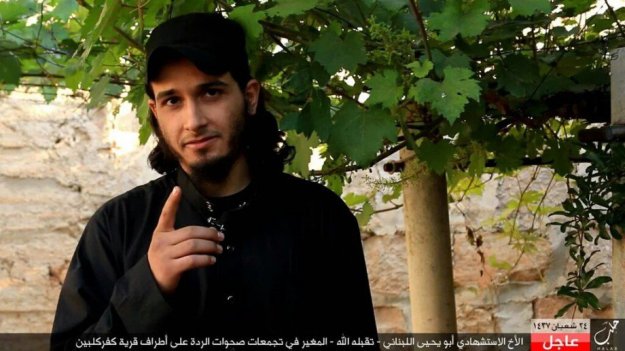
On 6 January 2017, pro-al-Qaeda channels distributed a statement, with the picture above, written by Abu Mahmud al-Filistini.1 Abu Mahmud writes of a young jihadist, Abd al-Rahman, who had, after joining the Islamic State (IS), not been fully seduced by their ideology and had maintained contact with Abu Mahmud. At a certain point, however, Abd al-Rahman accepted IS’s ideology and recently killed himself in a suicide bombing against insurgent forces in Syria. It is not clear whether the insurgents referred to are rebels or Jabhat Fatah al-Sham (JFS), al-Qaeda’s rebranded Syrian branch, which was until recently known as Jabhat al-Nusra. The statement is reproduced below with some minor editions, for the sake of clarity, to transliterations and punctuation. Continue reading
By Kyle Orton (@KyleWOrton) on April 17, 2014
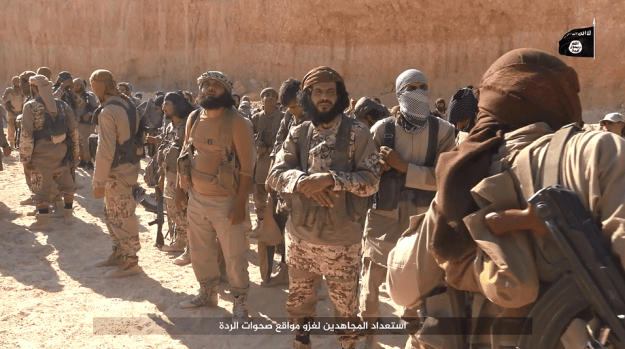
Since the Syrian rebellion went to war with the Islamic State of Iraq and Syria (ISIS) in January, there has been a parallel campaign of political warfare by the rebels and al-Qaeda’s branch in Syria, Jabhat al-Nusra, to delegitimize ISIS. This has often taken the form of referring to ISIS as Kharijites or the Khawarij.
This Khawarij are an ancient sect who broke from the Rashidun (Rightly-Guided) Caliphate in the name of righteous revolt in 658, and continued their campaign against the caliphate—by then in the hands of the Umayyads—for a century and more. Regarded as perhaps the first terrorists in Islamdom (by another definition it would be the Nizaris, a.k.a. “The Assassins”), the connotations of the Khawarij label are extremism and deviance, particularly a tendency to excommunicate (make takfir against) Muslims not only for sins that do not merit excommunication, but simply for reasons of political exclusivism. Continue reading
By Kyle Orton (@KyleWOrton) on April 4, 2014
The spokesman of the Islamic State of Iraq and Syria (ISIS), Abu Muhammad al-Adnani, made a speech on 19 June 2013, a transcript of which is reproduced below. Al-Adnani’s speech was entitled, “Fadharhum wa-ma yaftarun”, variously translated as: “So Leave Them Alone With Their Devising”, “Leave Them Alone with their Fabrications”, and “Ignore Them and Their False Allegations”. Continue reading
 Kyle Orton's Blog