Tag Archives: provocation

Islam’s First Terrorists, Part 6

By Kyle Orton (@KyleWOrton) on August 22, 2015

This is the final part of a six-part series. Read parts one, two, three, four, and five, or read the whole essay.

Masyaf fortress, the headquarters of the Nizari Ismailis (The Assassins) in Syria

Masyaf fortress, the headquarters of the Nizari Ismailis (The Assassins) in Syria

Conclusion

The Nizari Ismailis did not invent assassination, of course; only lent it their name. The Ismailis were “part of a long tradition that goes back to the beginnings of Islam … of popular and emotional cults in sharp contrast with the learned and legal religion of the established order.” Still, the Nizaris did rely on the Holy Law. The ideal of Islamic governance might be authoritarian, but it is not arbitrary; if a ruler crosses the shari’a it becomes a duty to resist. This element became gradually more marginal as the religion formed into a State and Empire, but it was there and many other sects had called on it in their opposition to the prevailing regimes. The Nizaris were the first to call up this tradition of righteous rebellion and combine it with an effective opposition organization.

In their use of conspiracy, assassination, and even the ceremonial nature of the murders and the weapon-cult, the Assassins were hardly unique. But they might well be the first terrorists: those who, at an overwhelming disadvantage in conventional terms, used unconventional means in a planned, long-term campaign of targeted violence as a political weapon with the intention of overturning the established order. Continue reading

Islam’s First Terrorists, Part 3

By Kyle Orton (@KyleWOrton) on August 19, 2015

This is the third of a six-part series. Read parts one and two.

Masyaf fortress, eastern Hama, the headquarters of the Assassins (1141-1270)

Masyaf fortress, eastern Hama, the headquarters of the Assassins (1141-1270)

The death of Hassan-i Sabbah and The Resurrection

Rashid ad-Din Sinan

Rashid ad-Din Sinan

Hassan-i Sabbah, the Nizaris’ first and most successful leader, died in May 1124. Hassan-i Sabbah was a fanatic who sternly imposed the Holy Law—even executing one of his own sons for drinking wine and another son (mistakenly) for an unauthorized assassination. An extreme ascetic and recluse, Hassan-i Sabbah left his house twice in the thirty-five years after taking Alamut. Hassan-i Sabbah’s great skill was in weaponizing the discontents of the dispossessed and refining the doctrine of al-dawa jadida (the new preaching).

Hassan-i Sabbah never claimed to be the Imam, merely the only one who knew what the Imam wanted. Hassan-i Sabbah confirmed the Ismaili doctrine as essentially authoritarian, where the believer must follow an Imam, the only source of truth, who has been appointed by god (unlike the Sunni view where the believer can choose an Imam).

The Nizaris’ history divides into essentially four parts after this: Continue reading

Russia’s Secret Police

By Kyle Orton (@KyleWOrton) on August 1, 20151

Charles Ruud’s and Sergei Stepanov’s Fontanka 16: The Tsar’s Secret Police traces the evolution of political policing in Russia, focusing on the Okhranka, the final incarnation of the secret police before the Russian Revolution in 1917, and along the way puts paid to a whole array of myths about the pre-Bolshevik Russian government, especially as regards the Jewish Question.

The growth of the Russian political police occurred in four major stages. The first phase lasted from the founding of the Russian State by Ivan the Terrible (1533-84) after the expulsion of the Tatars to the opening of the “Third Section” in 1826 as a reaction to the Decembrist revolt the previous year—the first time the Imperial State security services were housed at Fontanka 16 in St. Petersburg—which intended to (and succeeded in, as 1848 would demonstrate) extirpate the liberal spirit that challenged the autocracy. The third phase saw the Third Section become the Department of Police at the onset of a crackdown after the assassination of Alexander II in 1881, who had enacted broad liberal reforms on censorship and serfdom. The elite secret police force grew out of the palace guard, becoming known as the Okhranka (though this is more usually rendered in English as Okhrana). The final phase began in 1906, after the 1905 revolution, when the Okhranka worked to stop a liberal-radical coalition building. Continue reading

Does Iran Support The Islamic State?

By Kyle Orton (@KyleWOrton) on May 26, 2015

Qassem Suleimani, Iran's spymaster, believed in some MidEast conspiracy theories to control ISIS

Qassem Suleimani, Iran’s spymaster, believed in some Mid-East conspiracy theories to control ISIS

In 2010, Farzad Farhangian, an Iranian diplomat based in Belgium, defected to Norway. Farhangian has now emerged with the extraordinary accusation that the Islamic Republic of Iran is controlling the Islamic State (ISIS) and using it as part of Tehran’s war against the Gulf States, especially Saudi Arabia. Farhangian’s accusations are lurid and (literally) incredible, but the question of Iran’s role in ISIS’ creation and growth, and Iran’s manipulation of ISIS to further its own ends, is one well worth asking. Continue reading

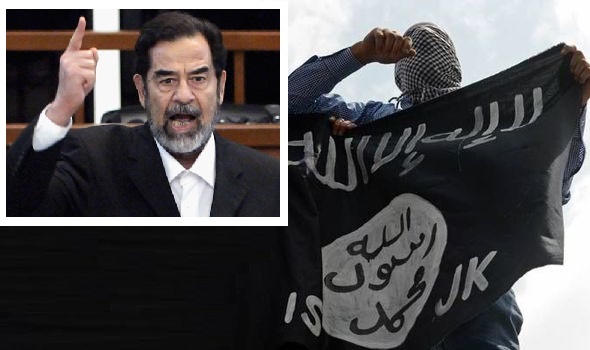
Saddam Hussein’s Regime Produced The Islamic State

By Kyle Orton (@KyleWOrton) on April 21, 2015

1

Having presented the evidence that Saddam Hussein Islamized his foreign policy and then Islamized his regime, above all with the Islamic Faith Campaign, beginning in June 1993 that tried to fuse Ba’athism with Salafism, encouraging (and keeping under surveillance) a religious revival in Iraq that redounded to the benefit of the regime’s legitimacy and support, I wanted to look at what this history means for Iraq and the wider region now.

I pointed out in October that the “military strength” of the Islamic State (ISIS) “comes from the remnants of Saddam Hussein’s military-intelligence apparatus and the Caucasus’ Salafi-jihadists.” Continue reading

Who Killed The Anti-Assad Imam In London?

By Kyle Orton (@KyleWOrton) on April 9, 2015

Abdul Hadi Arwani

Abdul Hadi Arwani

Abdul Hadi Arwani, a Syrian-born imam, was found shot dead in his car on Tuesday in Wembley, northwest London. The British police are still refusing to officially name Arwani, but his friends and supporters have done so. Arwani leaves behind six children.

There are many possibilities for who killed Arwani. As the manager of a construction firm, it could be a deal gone wrong. The involvement of anti-terrorism police in the investigation into Arwani’s murder could indicate a far-Right anti-Muslim assailant. However, a source close to the investigation said that Arwani was struck down in an operation that had all the hallmarks of a “State-sponsored assassination“. To find that the long arm of Bashar al-Assad’s mukhabarat had caught up with Arwani would hardly be a surprise. Continue reading

The Local And Regional Implications From The Fall Of Idlib

By Kyle Orton (@KyleWOrton) on March 31, 2015

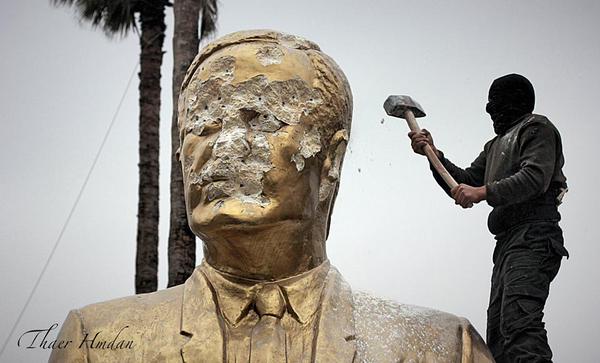
Statue of Hafez al-Assad defaced after Idlib City falls, March 29, 2015

Statue of Hafez al-Assad defaced after Idlib City falls, March 29, 2015

After an insurgent offensive began on March 24, Idlib City fell on March 29, making it only the second—of Syria’s fourteen—provincial capitals to slip from the control of Bashar al-Assad’s regime, the last one being Raqqa City on March 4, 2013. The regime has been on borrowed time in Idlib City since Wadi al-Deif to the south, near Maarat an-Numan, fell in mid-December.

In a scene reminiscent of Raqqa—and indeed the fall of Baghdad—a statue of Hafez al-Assad was destroyed. The insurgents broke open some secret prisons, while finding that in a final act of needless cruelty the regime had murdered other prisoners in the cells before retreating.

An operations room, Jaysh al-Fatah (Army of Conquest), organised this offensive, and is composed of: Faylaq a-Sham (Sham Legion), Liwa al-Haq, Ajnad a-Sham, Jaysh al-Sunna, Ahrar a-Sham, Jund al-Aqsa (JAA), and al-Qaeda’s Syrian branch, Jabhat an-Nusra. Continue reading

Defeat Jihadists in Syria by Being a Better Ally to the Opposition

By Kyle Orton (@KyleWOrton) on March 25, 2015

A still  from the video announcing the Ahrar a-Sham-Suqour a-Sham merger

A still from the video announcing the Ahrar a-Sham-Suqour a-Sham merger

Ahrar a-Sham “merged with“—in reality annexed—Suqour a-Sham on March 22. Ahrar’s leader, Hashem al-Sheikh (a.k.a. Abu Jabbar), is the leader of the Ahrar-Suqour formation, and Suqour’s leader, Ahmed Issa al-Sheikh (a.k.a. Abu Issa) is his deputy. Ahrar is the largest and most hardline Syrian insurgent group in Syria, and Suqour has a fairly stern Salafi-nationalist ideology—at least at its leadership level—and was once the largest rebel group in Idlib Province.

The first thing this brought to mind was Sam Heller’s witticism late last year: “the most successful, lasting approach to rebel unification so far has basically been ‘Ahrar al-Sham absorbs you’.” Continue reading

ISIS: America’s Alliance with Iran is Hampering the Fight Against Terror

By Kyle Orton (@KyleWOrton) on February 7, 20151

Published at Left Foot Forward

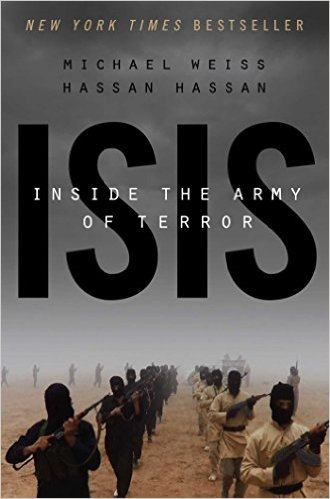
Book Review: ISIS: Inside the Army of Terror (2015) Michael Weiss and Hassan Hassan

ISIS: Inside the Army of Terror, by Michael Weiss and Hassan Hassan, is brilliantly easy to read. Concise yet thorough the book charts the history of a group, “[a]t once sensationalized and underestimated,” that is simultaneously a terrorist organisation, mafia, conventional army, sophisticated intelligence-gathering apparatus, propaganda machine and the remnants of the Saddam Hussein regime which controls an area the size of Britain in the heart of the Middle East. Continue reading

The Long History of Middle Eastern State-Terrorism In Paris

By Kyle Orton (@KyleWOrton) on January 19, 2015

Said Kouachi and Cherif Kouachi

Last week, Lee Smith wrote of the reasons that it was likely that there was a foreign hand, quite probably that of a State, in the attack on Charlie Hebdo and the Jewish deli in Paris. Smith noted that the French believe that the funding and weapons for the attacks came from abroad. Smith pointed to the historical record, in which terrorism in Paris is typically not carried out because of religion—or not directly: it might come from States that see themselves as god’s representatives on earth—or community grievances, but “because you’re getting paid to stage an operation on behalf of a particular cause or regime.” Smith gave three cases, and they seemed worth expanding on. Continue reading