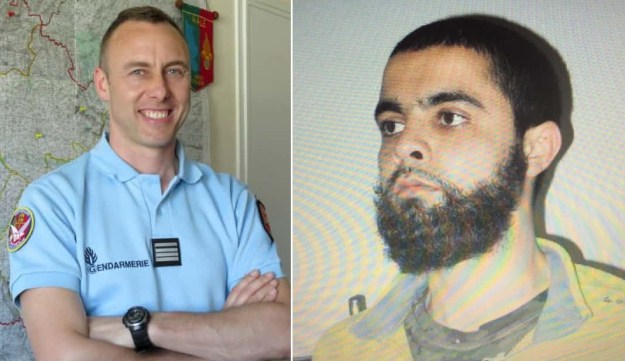
In Trebes, a small town of 5,000 people in southern France near Carcassonne, at 11 a.m. on 23 March 2018, a 25-year-old Moroccan-born man, Radouane Lakdim, walked into a “Super U” supermarket and opened fire, killing two people immediately, an attendant and a customer.
An hour earlier, Lakdim had hijacked a car on the outskirts of Carcassonne, killing the passenger by shooting him to death and seriously wounding the driver.
Lakdim then drove five miles to Trebes, appeared to stop outside a military barracks, before stopping outside a riot police centre and shooting at a group of four officers from 200 yards away, seriously injuring one. Continue reading →
The latest edition of the Islamic State’s newsletter, Al-Naba 108, released on 1 December 2017, has a profile on page 7 of a fighter named Abu Sulayman al-Libi, a Libyan jihadist who came to Syria soon after the caliphate declaration in June 2014 and became the senior religious official in Homs. Abu Sulayman was killed in the fighting between IS and the pro-Asad coalition in the deserts of eastern Homs Province, near the T3 oil pumping station. This probably means Abu Sulayman was killed in the last days of September or the first few days of October during the IS counter-attack to the regime coalition’s push into Deir Ezzor. A rough translation of the Naba obituary is published below. Continue reading →
Abdul Munim al-Badawi (Abu Hamza al-Muhajir), the “war minister” of the Islamic State of Iraq, the predecessor to ISIS, made a brief five-minute speech on 30 April 2007, entitled “Nada ila Ulema al-Umma” (نِدَاءٌ إِلَى عُلَمَاءِ الأُمَّةِ). “Ulema” refers to Islamic scholars, sometimes translated as “clerics”, a slightly misleading comparison with Christianity, and “umma” refers to the worldwide community of Muslims, so the title of the speech translates as, “An Appeal to the Community’s Scholars”. Al-Badawi’s basic point—made at a time when the Islamic State movement was beginning to suffer under the pressure of the Surge and Sahwa—was to condemn the regional ulema for not supporting, and not having supported, the jihadists in Iraq against the Americans and the Shi’is. Implicitly, Al-Badawi is criticising the ulema for holding back Muslims in regional States who might otherwise have joined the Iraqi jihad as foreign fighters and suicide bombers, potentially making a difference to the Islamic State’s military fortunes. A rough translation of the speech is reproduced below.
Abdallah al-Muhaysini and Muslah al-Alyani, two senior clerics in Hay’at Tahrir al-Sham (HTS), the former al-Qaeda branch in Syria, resigned on 11 September 2017 after leaked recordings showed HTS commanders musing about assassinating al-Muhaysini. There is clearly a well-orchestrated campaign underway to weaken HTS by discrediting and dividing it, and the sophistication of the campaign gives every indication of being the work of a state intelligence service, almost certainly Turkey’s. Continue reading →
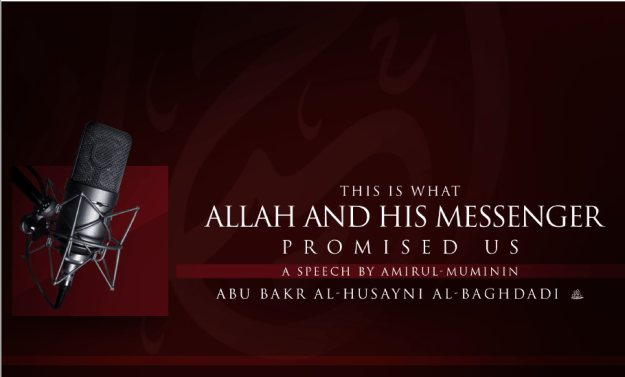
On 2 November 2016, a speech by the leader of the Islamic State, Ibrahim al-Badri (Abu Bakr al-Baghdadi), was released, entitled, “This Is What Allah and His Messenger Promised Us”. On 11 November, the third edition of IS’s English-language magazine, Rumiya, printed a transcript of the speech, which is reproduced below with some editions in transliteration, explanations added in square brackets, and notable or important sections shown in bold.Continue reading →
Taha Falaha (Abu Muhammad al-Adnani) is the governor Islamic State-held territory in Syria and oversees the foreign attacks, a roster of duties which indicates that Falaha so powerful that he is effectively the caliph’s deputy after the demise of Abd al-Rahman al-Qaduli (Abu Ali al-Anbari) in March. Falaha is also IS’s official spokesman, and on 21 May 2016 he gave a very significant speech entitled, “That They Live By Proof”. The speech, released by Al-Hayat Media Centre, is reproduced below with some minor alterations in transliteration, some important sections highlighted in bold, and some notes added for explanation.
Falaha made three major points. First, Falaha was especially adamant that territorial control by IS should not be considered a measure of IS’s success: it lost all urban holdings and went into the deserts last time, after the strategic defeat in 2008, but it held to its cause and America withdrew, and this ideological cohesiveness and determination led it to be more powerful than ever within five years. Second, Falaha made use of the savage conduct of the coalition made up of the Assad regime, Iran, and Russia—and the Western indifference to same—to argue for Sunnis to see IS as a protective barrier against such sectarian foes. And, third, Falaha called for foreign attacks by Western Muslims, saying that if IS’s loyalists were unable to journey to IS-held areas this should not be considered a problem since attacks in the West are “more beloved to [IS] than the biggest act done [within the caliphate]”. Continue reading →
This essay, written to tie together my work on the relationship between the Saddam Hussein regime and the Islamic State, was completed last summer and submitted to an outlet, where it entered a form of development hell. After giving up on that option late last year, the opportunity arose to get a shorter version published in The New York Times in December. But I procrastinated too long over what to do with the full essay and a recent change in my work situation means I no longer have the bandwidth to go through the process of finding it a new home, so here it is.
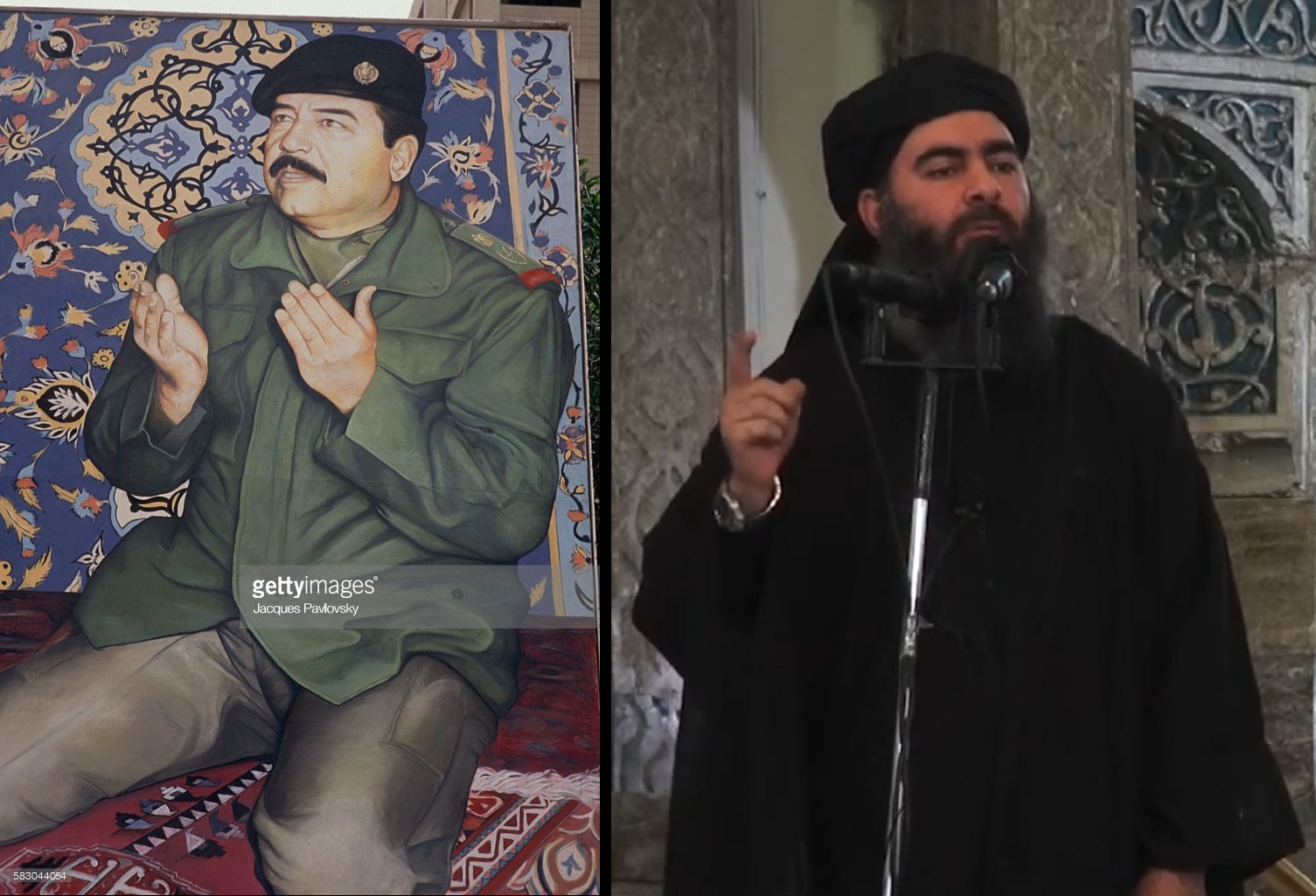
“Abu-Bakr al Baghdadi is a product of the last decade of Saddam’s reign,” argues Amatzia Baram, a scholar of Iraq. He is correct in at least three ways. First, in its last decade in power, the Iraqi Ba’ath regime transformed into an Islamist government, cultivating a more religious, sectarian population on which the Islamic State (ISIS) could draw. Part of Saddam Hussein’s “Faith Campaign” also involved outreach to Islamist terrorists, including al-Qaeda, which meant that the synthesis of Ba’athism and Salafism that fused into the Iraqi insurgency after the fall of Saddam was already well advanced by the time the Anglo-American forces arrived in Baghdad in 2003. Second, the ISIS leadership and military planning and logistics is substantially reliant on the intellectual capital grown in the military and intelligence services of the Saddam regime. And finally, the smuggling networks on which ISIS relies, among the tribes and across the borders of Iraq’s neighbours, for the movement of men and materiel, are directly inherited from the networks erected by the Saddam regime in its closing decade to evade the sanctions. The advantages of being the successor to the Saddam regime make ISIS a more formidable challenge than previous Salafi-jihadist groups, and one that is likely to be with us for some time.
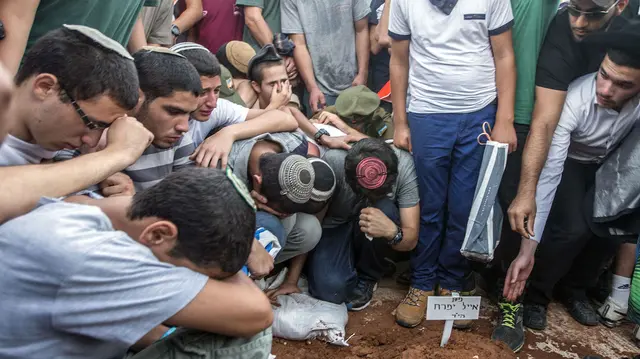
Another grisly week in the Holy Land. On Monday, three Jewish teenagers—Eyal Yifrach, Naftali Frankel, and Gilad Shaar—who had been kidnapped three weeks ago were found murdered on the West Bank. The studious attention to not releasing details suggests that something horrific was done. As they were being laid to rest on Wednesday, a Palestinian boy, Mohamed Abu Khudeir, either 16 or 17, was kidnapped in a revenge-attack, and burned alive.
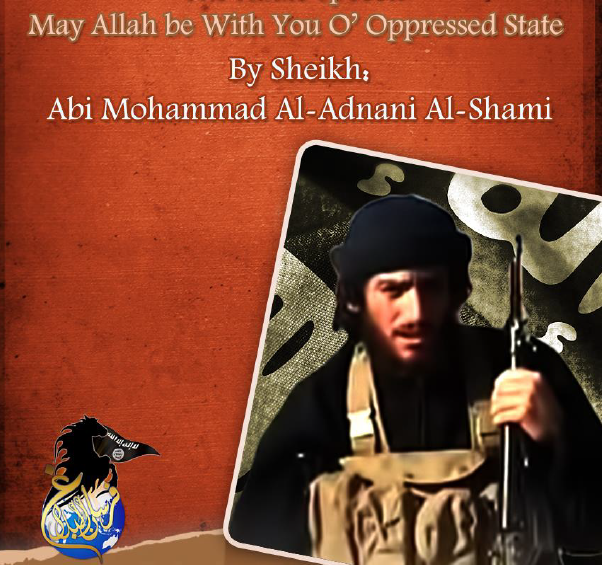
The spokesman for the Islamic State of Iraq and Syria (ISIS), Abu Muhammad al-Adnani, gave a speech on 30 September 2013, entitled, “Lak Allah Ayatuha al-Dawla al-Mazluma” (لك الله أيتها الدولة المظلومة), roughly: “God Is With You, O’ Oppressed State” (The English translation released by Fursan al-Balagh Media gives the title as, “May Allah Be With You, O’ Oppressed State”.) The speech is primarily a ferocious attack on the Syrian rebel groups, accusing them of being part of a Western-led conspiracy, which includes the media stations of Arab governments and their “mouthpieces” throughout the region, to manipulate the coverage of ISIS such that it blackens their name and turns Muslims away from them.



 Kyle Orton's Blog