Tag Archives: Saudi Arabia

Why Was There Ever An American Occupation of Iraq?

By Kyle Orton (@KyleWOrton) on 22 December 2019

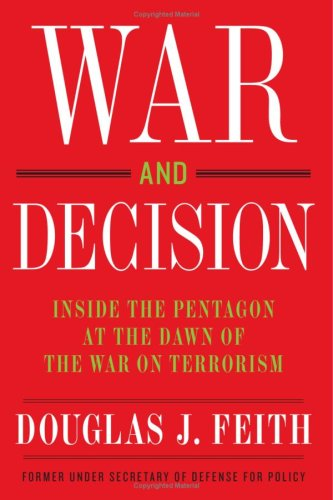
Douglas Feith was the U.S. Under Secretary of Defense for Policy from 2001 to 2005, one of the most senior positions at the Pentagon during one of the most consequential periods in recent history, covering the 11 September 2001 atrocities and early phase of the U.S.-led response. Feith later wrote a highly illuminating memoir, War and Decision: Inside the Pentagon at the Dawn of the War on Terrorism, which tried to drain some of the hysteria out of the public “debate” about the Iraq dimension of the U.S. policy in particular by explaining the internal arguments in the Bush administration leading up to the decision to finish with Saddam Husayn in 2003, and trying to set those arguments in their proper historical context, both in relation to Iraq—where “the war” had begun twelve years earlier—and the altered American threat perceptions in the shadow of 9/11. Unlike a lot of the gossipy tomes that emerged from former officials, Feith’s book is notably light on opinion and contains reams of declassified documents so readers can check his analysis against the source material. One of Feith’s key judgments is that “the chief mistake was maintaining an occupation government in Iraq for over a year”.[1] As Feith explains in great detail in the book, this was never supposed to happen. So how did it?

Continue reading

Trump’s Middle East Failure Was Made By Obama

By Kyle Orton (@KyleWOrton) on 19 November 2019

President Barack Obama meeting President-elect Donald Trump, 10 November 2016 [image source]

October 2019 may well remain in the popular memory as the inflection point marking the collapse of America’s — and by extension, the West’s — position in at least the northern Middle East. Having been thwarted twice before in efforts to leave Syria, in March and December 2018, President Donald Trump made one more try. For many, ‘Trump betrayed the Kurds’ will be the summary of the events that followed as Turkey made a swift move into the vacuum. The reality is a lot more complicated, and in truth the amount of blame that Trump can take for the events of the last month is rather limited. This catastrophe was baked into the policy of Barack Obama, and Trump’s main fault is to have followed the policy track laid down by his predecessor. Continue reading

The Memoir of a British Spy in Al-Qaeda

By Kyle Orton (@KyleWOrton) on 8 July 2019

This article was originally published at the European Eye on Radicalization

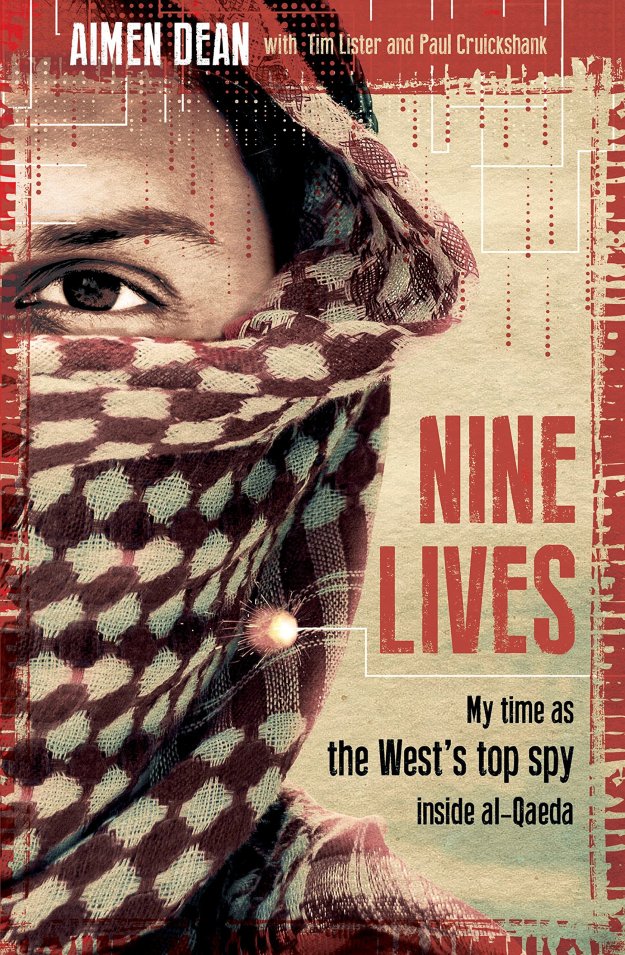
The main issue that Nine Lives has to overcome is the one that has attended Aimen Dean (a pseudonym) since he went public in March 2015 with an interview he gave to the BBC, claiming he had been a British spy within Al-Qaeda between 1998 and 2006. That issue is overcoming the doubts about his story. Nine Lives goes a long way to solving this by bringing in Paul Cruickshank, the editor-in-chief of CTC Sentinel, one of the premier academic resources in the terrorism field, and Tim Lister, a terrorism-focused journalist with CNN, as co-authors. As well as helping structure the book from Dean’s memories, the two co-authors note they had been able to “corroborate key details” that convinced them: “In the years immediately leading up to and following 9/11, Aimen Dean was by far the most important spy the West had inside al-Qaeda”.

Continue reading

America Isn’t Going To War With Iran

By Kyle Orton (@KyleWOrton) on 10 May 2019

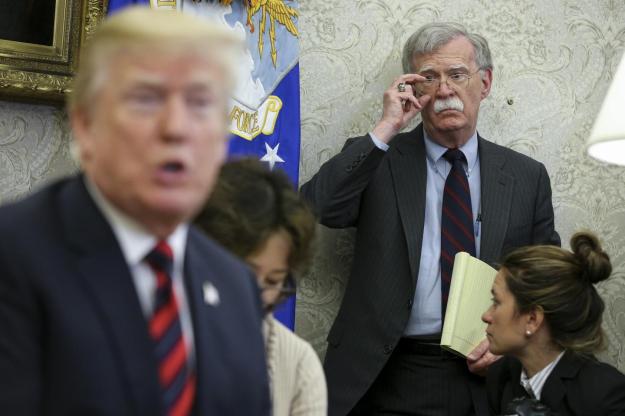
President Donald Trump speaks as John Bolton stands by in the Oval Office, 22 May 2018. OLIVER CONTRERAS-POOL/GETTY IMAGES

As tensions flared between the United States and Iran over the last ten days, a number of Washington’s Western allies have signalled their distance from the U.S. view, most dramatically in the case of Major-General Chris Ghika, Britain’s top commander in the coalition against the Islamic State (ISIS), who dismissed the U.S. intelligence assessment of an increased threat from Iran. This has since been walked back, but the fissures in the Western alliance over how to deal with Iran are real, and this has been compounded by differences within the U.S. government and the highly irregular nature of the Donald Trump administration, particularly its decision-making processes and public messaging. Continue reading

Islamic State Profiles the Leadership

By Kyle Orton (@KyleWOrton) on 6 April 2019

Islamic State flag in front of the main gate of Saddam Husayn’s palace in Tikrit, 5 April 2015 // AFP PHOTO / MOHAMMED SAWAF

A lengthy document—roughly sixty pages and 12,000 words—was published online on 21 February 2019 containing biographies of twenty-seven senior Islamic State (IS) officials, past and more recent. Those bios that are dated were written between October 2018 and the time of publication, with one exception that was written in the summer of 2018. The author claims to be an IS veteran. While longevity is difficult to prove, the fact that the author provides heretofore unseen images of some of the IS leaders suggests that at a minimum he is an IS operative. Continue reading

The Shah, the Cold War, and the Islamists

By Kyle Orton (@KyleWOrton) on 20 March 2019

Abbas Milani’s The Shah gives a portrait of Iran’s last monarch, Muhammad Reza Pahlavi, and the impact that his downfall forty years ago continues to have in the Middle East, notably the emboldening of the Islamist movement. Continue reading

Islamic State Newsletter Celebrates Guerrilla Campaign, Attacks Saudi Arabia as ‘Stalinist’

By Kyle Orton (@KyleWOrton) on 16 February 2019

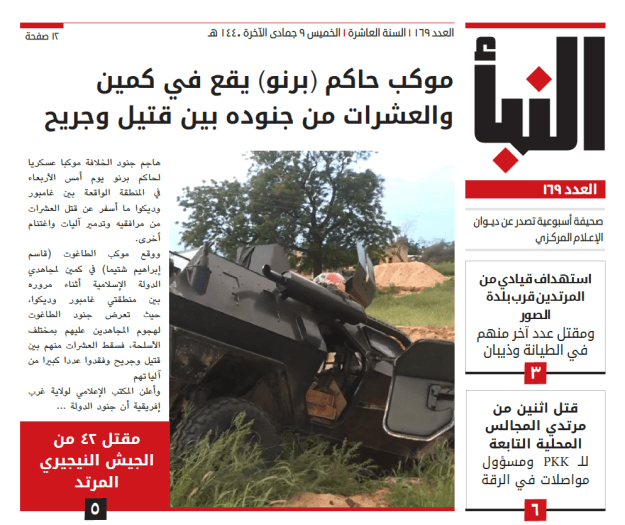
Front page Al-Naba 169

The Islamic State (IS) released the 169th edition of its newsletter, Al-Naba, on 14 February 2019. Al-Naba 169 leads with the attack on the governor of Borno in Nigeria by IS’s branch in that country. In terms of volume, much of the focus remains on the guerrilla campaign in Iraq and Syria, though there is an item on the last stand of the caliphate in Baghuz, the final village in eastern Syria. IS highlights its clashes with al-Qaeda in Yemen. There is a profile of a Russian-speaking atheist-turned-jihadist who was killed in Egypt. And perhaps most notable is an essay on Saudi Arabia, where IS has a terrorist infrastructure that is instructed to be patient. It is a question that likely is unanswerable until it is too late how strong IS is in Saudi Arabia. Continue reading

The Folly of Trying to Buy Assad’s Loyalty From Iran

By Kyle Orton (@KyleWOrton) on 5 February 2019

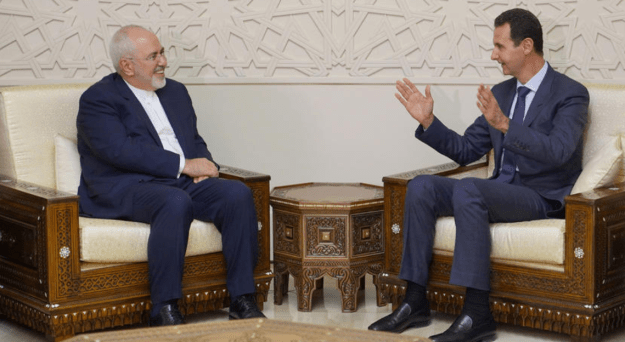
Bashar al-Assad meeting Iranian Foreign Minister Mohammad Javad Zarif, Damascus, Syria, 3 September 2018 // SANA handout to REUTERS

The Syrian regime of Bashar al Assad has nearly collapsed twice under pressure from the armed insurrection, in late 2012 and early 2015. On both occasions, Assad was rescued by outside powers, first Iran and then a joint Iranian-Russian operation. It has been a recurring illusion that there is or will be, a strategic split between Russia and Iran. This prospect has continued to tantalise the US and others, and occasional Moscow-Tehran disagreements are presented as evidence that dynamics are shifting this way. Another round of such speculation is currently underway. Continue reading

Israel Returns to Africa

Published at The Arab Weekly

By Kyle Orton (@KyleWOrton) on 27 January 2019

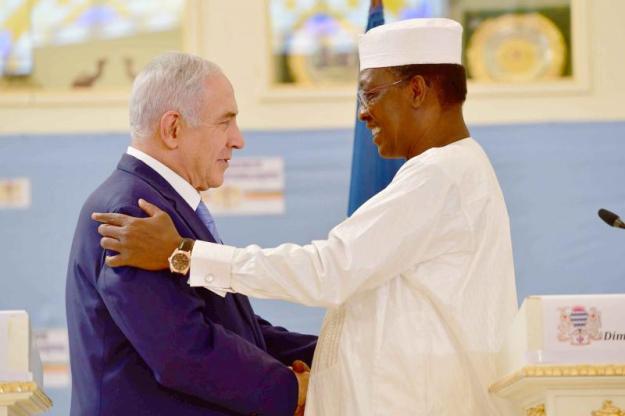
Israeli Prime Minister Binyamin Netanyahu and Chadian President Idriss Deby meeting in N’Djamena, 20 January 2019 [AFP]

Diplomatic relations between Israel and Chad have been restored after a half century of separation. This was a symbolic breakthrough with a Muslim-majority African country, albeit one in the works for some time. It is an illumination of Israel’s changed geopolitical circumstances, some aspects sustainable, some more wishful and illusory.
Continue reading

IHH, Al-Qaeda, and Turkey

By Kyle Orton (@KyleWOrton) on 26 January 2019

Mavi Marmara arrives at Sarayburnu port as people wave Turkish and Palestinian flags, 26 December 2010 [source]

An article posted on the website of IHH Humanitarian Relief Foundation on 14 July 2006 told of a massive funeral ceremony in Istanbul for Shamil Basayev, an al-Qaeda-linked Chechen jihadist. The original article has been removed, though a cached version is currently available. To avoid this being lost, the article is reproduced below. Before that is a brief outline of the context. Continue reading