By Kyle Orton (@KyleWOrton) on November 25, 2015
Today, my first report with The Henry Jackson Society was published: “Destroying Islamic State, Defeating Assad: A Strategy for Syria“. Continue reading
By Kyle Orton (@KyleWOrton) on November 25, 2015
Today, my first report with The Henry Jackson Society was published: “Destroying Islamic State, Defeating Assad: A Strategy for Syria“. Continue reading
By Kyle Orton (@KyleWOrton) on October 20, 2015
Published at NOW Lebanon.

The Pentagon-run train-and-equip (T&E) program had intended to take Syrian rebels, stop them from being rebels by preventing them from fighting the Assad regime, and repurpose them into an American-directed strike force against the Islamic State (ISIS). Unsurprisingly, there were few takers and the program ended in disaster and humiliation. In the wake of this failure, President Barack Obama has turned away from the Arab rebels and looked to the Syrian Kurds to fight ISIS. This is a strategy that is not only doomed to fail—since Sunni Arabs taking responsibility for their local security is the only way to sustainably defeat ISIS—but would, if implemented, make the ISIS problem worse. A report from Amnesty International this week documenting crimes, including ethnic cleansing, by the armed Kurdish forces against Arabs and Turkmens in northern Syria also provides an occasion to look more closely at a force with a history of regime collaboration, political extremism, and terrorism. Continue reading
By Kyle Orton (@KyleWOrton) on October 4, 2015

In the last few days I’ve written about Russia’s initial military action in Syria, which is intended to prop up the dictatorship of Bashar al-Assad, and explained (with my friend James Snell) how U.S. policy has enabled this, both by effectively outsourcing Middle East policy to Vladimir Putin over the chemical weapons “red line” debacle, and by the pro-Iran tilt that is implicit in President Obama’s nuclear deal-facilitated move toward détente with the Islamic Republic: Obama is effectively supporting Iran’s assets in Syria, and Putin is now using those same pieces to prosecute his own war in the Levant. With this in the background, this post will focus on what Putin wants in Syria.
Putin’s aims in Syria can be boiled down to two: (1) Ensure the Assad tyranny survives, which includes the building of a permanent military-colonial outpost on the Mediterranean coast and destroying all the moderate rebels so that Syria can be presented as a choice of Assad or the Islamic State (I.S.), legitimizing Russia’s support for Assad; and (2) humiliating the West on the way to constructing an alternate world order to American hegemony. Continue reading
By Kyle Orton (@KyleWOrton) on August 30, 2015
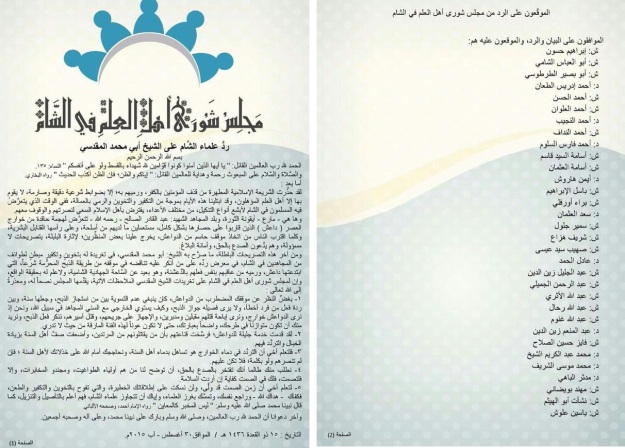
A council of ulema (clerics), some within Syria and some abroad, al-Majlis Shura Ahl al-ilm fil-Sham (Advisory Council of the People of Knowledge in Syria), was formed late last month. Its first statement was to condemn the 25 July assassination of the Faylaq al-Sham commander Mazin al-Qassum by Islamic State (IS) operatives with Jund al-Aqsa, and to demand that all groups clarify their stance on IS and expel IS agents and sympathizers from their ranks. A fatwa early this month said it was permissible to work with Turkey against IS and the Kurdistan Workers’ Party (PKK), which in Syria operates politically under the name of the Democratic Union Party (PYD) and militarily as the People’s Protection Units (YPG).
Among the leading names associated with this new council are three foreign Islamist scholars: Umar al-Hadouchi, a Moroccan jihadi-salafist; Muhammad al-Hassan Ould al-Dedew al-Shinqiti (not to be confused with Abu al-Mundhir al-Shinqiti), a Mauritanian more closely aligned with Sururism than outright jihadism; and Abdallah al-Muhaysini, a Saudi jihadist who is inside Syria and a member of al-Qaeda in everything but name. Prominent Syrians involved include Dr. Ayman al-Harush, associated with Ahrar al-Sham, and another Ahrar member, a shar’i, Mohamed Ayman Aboul-Tout (Abu Abbas al-Shami), who fought against the Assad regime during the revolt in the 1980s as part of the most extreme Islamist splinter from the Muslim Brotherhood, the Fighting Vanguard. There is also the son of Abd al-Karim, an important figure in the Hama branch of the Muslim Brotherhood, Sa’ad al-Uthman; a follower of the ideas of Muhammad Surur that mix Salafism with political agitation, Ahmad al-Salum, and many others.
Majlis Shura Ahl al-ilm fil-Sham put out a statement today, “Response of the Ulema of Sham to Shaykh Abu Muhammad al-Maqdisi”. Al-Maqdisi’s real name is Issam al-Barqawi; he is based in Jordan and is the most influential jihadi-salafist cleric. The Council attacks al-Maqdisi for what they perceive as his softness toward IS. The statement, translated by @nasrshahada, is reproduced below. Continue reading
By Kyle Orton (@KyleWOrton) on August 14, 2015

In the last week, two events have provided further evidence that the United States has effectively sided with the Assad regime in Syria, acting effectively as the regime’s air force, and that America’s alliance with Assad is part of the broader policy of détente with Iran, facilitated by the nuclear deal, which has ceded Syria to Iran as a sphere of influence. Continue reading
By Kyle Orton (@KyleWOrton) on August 4, 2015
Just over a week ago, a new clerical body was formed, al-Majlis Shura Ahl al-ilm fil-Sham (Advisory Council of the People of Knowledge in Syria), which includes Islamists from within Syria and from outside. Among the notable foreigners are Umar al-Hadouchi, a Moroccan jihadi-salafist, and Muhammad Ould al-Dedew, a Mauritanian who is more in line with the Sururis. There is also Abdallah al-Muhaysini, the Saudi jihadi cleric who is very close to al-Qaeda’s leadership inside Syria. From among Syrians, there are two Ahrar al-Sham notables, Dr. Ayman al-Harush and Mohamed Ayman Aboul-Tout (Abu Abbas al-Shami); Sa’ad al-Uthman, the son of Abd al-Karim, a major figure in the Hama wing of the Syrian Muslim Brotherhood, and Ahmad al-Salum, a Sururi (an activist/political Salafi).
The Council’s first statement condemned the 25 July assassination of the Faylaq al-Sham commander Mazin al-Qassum by Islamic State (IS) operatives with Jund al-Aqsa, and demanded that all groups clarify their stance on IS and cleanse their ranks of IS agents and sympathizers. Today’s fatwa, “Concerning cooperation and coordination with the Turks in repelling Daesh and the PKK,” licensed Muslims to work with the Turkish government against IS and the PKK. The fatwa is reproduced below. Continue reading
By Kyle Orton (@KyleWOrton) on July 28, 2015
A version of this article was published at NOW Lebanon
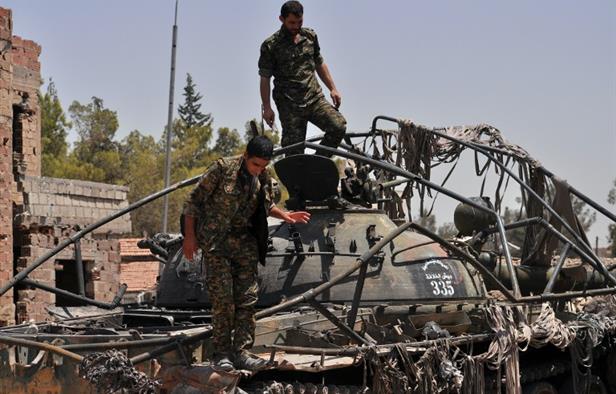
After years of threatening, Turkey directly intervened in Syria on Friday, launching airstrikes against the Islamic State (ISIS), and finally allowed the U.S. to use Incirlik for jet and drone attacks against ISIS. Concurrently, Turkey launched airstrikes into Iraqi Kurdistan against the Kurdistan Workers’ Party (PKK). Ankara is framing this as an equal-opportunities war on terrorists, but Turkey’s actions over the last four years in Syria give a lot of cause for wonder as to which side Ankara is on when it comes to terrorism. Continue reading
By Kyle Orton (@KyleWOrton) on June 13, 2015
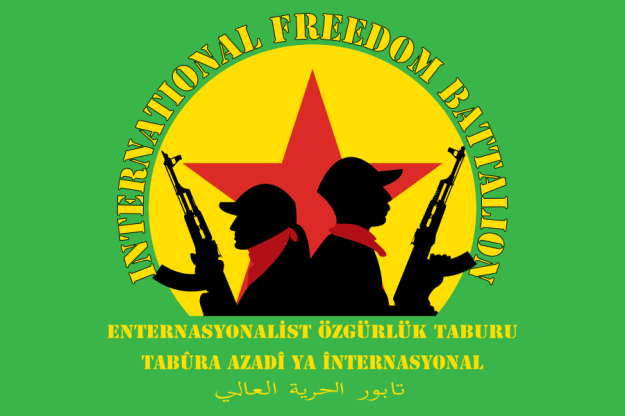
Logo of the Internationalist Freedom Battalion or Enternasyonalist Ozgurluk Taburu (EOT)
The Kurdish People’s Protection Forces (YPG), the Syrian branch of the Kurdistan Workers’ Party (PKK), has been in receipt of a flow of non-Kurdish, mostly-Western foreign fighters for approximately a year. These volunteers had gathered in informal groupings such as the “Lions of Rojava,” a primarily English-speaking unit of non-ideological ex-military men. The recruitment pattern of the YPG has begun to shift, however, and the stream of foreign fighters to “Rojava,” as the YPG calls the areas it rules, has become increasingly ideological. In January, a process was begun to create a unified structure—or at least a brand—for the disparate foreign groups and individuals in Rojava. This effort concluded two days ago with the formation of the International Freedom Battalion (EOT).
Continue reading
By Kyle Orton (@KyleWOrton) on June 9, 2015
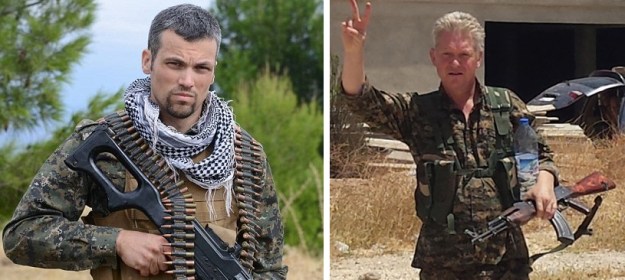
Jordan Matson, Michael Enright
Jordan Matson, an American fighting in the ranks of the People’s Protection Units (YPG), the Syrian wing of the Kurdistan Workers’ Party (PKK), posted a message to Facebook on 4 June 2015 about Michael Enright, a British YPG fighter who had been living in America and working as an actor. Matson says that Enright is “mentally unstable,” had come to Syria to sell his story and write a movie script, and had been disarmed and isolated by the YPG already because of the worry that he would harm himself or be harmed by others. Matson’s message is posted below with typos and “text speak” corrected. Continue reading
By Kyle Orton (@KyleWOrton) on February 10, 2015

This is the fourth of a four-part series looking at the United States’ increasingly-evident de facto alliance with Iran in the region. The first part looked at the way this policy has developed since President Obama took office and how it has been applied in Iraq; the second part looked at the policy’s application in Syria; the third part looked at its application in Lebanon, Afghanistan, and Yemen; and this part is a conclusion. Continue reading
 Kyle Orton's Blog