By Kyle Orton (@KyleWOrton) on 4 October 2025
By Kyle Orton (@KyleWOrton) on 4 October 2025
By Kyle Orton (@KyleWOrton) on 25 October 2020
The spokesman of the Islamic State (IS), Abu Hamza al-Qurayshi, released his fourth speech since his appointment a year ago on 18 October 2020, entitled, “So Relate the Stories That Perhaps They Will Give Thought”. Continue reading
By Kyle Orton (@KyleWOrton) on 20 September 2020
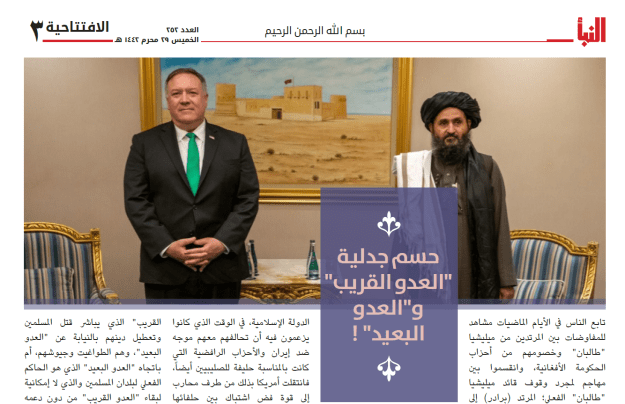
Al-Naba 252, page 3
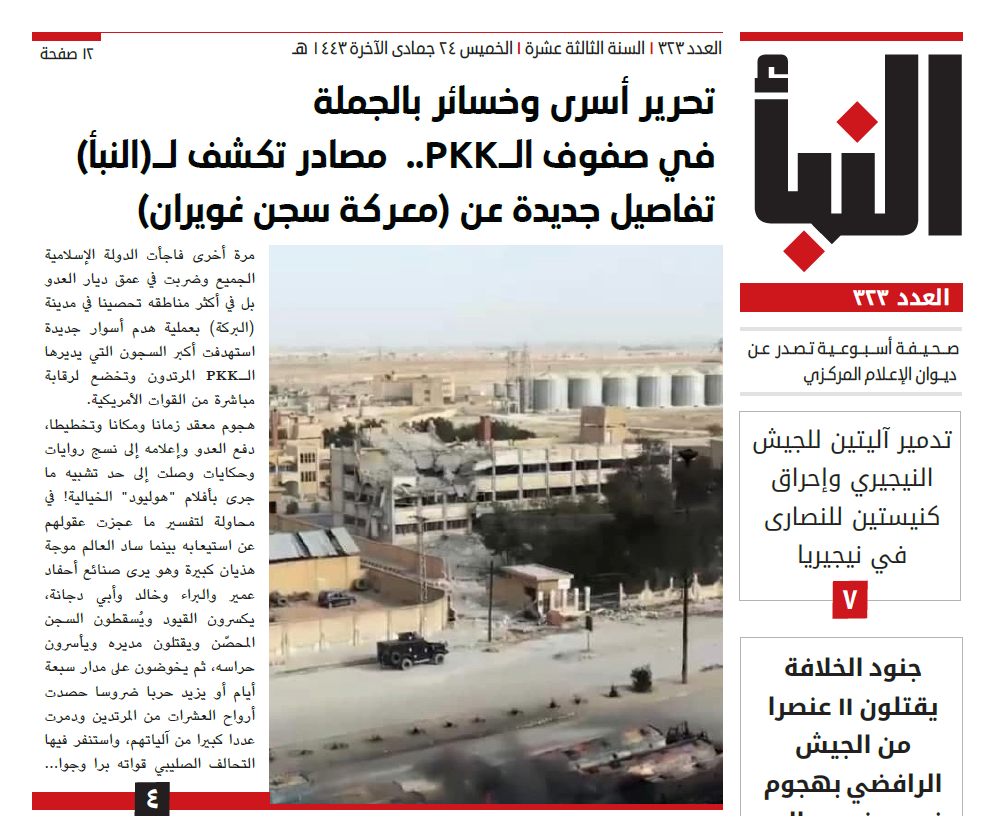
The 252nd edition of Al-Naba, the weekly newsletter of the Islamic State (IS), was released on 17 September.
Al-Naba 252 contained reports of guerrilla attacks and targeted assassinations at the Centre—against Iraqi security forces and the Iranian proxy militias in the Hashd al-Shabi in Iraq, and against the SDF/PKK in eastern Syria—and the “West African State”, Chad and Niger specifically. IS has been making the Maghreb a primary front since the caliphate collapsed. There was, as ever, the ideological essay on page eleven (of twelve).
The two most notable aspects of Al-Naba 252—expanded on below—were the devotion of the main editorial on page three to an attack on the Taliban for the deal they have made with the Americans over Afghanistan, and IS finally claiming responsibility for the murder of the French aid workers in Niger on 9 August, while continuing its ideological war with Al-Qaeda in Africa. Continue reading
By Kyle Orton (@KyleWOrton) on 13 June 2020
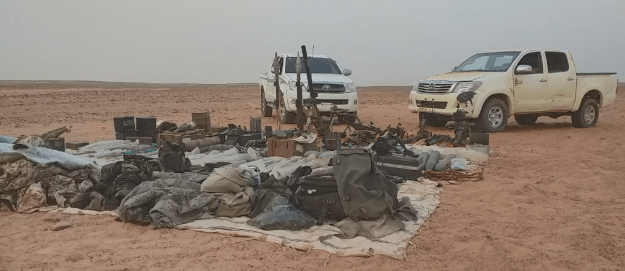
Ghanima (war spoils) captured by Islamic State in Sabha, Libya [Al-Naba 181, 9 May 2019]
By Kyle Orton (@KyleWOrton) on 28 December 2019

In a long article last week, I looked at why the U.S. ran a formal occupation of Iraq for fourteen months after the fall of Saddam Husayn in April 2003, given that there had been an explicit pre-invasion decision not to have an occupation government. The short answer is that the occupation was installed through deception by the State Department, supported by the Central Intelligence Agency (CIA). State and CIA had argued for a protracted occupation in the Situation Room debates in 2002, but President George W. Bush had sided with the Pentagon, which advocated a rapid transfer of power to Iraqis. Having lost in the formal inter-agency process, the State Department succeeded by subversion in getting its way on the ground in Iraq. The disaster this caused in the mismanagement of post-Saddam Iraq was, as the article explained in detail, only the most serious impact of the toxic schism between State/CIA and the Pentagon, a factor whose import is difficult to overstate when examining how the Bush administration functioned. (This feud also at times drew in the Vice President’s Office, which tended to support the Pentagon.)



 Kyle Orton's Blog