Tag Archives: insurgency

The Announcement of the Mujahideen Shura Council in Iraq

By Kyle Orton (@KyleWOrton) on 17 March 2018

A statement attributed to Abu Maysara al-Iraqi, the official spokesman of Al-Qaeda in Mesopotamia (AQM), was released on 15 January 2006 that announced AQM was being merged with five other Salafi insurgent groups to create the Mujahideen Shura Council (al-Majlis Shura al-Mujahideen). A translation of the statement is produced below.

Continue reading

Islamic State Newsletter Tells the Story of Transition Between Statehood and Insurgency

By Kyle Orton (@KyleWOrton) on 13 January 2018

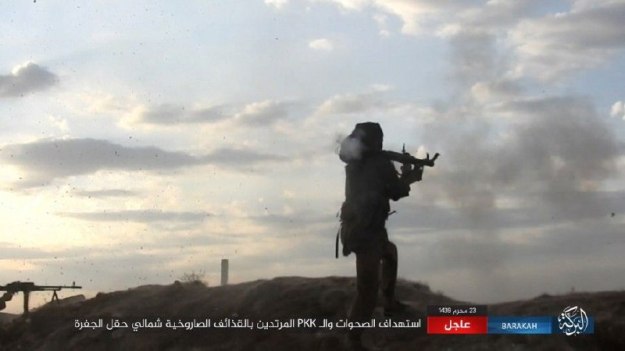
Islamic State, Wilayat al-Baraka, fighting north of al-Jafra with PKK, 14 October 2017

The Islamic State’s (IS) tactical behaviour, particularly its attitude toward the holding of territory, has become a centrally important matter recently with the destruction of the “caliphate” and IS’s reversion to insurgency. Continue reading

The Islamic State Was Engaged in Insurgency Long Before the Caliphate Collapsed

By Kyle Orton (@KyleWOrton) on 11 January 2018

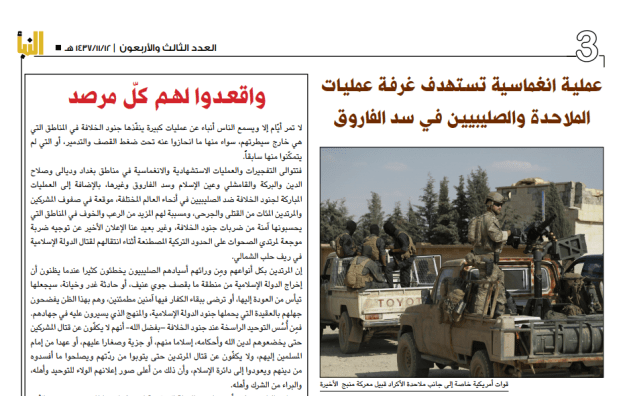
Al-Naba 43, page 3

The Islamic State (IS) brought out the forty-third edition of Al-Naba, its newsletter, on 16 August 2016. On page 3 was an article that made reference to IS’s insurgent activities, which had already begun in areas it had lost. A rough copy is reproduced below.

At that time this article was published, IS was on the verge of losing Minbij, and had issued statements in May 2016 and June saying that the loss of the caliphate would not be the end of the group. By early 2017, IS’s insurgent operations were visibly mature, long before the formal declaration in October 2017 that IS was giving up its statelet and recommencing all-out insurgency. Continue reading

Islamic State Claims its Switch to Insurgency and Terrorism is Working

By Kyle Orton (@KyleWOrton) on 30 December 2017

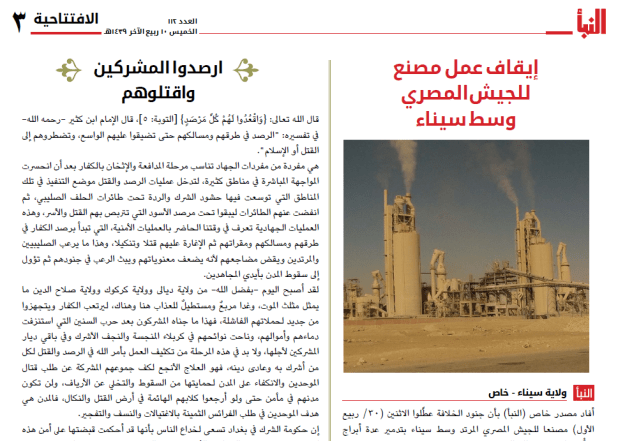
Al-Naba 112, page 3

The 112th edition of the Islamic State’s newsletter, Al-Naba, released on 29 December 2017 contained an article on page 3, which reported that the reversion from statehood to insurgency was yielding results, particularly in the Diyala, Kirkuk, and Saladin provinces of Iraq. The article is reproduced below. Continue reading

The Islamic State Says the Loss of the Caliphate Does Not Mean Defeat

By Kyle Orton (@KyleWOrton) on 16 December 2017

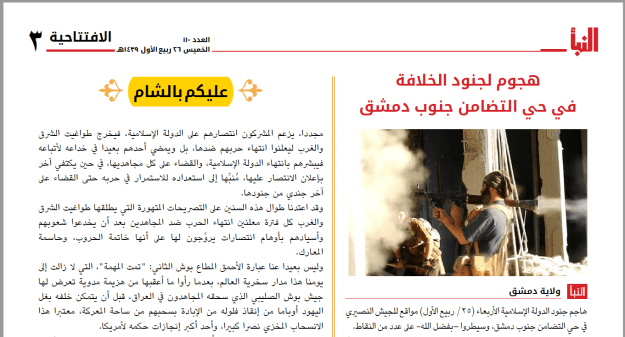
Ak-Naba 110, page 3

The Islamic State newsletter, Al-Naba, had an article on page 3 of its 110th edition, released on 15 December, which mocked those who have declared that the Islamic State is finished, pointing out that it has survived such obituaries before. A rough translation of the article is produced below. Continue reading

Islamic State Officially Gives Up the Caliphate, Returns to Insurgency

By Kyle Orton (@KyleWOrton) on 15 November 2017

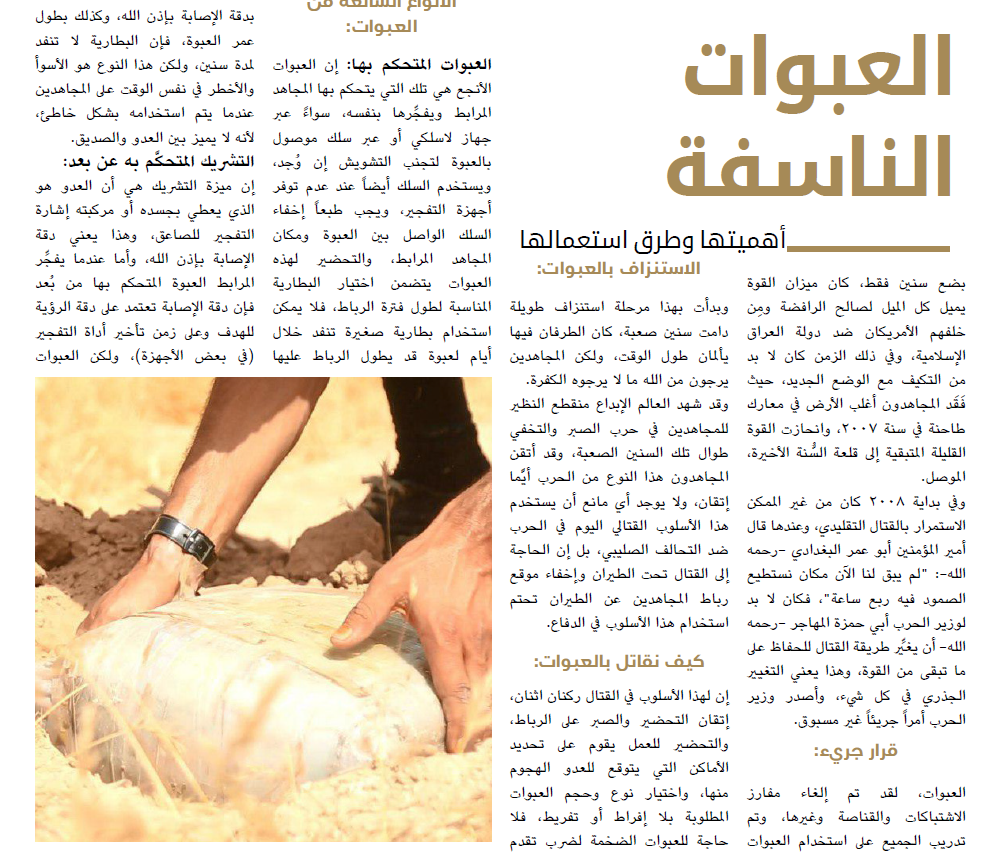
Al-Naba 101, page 8

In the 101st edition of the Islamic State’s weekly newsletter al-Naba (page 8-9), released on 12 October 2017, the organisation gave some fascinating details about how they responded to the “defeat” inflicted on them in 2007-08 by the American surge and the tribal Sahwa (Awakening) forces. The article describes how IS switched wholly to insurgent-terrorist tactics, dismantling its conventional fighting units and even its sniper teams in March 2008, and training in hit-and-run bombings. The leadership at that time, the emir Hamid al-Zawi (Abu Umar al-Baghdadi) and his deputy, the “first minister” and the “war minister” Abdul Munim al-Badawi (Abu Hamza al-Muhajir), encountered some initial scepticism, but the rank-and-file soon came on board when they saw its effectiveness. IS says that it is time to return to this form of warfare. In short, IS marked a switch in al-Naba 101 entirely from the statehood and governance phase of its revolutionary warfare, back into insurgency mode. The article is reproduced below. Continue reading

Coalition Risks Replacing the Islamic State With the Islamic Republic

By Kyle Orton (@KyleWOrton) on 14 September 2017

By recent reports, one could easily come away with the impression that war and instability across the Fertile Crescent are winding down. Predictions about what comes next, always a risky enterprise in the Middle East, are at a point of unique vulnerability. Chaos and violence for some considerable time to come look like a safe bet, though the timing and scale look more uncertain. Nonetheless, certain trendlines are visible, most clearly the emergence of a regional order, abetted by the international coalition’s campaign against the self-proclaimed Islamic State (ISIS), dominated by the Islamic Republic of Iran. Continue reading

Third Speech of Islamic State Spokesman Abu Hassan al-Muhajir

By Kyle Orton (@KyleWOrton) on 29 June 2017

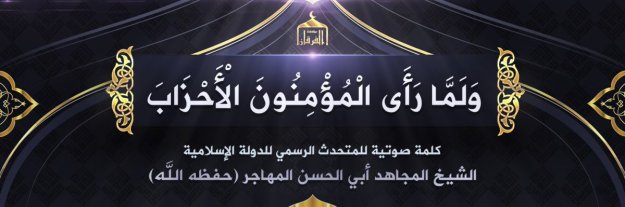
The spokesman of the Islamic State (IS), Abu Hassan al-Muhajir, made his third speech on 12 June 2017, entitled, “And When The Believers Saw The Companies”. Abu Hassan’s first speech was in December 2016 and his second was in April 2017. The primary message of Abu Hassan’s speech was for IS’s troops to resist to the end in what is left of the caliphate’s grip on its Iraqi capital Mosul as that offensive, begun last October, draws to a close, and to hold similarly firm as the operation to evict IS from its Syrian capital Raqqa, launched on 6 June, gets underway. The main editorial of Al-Naba 84 a few days before Abu Hassan spoke laid out IS’s intention, somewhat contrary to its general practice, to resist fiercely in Raqqa. Abu Hassan continues the messaging, consistent since the U.S.-led coalition began its countermeasures against IS, that “patience” will lead to victory. IS has not wavered from this strategy in more than ten years, and it is showing signs of bearing fruit already, a trendline likely to continue unless there is a change of Coalition strategy. In crude, practical terms, Abu Hassan means to say that the terrorism and guerrilla campaign will continue after IS is uprooted from the urban areas.
Continue reading

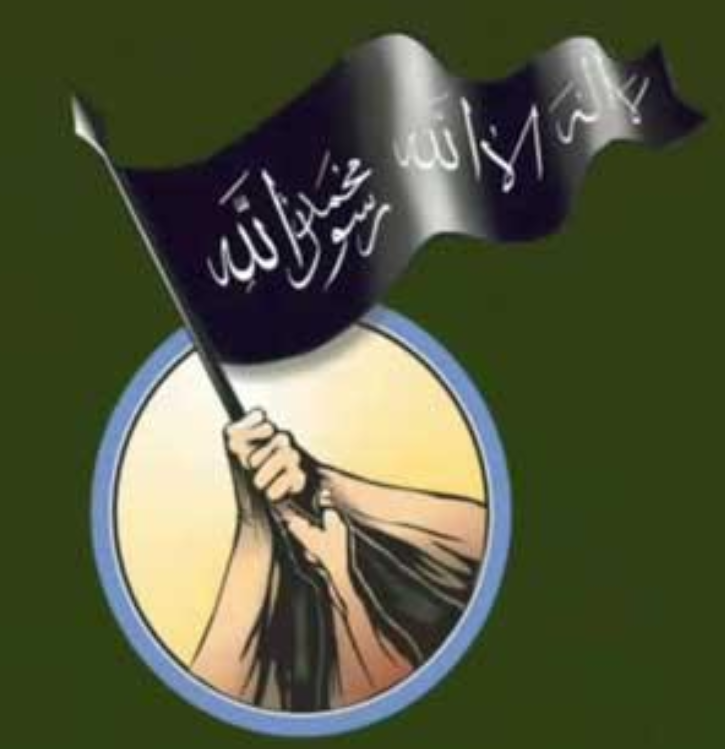
The Flag of the Islamic State

By Kyle Orton (@KyleWOrton) on January 27, 2017

The Islamic State’s June 2014 declaration that the areas it controlled were the restored “Caliphate” was seen by many as a novel development. In fact, “the State” was declared in October 2006. The next month, the predecessor of the Islamic State (IS), Al-Qaeda in Mesopotamia (AQM), dissolved itself, and a month after that the claim to statehood was expanded upon—while being wilfully ambiguous about the caliphal pretensions—in the first speech by the then-emir, Hamid al-Zawi (Abu Umar al-Baghdadi). Similarly, though confusion remains on the point, it was in this same period that the symbol of the Islamic State, its black flag, was established.

Continue reading

Syria Is Only Going to Get Worse After the Fall of Aleppo

Published at The New Arab

By Kyle Orton (@KyleWOrton) on December 14, 2016
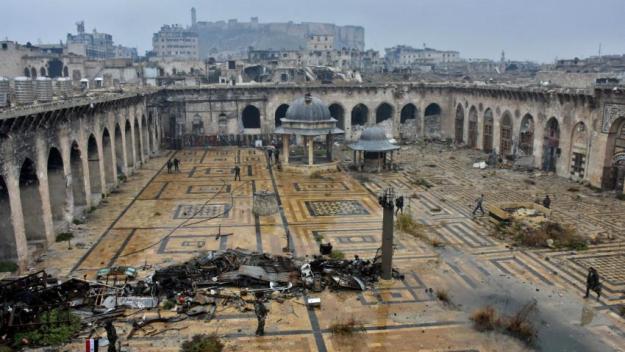
Syrian pro-government forces recapture the old city of Aleppo, December 13, 2016 [Getty]

In May 2016, the Roman Theatre in Palmyra was the site of a Russian orchestra performance, led by Valery Gergiev, a supporter of Russian ruler Vladimir Putin. The event was broadcast widely on RT (formerly Russia Today), the state-run English-language propaganda channel, and images and clips of the event were disseminated worldwide. The concert crowned Putin’s eight-month intervention in Syria, reinforcing the Kremlin’s messaging: Moscow and its blood-drenched client, Bashar al-Assad, were staffing the front line for civilisation against the barbarous hordes of the Islamic State group—and they were winning. What a difference seven months has made. Continue reading