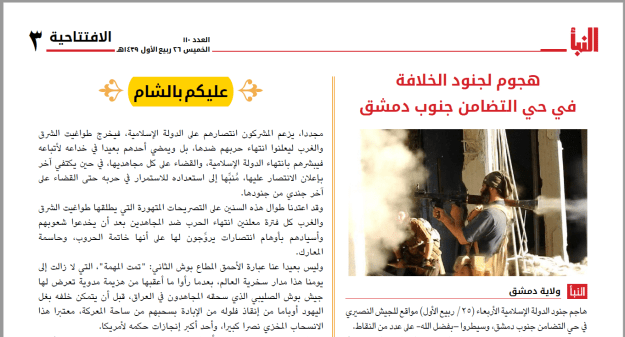
The Islamic State newsletter, Al-Naba, had an article on page 3 of its 110th edition, released on 15 December, which mocked those who have declared that the Islamic State is finished, pointing out that it has survived such obituaries before. A rough translation of the article is produced below. Continue reading →
In the 110th issue of the Islamic State’s newsletter, Al-Naba, released on 15 December 2017, the jihadists claimed responsibility for the attempted pipe bomb attack at the Port Authority bus terminal in Manhattan, New York City, on 11 December 2017. The claim appeared on page 11 of 12 in a section entitled, “Events of the Week”. The text of the claim is reproduced below. Continue reading →
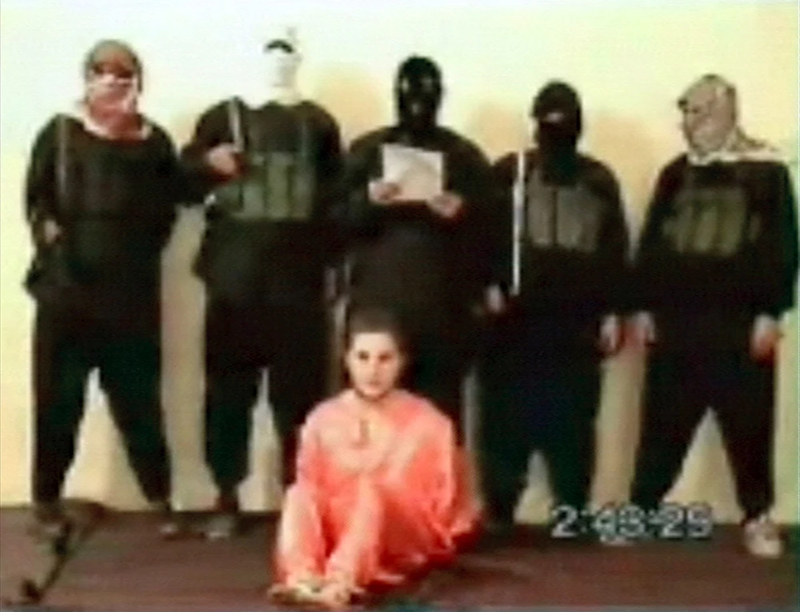
The Islamic State (IS) triggered the war against its “caliphate” by disseminating footage of its jihadists beheading an American journalist, James Foley, on 19 August 2014. Over the next three months, five more Western hostages were decapitated on video. This was shocking to many, but it should not have been. IS began producing snuff videos like this a decade earlier.
The first video beheading by the Islamic State movement—known at the time as Jamaat al-Tawhid wal-Jihad or JTJ (the Group of Monotheism and Holy War)—was released on 11 May 2004; the murderer in the video was IS’s founder, Abu Musab al-Zarqawi; and he gave a brief statement to accompany his crime, later published under the title, “A Word in the Tape of the Beheading of Nicholas Berg (Kalima fi sharit nahr Nicholas Berg)”. Berg was an American civilian who went to Iraq as a freelance engineer.
The founder of what is now the Islamic State, Abu Musab al-Zarqawi, gave a speech on 30 April 2004, entitled, “Blowing up the Intelligence Headquarters: A Response to the Lies of Jordanian Intelligence”.
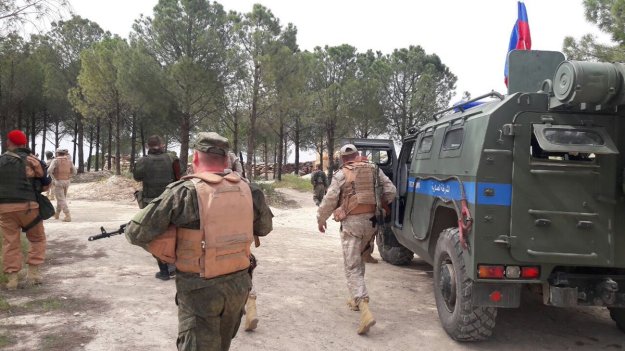
Russian soldiers in Efrin, Syria, 1 May 2017 (source)
The American-led Coalition against the Islamic State (IS) partnered with the “Syrian Democratic Forces” (SDF), a political façade for the proscribed Kurdistan Workers’ Party (PKK), as the ground force in Syria. The most ventilated problems with this partnership so far have been the strain it has put on relations with NATO ally Turkey, against which the PKK has run a terrorist-insurgency for more than thirty years, and the deep local suspicion of the PKK’s governing program that might yet reverse the gains against IS and open political space for other jihadists like al-Qaeda. Another of the problems is now gaining salience: the PKK’s long-term alliance with Bashar al-Asad’s regime and the states—Russia and Iran—that keep it alive. Continue reading →
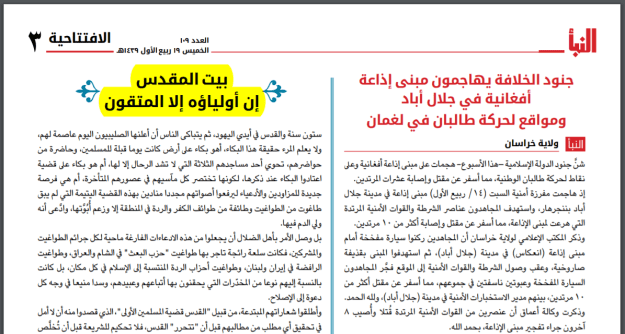
The Islamic State responded to President Donald Trump’s announcement, on 6 December 2017, that the United States would move its Embassy in Israel from Tel Aviv and Jerusalem, with an editorial on page 3 of the 109th edition of Al-Naba on 8 December 2017. Below is a very rough translation. Continue reading →
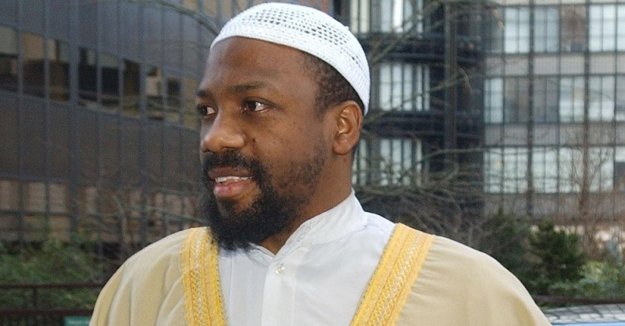
The U.S. Treasury Department sanctioned Abdullah Ibrahim al-Faisal (born: Trevor William Forrest), a Jamaican cleric who supports the Islamic State (IS) on 5 December. This was long overdue. Al-Faisal’s record of disseminating jihadist ideology, and influencing and/or interacting with terrorists, goes back several decades. And since 2014, al-Faisal has been one of IS’s influential English-language propagandist-recruiters. Continue reading →
The leader of al-Qaeda, Ayman al-Zawahiri, gave a thirty-five-minute speech on 28 November 2017, entitled: “Let Us Fight Them As A Solid Structure” (or “Let Us Fight Them As One Body” or “Let Us Fight Them With Solid Foundations”), dealing with the vexed question of al-Qaeda’s relationship with the Syrian jihadi group, Hay’at Tahrir al-Sham, a situation that escalated again in recent days. The mention of an impending Turkish intervention into Idlib—which began on 7 October—suggests that al-Zawahiri recorded this speech in the last days of September or the first few days of October. An English transcript of the speech was released by As-Sahab Media, and is reproduced below with some edits for syntax and transliteration. Continue reading →
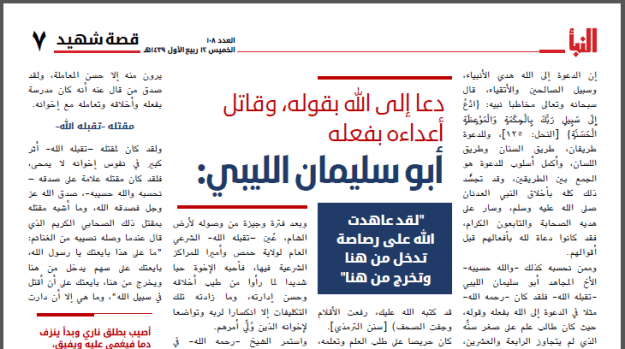
The latest edition of the Islamic State’s newsletter, Al-Naba 108, released on 1 December 2017, has a profile on page 7 of a fighter named Abu Sulayman al-Libi, a Libyan jihadist who came to Syria soon after the caliphate declaration in June 2014 and became the senior religious official in Homs. Abu Sulayman was killed in the fighting between IS and the pro-Asad coalition in the deserts of eastern Homs Province, near the T3 oil pumping station. This probably means Abu Sulayman was killed in the last days of September or the first few days of October during the IS counter-attack to the regime coalition’s push into Deir Ezzor. A rough translation of the Naba obituary is published below. Continue reading →
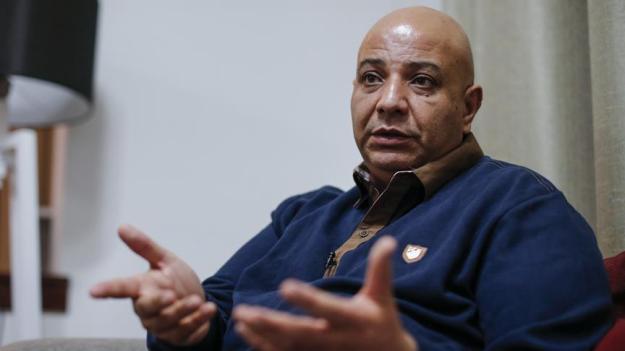
Talal Silo was the leader of an ethnic Turkoman unit within the Syrian Democratic Forces (SDF), the ground partner in Syria of the American-led international coalition against the Islamic State (IS). Having defected recently, Tilo has now given an interview about his experiences, the nature of the SDF, and the SDF’s links to the Bashar al-Asad regime and its supporters, Russia and Iran. Continue reading →