Tag Archives: Islamism

Is Britain Cracking Down on PKK Terrorist Activity?

Originally published at The Henry Jackson Society

By Kyle Orton (@KyleWOrton) on 16 December 2017
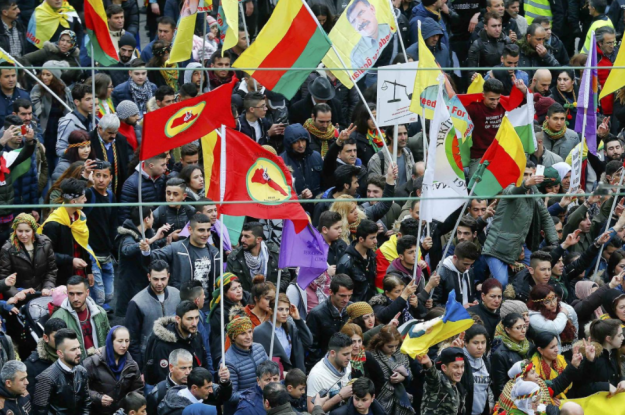
Pro-PKK demonstrators in Frankfurt, Germany, 18 March 2017, REUTERS / Ralph Orlowski

The BBC reported yesterday that on 7 December the Metropolitan Police Service arrested four people—two 17-year-old boys, a 38-year-old woman, and a 50-year-old woman—were arrested in the Haringey area of north London as part of a probe into terrorist fundraising, through money laundering and fraud. The terrorist group at issue is the Kurdistan Workers’ Party (PKK), and those arrested are believed to have contributed to the PKK’s finances through sale and distribution of one of the PKK’s most important propaganda instruments, the Yeni Ozgur Politika (New Free Politics) newspaper. Time will tell if this is a one-off or the beginning of a serious and long-overdue attempt to curtail the PKK’s propaganda-recruitment activity and fundraising in the West. Continue reading

Another Product of “Londonistan”: Abdullah Ibrahim al-Faisal

By Kyle Orton (@KyleWOrton) on 8 December 2017

Abdullah al-Faisal

The U.S. Treasury Department sanctioned Abdullah Ibrahim al-Faisal (born: Trevor William Forrest), a Jamaican cleric who supports the Islamic State (IS) on 5 December. This was long overdue. Al-Faisal’s record of disseminating jihadist ideology, and influencing and/or interacting with terrorists, goes back several decades. And since 2014, al-Faisal has been one of IS’s influential English-language propagandist-recruiters. Continue reading

Islamic State Profiles a Libyan Jihadist Killed in Eastern Syria

By Kyle Orton (@KyleWOrton) on 4 December 2017

Al-Naba 108, page 7

The latest edition of the Islamic State’s newsletter, Al-Naba 108, released on 1 December 2017, has a profile on page 7 of a fighter named Abu Sulayman al-Libi, a Libyan jihadist who came to Syria soon after the caliphate declaration in June 2014 and became the senior religious official in Homs. Abu Sulayman was killed in the fighting between IS and the pro-Asad coalition in the deserts of eastern Homs Province, near the T3 oil pumping station. This probably means Abu Sulayman was killed in the last days of September or the first few days of October during the IS counter-attack to the regime coalition’s push into Deir Ezzor. A rough translation of the Naba obituary is published below. Continue reading

Qatar and the Gulf Crisis

By Kyle Orton (@KyleWOrton) on 30 November 2017

I released a report today, published by the Henry Jackson Society, Qatar and the Gulf Crisis. The intent was to examine the charges made against the Qatari government by its Gulf neighbours with regard to the funding of terrorism, the hosting of extremists, the dissemination of hate speech and incitement, among other things. Having separated fact from fiction with regards to he accusations against Qatar, the report proposes how Britain might proceed in such a way as to press Doha on issues of concern, while avoiding being drawn into the middle of the Gulf dispute, and trying to foster reconciliation between allies, especially at a time when a united front is necessary to oppose the far larger challenge of the Iranian theocracy.  Continue reading

The Islamic State’s Minister of War Criticises Regional Religious Leaders For Not Supporting The Jihad in Iraq

By Kyle Orton (@KyleWOrton) on 24 November 2017

Abdul Munim al-Badawi (Abu Hamza al-Muhajir), the “war minister” of the Islamic State of Iraq, the predecessor to ISIS, made a brief five-minute speech on 30 April 2007, entitled “Nada ila Ulema al-Umma” (نِدَاءٌ إِلَى عُلَمَاءِ الأُمَّةِ). “Ulema” refers to Islamic scholars, sometimes translated as “clerics”, a slightly misleading comparison with Christianity, and “umma” refers to the worldwide community of Muslims, so the title of the speech translates as, “An Appeal to the Community’s Scholars”. Al-Badawi’s basic point—made at a time when the Islamic State movement was beginning to suffer under the pressure of the Surge and Sahwa—was to condemn the regional ulema for not supporting, and not having supported, the jihadists in Iraq against the Americans and the Shi’is. Implicitly, Al-Badawi is criticising the ulema for holding back Muslims in regional States who might otherwise have joined the Iraqi jihad as foreign fighters and suicide bombers, potentially making a difference to the Islamic State’s military fortunes. A rough translation of the speech is reproduced below.

Continue reading

Iran Escalates its Subversive Activities in Bahrain

Post originally appeared at The Henry Jackson Society

By Kyle Orton (@KyleWOrton) on 19 November 2017

Fire at the oil pipeline in Buri village, south of Manama, Bahrain, 10 Nov. 2017. REUTERS/Hamad I Mohammed

Just over a week ago, the major oil pipeline in Bahrain was bombed by operatives the government says were working for the Islamic Republic of Iran. This is the latest in an escalating series of terrorist attacks inside Bahrain. Throughout the year, Manama has also been rolling up terrorist cells that have links to Iran’s intelligence services and Bahraini citizens now in Iran that form part of Tehran’s regional terrorist network. The breakdown in Gulf unity is especially worrying in the face of this intensified Iranian aggression and subversion in Bahrain. Continue reading

Russia Takes Advantage of the Schism in NATO Between America and Turkey

Originally published at The International Business Times

By Kyle Orton (@KyleWOrton) on 9 October 2017

President Donald Trump meets Turkey’s President Recep Tayyip Erdogan at the White House, 16 May 2017. (AP Photo/Pablo Martinez Monsivais)

Relations between Turkey and the United States hit a new low on Sunday 8 October. The U.S. State Department suspended “all non-immigrant visa services at all U.S. diplomatic facilities in Turkey”.

The Turkish government retaliated—citing concerns about the “commitment of the government of the United States to the security of the Turkish Mission facilities and personnel”—by “suspend[ing] all non-immigrant visa service[s] at all Turkish diplomatic facilities in the U.S..” Continue reading

The Islamic State’s Fourth Attack in Britain in 2017

By Kyle Orton (@KyleWOrton) on 16 September 2017

“Bucket bomb” on the Parsons Green trube (image source)

At 8:20 on 15 September 2017, a bomb detonated in a rear carriage of a tube train at Parsons Green station in London. The passengers on the packed, rush-hour train described a flash “fireball” that travelled down the train. Thirty people were injured, some horribly burned, but there were no fatalities and the main explosive clearly did not detonate. The attack was claimed by the Islamic State (IS). Continue reading

One More Time on Saddam and the Islamic State

Originally published at The Henry Jackson Society

By Kyle Orton (@KyleWOrton) on 2 September 2017

The most recent issue of Perspectives on Terrorism had a paper by Ronen Zeidel entitled, ‘The Dawa’ish: A Collective Profile of IS Commanders’, which was “the first attempt to provide a comprehensive collective profile of commanders and leaders of the Islamic State (IS)”. Based on “an inventory of over 600 names”, the paper assessed the nationality, ethnicity, and tribal origins not just of the very senior IS commanders, but those lower down, a novel and much-needed line of investigation. Zeidel found that these commanders of the IS movement are or were overwhelmingly Iraqi and Sunni Arab, with an important Turkoman contingent.

Zeidel’s findings are important for drawing attention again to the local-revolutionary character of an organisation that gets a great deal of attention for its foreign fighters and external attacks, especially in the West, but which only a recently acquired global reach—and, indeed, only recently needed to: until 2011, the West was easily reachable since it had troops on the ground in Iraq, so the incentive to invest resources in creating a foreign terrorist apparatus was minimal.

One small part of Zeidel’s work has created something of a storm, however. Zeidel gives the occupation held by these commanders and, for those where this was known, 72% of them were former regime elements (FREs) from the dictatorship of Saddam Husayn. This reignited the argument over how important the FREs have been to IS. Continue reading

The Role of Turkey in Syria

By Kyle Orton (@KyleWOrton) on 16 August 2017

Recep Tayyip Erdogan (image source)

The Turkish government has gotten more and more deeply involved in Syria since the uprising began in 2011. But Turkey now finds its original aim, namely the overthrow of Bashar al-Assad’s regime, unattainable, creating tensions with the Syrian armed opposition, its primary lever inside Syria, and there are considerable problems stabilizing the zone of Syria that came under Turkish occupation after Ankara’s direct intervention in 2016. The defeat of Turkey’s primary objective has been accompanied by the rise of further problems, notably the exacerbation of its longest-standing internal security threat, that posed by the Kurdistan Workers’ Party (Partiya Karkerên Kurdistan – PKK), and the generation of new internal threats, from the Islamic State (IS) and potentially from al-Qaeda-linked groups. The options for solving these problems are constrained and unpalatable. Continue reading