Tag Archives: Kurds

What Russia Wants in Syria

By Kyle Orton (@KyleWOrton) on October 4, 2015

US President Barack Obama (R) listens to Russian President Vladimir Putin after their bilateral meeting in Los Cabos, Mexico on June 18, 2012 on the sidelines of the G20 summit. Obama and President Vladimir Putin met Monday, for the first time since the Russian leader's return to the presidency, for talks overshadowed by a row over Syria. The closely watched meeting opened half-an-hour late on the sidelines of the G20 summit of developed and developing nations, as the US leader sought to preserve his

In the last few days I’ve written about Russia’s initial military action in Syria, which is intended to prop up the dictatorship of Bashar al-Assad, and explained (with my friend James Snell) how U.S. policy has enabled this, both by effectively outsourcing Middle East policy to Vladimir Putin over the chemical weapons “red line” debacle, and by the pro-Iran tilt that is implicit in President Obama’s nuclear deal-facilitated move toward détente with the Islamic Republic: Obama is effectively supporting Iran’s assets in Syria, and Putin is now using those same pieces to prosecute his own war in the Levant. With this in the background, this post will focus on what Putin wants in Syria.

Putin’s aims in Syria can be boiled down to two: (1) Ensure the Assad tyranny survives, which includes the building of a permanent military-colonial outpost on the Mediterranean coast and destroying all the moderate rebels so that Syria can be presented as a choice of Assad or the Islamic State (I.S.), legitimizing Russia’s support for Assad; and (2) humiliating the West on the way to constructing an alternate world order to American hegemony. Continue reading
A Year Into The War Against The Islamic State, The Coalition Has Little To Show For It

By Kyle Orton (@KyleWOrton) on September 30, 2015

Published at Left Foot Forward

1

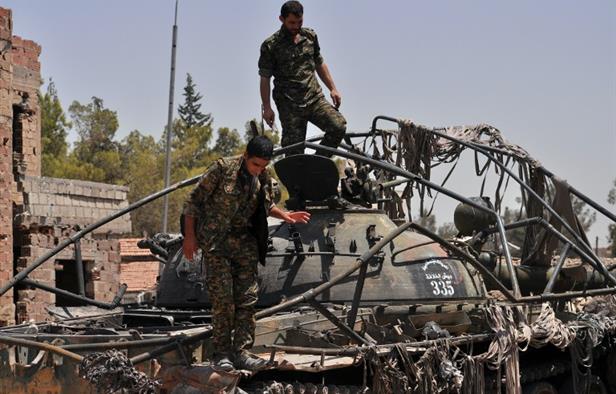
A year into the campaign against the Islamic State, the American-led coalition has precious little to show for it. Tactical victories in Kobani, Tikrit and Tel Abyad have been more than offset not only by the negative long-term side-effects of those victories but by direct I.S. military gains in the present—notably the capture of a third provincial capital in Ramadi, the capture of Palmyra and a push into Homs and southern Syria; as well as increasing I.S. infiltration of Idlib, an area cleared entirely of I.S. by a rebel offensive in early 2014. Continue reading

America Abandons the Syrian Revolution

By Kyle Orton (@KyleWOrton) on August 14, 2015

1

In the last week, two events have provided further evidence that the United States has effectively sided with the Assad regime in Syria, acting effectively as the regime’s air force, and that America’s alliance with Assad is part of the broader policy of détente with Iran, facilitated by the nuclear deal, which has ceded Syria to Iran as a sphere of influence. Continue reading

Islamist Clerics Give Permission to Work with Turkey Against ISIS and PKK

By Kyle Orton (@KyleWOrton) on August 4, 2015

Just over a week ago, a new clerical body was formed, al-Majlis Shura Ahl al-ilm fil-Sham (Advisory Council of the People of Knowledge in Syria), which includes Islamists from within Syria and from outside. Among the notable foreigners are Umar al-Hadouchi, a Moroccan jihadi-salafist, and Muhammad Ould al-Dedew, a Mauritanian who is more in line with the Sururis. There is also Abdallah al-Muhaysini, the Saudi jihadi cleric who is very close to al-Qaeda’s leadership inside Syria. From among Syrians, there are two Ahrar al-Sham notables, Dr. Ayman al-Harush and Mohamed Ayman Aboul-Tout (Abu Abbas al-Shami); Sa’ad al-Uthman, the son of Abd al-Karim, a major figure in the Hama wing of the Syrian Muslim Brotherhood, and Ahmad al-Salum, a Sururi (an activist/political Salafi).

The Council’s first statement condemned the 25 July assassination of the Faylaq al-Sham commander Mazin al-Qassum by Islamic State (IS) operatives with Jund al-Aqsa, and demanded that all groups clarify their stance on IS and cleanse their ranks of IS agents and sympathizers. Today’s fatwa, “Concerning cooperation and coordination with the Turks in repelling Daesh and the PKK,” licensed Muslims to work with the Turkish government against IS and the PKK. The fatwa is reproduced below. Continue reading

Turkey Fears A Kurdish State More Than The Islamic State

By Kyle Orton (@KyleWOrton) on July 28, 2015

A version of this article was published at NOW Lebanon 

1

After years of threatening, Turkey directly intervened in Syria on Friday, launching airstrikes against the Islamic State (ISIS), and finally allowed the U.S. to use Incirlik for jet and drone attacks against ISIS. Concurrently, Turkey launched airstrikes into Iraqi Kurdistan against the Kurdistan Workers’ Party (PKK). Ankara is framing this as an equal-opportunities war on terrorists, but Turkey’s actions over the last four years in Syria give a lot of cause for wonder as to which side Ankara is on when it comes to terrorism. Continue reading

Islamic State: The Afterlife of Saddam Hussein’s Regime

By Kyle Orton (@KyleWOrton) on July 4, 2015

Published at Baghdad Invest

1

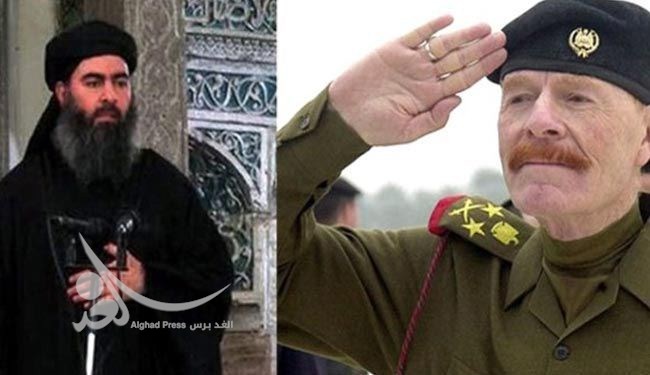
Izzat Ibrahim ad-Douri, Saddam Hussein’s long-time deputy, was reported dead (again) on April 17. An audio message on May 15 disproved this. Douri was the implementer of the Saddam regime’s Islamization program in its later years and a key architect of the insurgency after the regime was overthrown, which helped pave the way for the Islamic State (ISIS). ISIS has now turned on Douri and his associates, but ISIS could not have risen to its current stature without Douri’s help. Continue reading

A Myth Revisited: “Saddam Hussein Had No Connection To Al-Qaeda”

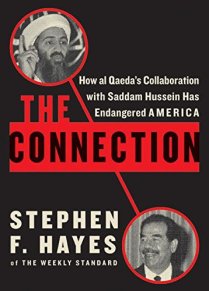
Book Review: The Connection: How al-Qaeda’s Collaboration With Saddam Hussein Has Endangered America (2004) by Stephen Hayes
By Kyle Orton(@KyleWOrton) on June 21, 2015


More than twelve years after the fall of Saddam Hussein, the conventional wisdom is that Saddam’s regime had no connection with al-Qaeda, and such “evidence” as was adduced was tortured out of Ibn al-Shaykh al-Libi in the Bush administration’s desperation to cobble together a casus belli. But if one puts ideology on hold, and considers the evidence of Stephen Hayes’ The Connection, a rather different picture emerges. Continue reading

Syrian Kurds Announce Unified Foreign Fighter Unit

By Kyle Orton (@KyleWOrton) on June 13, 2015

Logo of the Internationalist Freedom Battalion or Enternasyonalist Ozgurluk Taburu (EOT)

The Kurdish People’s Protection Forces (YPG), the Syrian branch of the Kurdistan Workers’ Party (PKK), has been in receipt of a flow of non-Kurdish, mostly-Western foreign fighters for approximately a year. These volunteers had gathered in informal groupings such as the “Lions of Rojava,” a primarily English-speaking unit of non-ideological ex-military men. The recruitment pattern of the YPG has begun to shift, however, and the stream of foreign fighters to “Rojava,” as the YPG calls the areas it rules, has become increasingly ideological. In January, a process was begun to create a unified structure—or at least a brand—for the disparate foreign groups and individuals in Rojava. This effort concluded two days ago with the formation of the International Freedom Battalion (EOT).
Continue reading

Calls for U.S. Government to Recover ‘Mentally Unbalanced’ YPG Foreign Fighter

By Kyle Orton (@KyleWOrton) on June 9, 2015

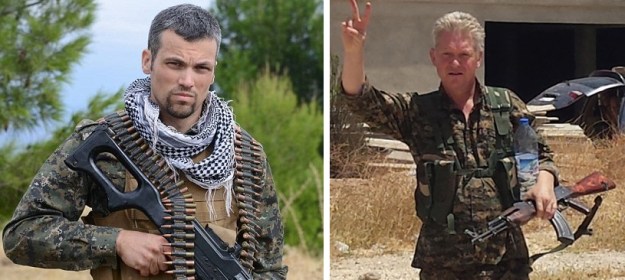
Jordan Matson, Michael Enright

Jordan Matson, an American fighting in the ranks of the People’s Protection Units (YPG), the Syrian wing of the Kurdistan Workers’ Party (PKK), posted a message to Facebook on 4 June 2015 about Michael Enright, a British YPG fighter who had been living in America and working as an actor. Matson says that Enright is “mentally unstable,” had come to Syria to sell his story and write a movie script, and had been disarmed and isolated by the YPG already because of the worry that he would harm himself or be harmed by others. Matson’s message is posted below with typos and “text speak” corrected. Continue reading

The Islamic State’s Strategy Is Working, Its Enemies Are Failing

By Kyle Orton (@KyleWOrton) on May 23, 2015

1

To hear President Obama tell it, his announced program to defeat the Islamic State (ISIS), which began with airstrikes into Iraq last August that were extended into Syria in September, is working, albeit with some tactical setbacks. The implication is that the setbacks of the U.S.-led anti-ISIS campaign are not strategic.

As J.M. Berger phrased it:

In the Washington vernacular, the act of Being Strategic implies a near mystical quality of superior thinking possessed by some, and clearly lacking amongst the vulgarians of the world—heedless brutes such as ISIL. Tactics are short-term ploys, easy to dismiss. Strategy is for winners.

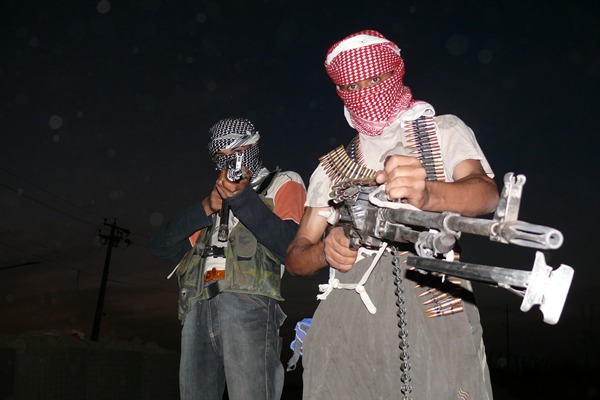
Unfortunately, this soothing view is almost exactly wrong: it is the United States that is relying on various short-term methods—commando raids into the Syrian desert, for example—while ISIS has a long-term goal fixed in mind and is working assiduously to achieve it. The U.S.-led Coalition is losing, in short, and ISIS is winning. Continue reading