Tag Archives: Osama bin Laden

The Flag of the Islamic State

By Kyle Orton (@KyleWOrton) on January 27, 2017

The Islamic State’s June 2014 declaration that the areas it controlled were the restored “Caliphate” was seen by many as a novel development. In fact, “the State” was declared in October 2006. The next month, the predecessor of the Islamic State (IS), Al-Qaeda in Mesopotamia (AQM), dissolved itself, and a month after that the claim to statehood was expanded upon—while being wilfully ambiguous about the caliphal pretensions—in the first speech by the then-emir, Hamid al-Zawi (Abu Umar al-Baghdadi). Similarly, though confusion remains on the point, it was in this same period that the symbol of the Islamic State, its black flag, was established.

Continue reading

The Islamic State’s First War Minister

By Kyle Orton (@KyleWOrton) on January 25, 2017

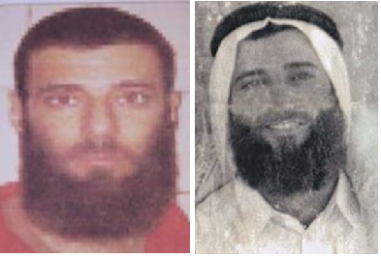
One of the few existing pictures of Abu Hamza al-Muhajir (Abdul Munim al-Badawi)

One of the few existing pictures of Abu Hamza al-Muhajir (Abdul Munim al-Badawi)

Below is reproduced a very short biography for Abu Hamza al-Muhajir, sometimes called Abu Ayyub al-Masri, whose real name is Abdul Munim al-Badawi,[1] that circulated on pro-Islamic State forums. Al-Badawi took over leadership of al-Qaeda in Iraq (AQI) when its founder, Ahmad al-Khalayleh (Abu Musab al-Zarqawi), was killed on 7 June 2006. Al-Badawi then declared his allegiance to Hamid al-Zawi (Abu Umar al-Baghdadi) and the Islamic State of Iraq (ISI) on 10 November 2006, formally dissolving al-Qaeda on Iraqi territory, and becoming al-Zawi’s deputy. Abu Hamza had been in Iraq, including Baghdad, a year before Saddam Husayn was overthrown, and he and al-Zawi were killed together on 18 April 2010. Continue reading

How the Islamic State’s Caliph Responded to Defeat Last Time

By Kyle Orton (@KyleWOrton) on January 21, 2017

1-2

The first proto-caliph of the Islamic State (IS), Hamid al-Zawi (Abu Umar al-Baghdadi), gave his fourth audio speech on 16 April 2007, “The Harvest of the Years for the State of the Muwahideen (Monotheists)”. An English version of al-Zawi’s speech was disseminated by IS’s al-Furqan Media and it is reproduced below with some editions in transliteration and syntax, and some interesting or important sections highlighted in bold. Continue reading

The Coalition Strikes Down Al-Qaeda’s Leaders In Syria

By Kyle Orton (@KyleWOrton) on January 20, 2017

Muhsin al-Fadhli [top-left]; Abdul al-Sharikh (Sanafi an-Nasr) [bottom-left]; Radwan Nammous (Abu Firas al-Suri) [centre]; David Drugeon [top-right]; Rifai Taha (Abu Yasser al-Masri) [bottom-right]

Since September 2014, the U.S.-led Coalition has been targeting the leaders of Jabhat al-Nusra, al-Qaeda’s Syrian branch, which has since rebranded as Jabhat Fatah al-Sham (JFS). Below is a list of the Qaeda-linked individuals killed in Coalition air attacks since 2014. It will be updated and kept as a rolling record of the ongoing campaign. Continue reading

Chelsea Manning is a Traitor, Not a Hero

Published at The International Business Times

By Kyle Orton (@KyleWOrton) on January 18, 2017

Chelsea Manning (REUTERS/U.S. Army)

It might have been thought that a consistent opposition to treason was not all that difficult. But President Barack Obama’s surprise decision last night to commute the sentence of Bradley, now Chelsea, Manning, showed how deeply political partisanship has penetrated into areas like national security, where ideally country would be put before party or ideology. Continue reading

A Counterterrorism Policy in Syria That Helps Terrorists

Originally published at The Henry Jackson Society

By Kyle Orton (@KyleWOrton) on January 5, 2017

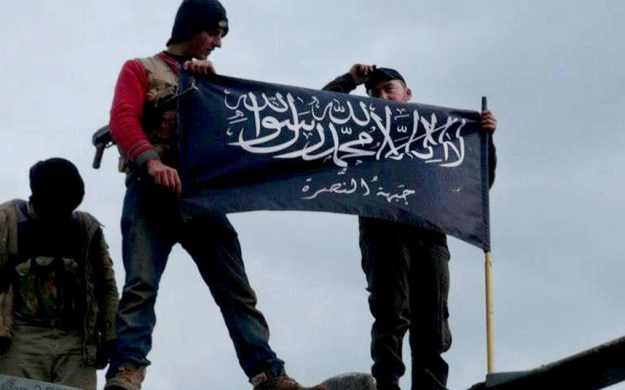
Jabhat al-Nusra jihadists wave their flag in Syria (Associated Press picture, source)

In the last week, the American-led Operation INHERENT RESOLVE, whose primary mission is to “degrade and ultimately destroy” the Islamic State (IS), has apparently conducted two airstrikes against senior members of Jabhat Fatah al-Sham (JFS), once known as Jabhat al-Nusra, al-Qaeda’s rebranded presence in Syria. In late 2016, the U.S. began an intensified targeting campaign against al-Qaeda and associated individuals; this appears to be a continuation of that policy, which provides some guidance about Western policy on Syria more broadly. Continue reading

The Islamic State’s Media Apparatus and its New Spokesman

Originally published at The Henry Jackson Society.

By Kyle Orton (@KyleWOrton) on December 16, 2016

1

The Islamic State (IS) has named a new official spokesman, Abu Hassan al-Muhajir. Abu Hassan is the fourth man to hold the position of spokesman within the IS movement, and the third since it declared statehood in 2006. Very little is known about Abu Hassan but assessing the history of IS’s media enterprise offers some hints about his profile. In this regard, a new paper by Dr. Craig Whiteside of the International Centre for Counter Terrorism Terrorism is instructive. Looking forward, examining Abu Hassan’s inaugural speech offers some clues about the direction IS’s messaging and behaviour will take now as its statelet shrinks under pressure from the U.S.-led Coalition. Continue reading

Al-Qaeda Explains its Split with the Islamic State

By Kyle Orton (@KyleWOrton) on December 6, 2016

1

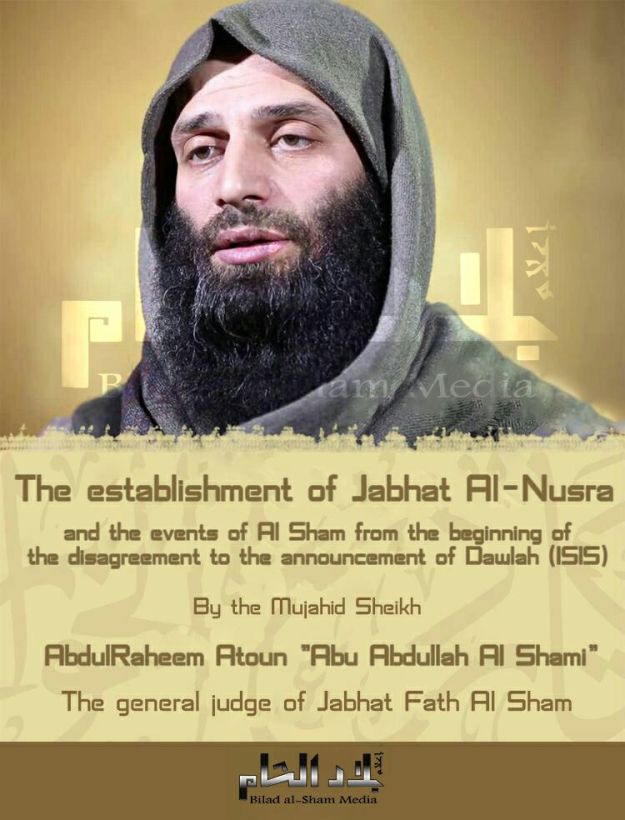
On 20 November 2016, Jabhat Fatah al-Sham (JFS), al-Qaeda’s rebranded presence in Syria, published its first official account of how JFS, previously known as Jabhat al-Nusra, split from its parent organization, the group we now know as the Islamic State (IS). The statement was composed by Abd al-Rahim Atun (Abu Abdullah al-Shami), identified as the General Judge of JFS. It is apparently drawn from the book, “Under the Shade of the Tree of Jihad” (p. 177-194), and the post was entitled, “The Establishment of Jabhat al-Nusra and the Events of al-Sham [Syria] from the Beginning of the Disagreement to the Announcement of al-Dawla [the State]”. On 27 November, Bilad al-Sham Media released an English language version of this statement, which is reproduced below with some editions for spelling, grammar, and so on, and some especially notable sections bolded. Continue reading

An Ideological Founder of Islamic State is Killed in Syria

UPDATE: It has subsequently become clear that the “Abu Abdullah al-Muhajir” who was killed in Syria on 18 November 2016 was not Muhammad al-Saghir, who is profiled below. The slain man, like al-Saghir a veteran of the war get the Soviets out of Afghanistan and an Egyptian jihadist with close links to al-Qaeda, also used the kunya “Abu Afghan al-Muhajir”.

By Kyle Orton (@KyleWOrton) on November 20, 2016

Abu Abdallah al-Muhajir (source)

A week ago, it became clear that the air war being waged by the U.S.-led Coalition, which primarily targets the Islamic State (IS), was going to expand its campaign against the leadership of Jabhat Fatah al-Sham (JFS), al-Qaeda’s rebranded branch in Syria. In the evening of 18 November 2016, the Coalition killed Abu Abdullah al-Muhajir, whose real name is Muhammad Ibrahim al-Saghir. Al-Saghir also uses the name Abd al-Rahman al-Ali. This killing would appear to be part of the Coalition’s new effort.

Al-Saghir has a long record as an important jihadi religious ideologue, though his exact relationship with al-Qaeda’s network remains unclear. Al-Saghir’s most lasting contribution to jihadi-salafism is as a key guide to the founder of IS, Ahmad al-Khalayleh. Continue reading

America Escalates the War Against Al-Qaeda in Syria

By Kyle Orton (@KyleWOrton) on November 11, 2016

On the right: Abdullah al-Muhaysini (source)

The United States and therefore the international Coalition is about to step up its operations against Jabhat Fatah al-Sham (JFS), al-Qaeda’s recently rebranded Syrian branch. This is a necessary policy, but pursued in isolation—without replacing the capacities that JFS provides to the insurgency—this action will strengthen the coalition supporting the regime of Bashar al-Assad, the actors chiefly responsible for the humanitarian abomination in Syria that has deliberately given rise to the security menace of the Islamic State (IS) and the flow of refugees into Europe that has destabilized Western security. Assad’s coalition also includes the Islamic Republic of Iran, a more significant global terrorism threat than IS which has repeatedly attacked the West. Continue reading