Tag Archives: Taha Subhi Falaha

Islamic State Spokesman Admits Caliph’s Deputy is Dead, Invites Armageddon

By Kyle Orton (@KyleWOrton) on October 14, 2015

1

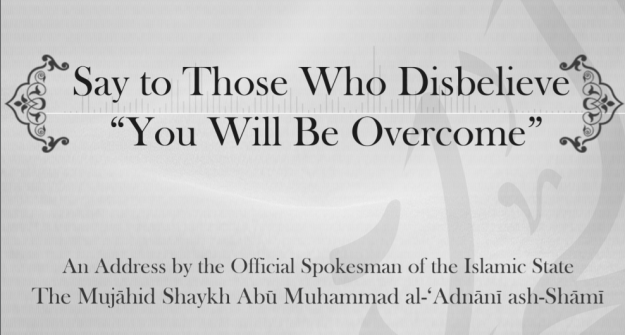
The Islamic State’s spokesman, Taha Subhi Falaha (Abu Muhammad al-Adnani) gave a speech on 13 October 2015 entitled, “Say to Those Who Disbelieve, ‘You Will Be Overcome’.”

Falaha’s speech contained an important piece of news, or rather confirmation of news: the caliph’s deputy, Fadel al-Hiyali, was in fact killed on 18 August 2015.[4]

The themes in Falaha’s speech were largely familiar: the jihadists were facing a global conspiracy of America, its allies, Russia, Iran, and apostate Muslims in Syria and Iraq; Muslims should therefore unite around the Islamic State’s banner in order to repel this aggression aimed at all (Sunni) Muslims; but the Islamic State remains strong—the killing of leaders and the loss of some areas was more than made up for by other advances—and able to murder those Muslims who remain opposed to it and shatter the Americans. Continue reading

Islamic State Spokesman Calls For Immigration to the Caliphate, All Factions To Join

By Kyle Orton (@KyleWOrton) on July 1, 2015

On June 23, 2015, the Islamic State (IS) spokesman Abu Muhammad al-Adnani gave a speech, “O Our People, Respond to the Caller of Allah”. Al-Adnani, noting the coming of Ramadan, called on Muslims to journey to the caliphate, saying that hijra (emigration) in this month—and martyrdom—is the most blessed. Al-Adnani called on Muslims—specifically Iraqi Sunnis and Syrian rebel and Islamist insurgent groups—to unite around IS, which had no theological factions or ethnic distinctions among its membership, being the only pure expression of Islam, ruling by god’s law. Iraqi Sunni militias and Syrian rebels had betrayed the religion by seeking favour from, and even seeking alliance with, Western states. Al-Adnani threatened the town of Haditha, specifically the Jaghayfa clan, that if it surrendered now its repentance would be accepted, but if the town was overrun first then they would be slaughtered. Al-Adnani played heavily on the interlinked themes of anti-Shi’a sectarianism and the spreading influence of Iran and its proxies, repressing Sunnis. The old guard of the jihadi movement—clerics like Abu Muhammad al-Maqdisi and al-Qaeda’s leader Ayman al-Zawahiri (though neither are mentioned by name)—are attacked for not being on the battlefields. Al-Adnani also accepted the allegiance of the Russian-based faction that declared itself under the caliph’s authority, naming the group Wilayat al-Kavkaz. An English transcript of the speech was posted by IS and is reproduced below with some minor editions in transliteration and some interesting sections highlighted in bold. Continue reading

Islamic State Claims Responsibility for Terror Attacks in Australia, Canada, and America

By Kyle Orton (@KyleWOrton) on November 21, 2014

The Islamic State released the fifth edition of its English-language propaganda magazine, Dabiq, on November 21, 2014. In it, the Islamic State claimed responsibility for the terrorist attacks: in Australia by Numan Haider on September 23, in Canada by Martin Couture-Rouleau on October 20 and Michael Zehaf-Bibeau on October 22, and in America by Zale Thompson on October 23. The Islamic State says these attacks were in response to the call on September 22 by the organization’s spokesman, Abu Muhammad al-Adnani. The article is reproduced below with some minor editions for transliteration and some important sections highlighted in bold. Continue reading

Islamic State Biography of the Spokesman: Abu Muhammad al-Adnani

By Kyle Orton (@KyleWOrton) on November 8, 2014

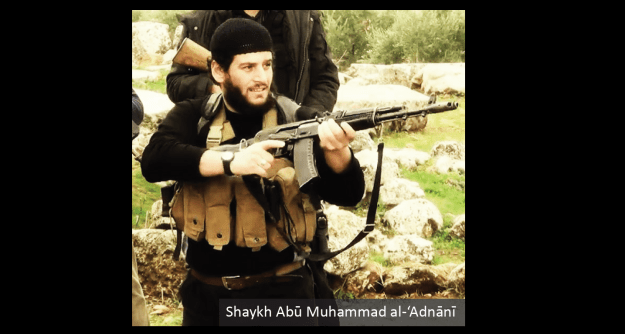
Picture of Abu Muhammad al-Adnani from the second edition of Dabiq magazine (July 27, 2014)

A Bahraini jihadist ideologue, Turki al-Binali, who has become a cleric in the Islamic State, put out a profile of the Islamic State’s official spokesman, Abu Muhammad al-Adnani, on November 1. By this account, al-Adnani took up jihadism in 2000 and was among a small cadre of people who joined the Islamic State’s founder, Ahmad al-Khalayleh, the infamous Abu Musab al-Zarqawi, when he journeyed through Syria on a recruitment-drive in 2002. Learned in Islamic jurisprudence and rigid in doctrinal literalness, al-Adnani was associated with some of the titans of the Islamic State’s legend like Abu Muhammad al-Lubnani and Abu Anas al-Shami. Appointed as emir of a small town in Anbar, Haditha, the first leader after the declaration of “the State” in 2006, Hamid al-Zawi (Abu Umar al-Baghdadi), worked under al-Adnani’s command. Al-Adnani then moved on to be an ideological instructor. Such was al-Adnani’s status, he did not have to consult al-Zarqawi before ordering operations; he only had to brief al-Zarqawi afterwards. Al-Adnani was arrested by the Americans in Iraq in May 2005, thereafter spending six years behind the wire, though never giving up his missionary activity. Indeed, the profile says al-Adnani developed the first full training program, academic and physical, for jihadi inmates. Upon release, al-Adnani took the post of official spokesman and has maintained it ever since. This profile is reproduced below with some minor editions for transliteration, syntax, and spelling. Continue reading

Islamic State Spokesman Calls For Attacks Against the West

By Kyle Orton (@KyleWOrton) on September 22, 2014

1

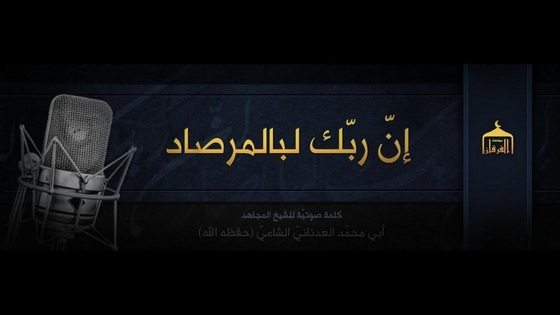
The Islamic State’s official spokesman, Abu Muhamad al-Adnani al-Shami, gave a speech, released by al-Furqan Media on 21 September 2014, entitled, “Indeed Your Lord Is Ever Watchful”.

The main message was in al-Adnani’s conclusion: a call for Muslims in the West to kill their non-Muslim neighbours—or to maim them or destroy their property or at the very least spit in their faces if Muslims are unable to acquire the weapons or courage for murder rampages. “Do not be contemptible,” al-Adnani implores. Al-Adnani’s incitement to “lone wolf” attacks was justified as a response to aggression by a coalition consisting of America, the Assad regime, and Iran. Continue reading

Islamic State Claims the Leadership of Jihad

By Kyle Orton (@KyleWOrton) on May 15, 2014

The Islamic State’s official spokesman, Abu Muhammad al-Adnani, gave a speech on March 7, 2014, entitled, “Then Let Us Invoke The Curse Of Allah Upon The Liars”. An English translation of the speech was made by Musa Cerantonio and is reproduced below. Continue reading

ISIS’s Spokesman Denounces Al-Qaeda’s Leader, Claims ISIS Is The Victim

By Kyle Orton (@KyleWOrton) on May 13, 2014

The spokesman of the Islamic State of Iraq and Syria (ISIS), Abu Muhammad al-Adnani, gave a speech via audio message on 11 May 2014, entitled “‘Adhr’a emir al-Qaeda” (Apologies, emir of al-Qaeda). Al-Qaeda’s leader, Ayman al-Zawahiri, disowned ISIS, al-Qaeda’s prior Iraqi branch, in February, and then gave an extended statement a few days ago that placed blame for the schism squarely on ISIS. Al-Adnani’s speech was a response to al-Zawahiri, and it was among ISIS’s most stern attacks on al-Qaeda so far. Al-Adnani denounced al-Zawahiri for allegedly deviating from the outlook of Usama bin Ladin. Al-Adnani called on al-Zawahiri to reverse his ruling that accepted Jabhat al-Nusra’s split from ISIS. Al-Nusra has rebelliously broken its pledge of allegiance to ISIS, al-Adnani says, and al-Zawahiri’s duty was to side with ISIS against this renegade—not to join in a campaign of sedition and conspiracy against ISIS. Most intriguingly, al-Adnani denied that ISIS had ever been, in a formal sense, subordinate to al-Qaeda. Rather, says al-Adnani, ISIS had placed itself in a position of voluntarily labelling themselves as al-Qaeda and accepting the advice of the “elders of jihad” in order to unite the ranks of the jihadists. But, says al-Adnani, this was not a command relationship for ISIS’s internal affairs: witness, al-Adnani says, ISIS’s refusal to listen to al-Qaeda’s order to cease attacking Shi’i civilians. Though, says al-Adnani, ISIS did obey al-Qaeda in external matters, specifically not targeting Iran, where al-Qaeda has an important facilitation network that serves as its supply line from Afghanistan-Pakistan to the Arab world. Al-Adnani’s speech was translated today by Musa Cerantonio, an Australian convert to Islam who is one of ISIS’s most important international propagandist-recruiters. Al-Adnani’s speech is reprinted below. Continue reading

ISIS’s Spokesman Attacks Al-Qaeda’s Ruling That ISIS Should Leave Syria

By Kyle Orton (@KyleWOrton) on April 4, 2014

The spokesman of the Islamic State of Iraq and Syria (ISIS), Abu Muhammad al-Adnani, made a speech on 19 June 2013, a transcript of which is reproduced below. Al-Adnani’s speech was entitled, “Fadharhum wa-ma yaftarun”, variously translated as: “So Leave Them Alone With Their Devising”, “Leave Them Alone with their Fabrications”, and “Ignore Them and Their False Allegations”. Continue reading

ISIS Rejects Al-Qaeda’s Command To Return To Iraq

By Kyle Orton (@KyleWOrton) on April 3, 2014

1

The emir of the Islamic State of Iraq (ISI), Abu Bakr al-Baghdadi, released an audio message on 14 June 2013, “Baqiya fil-Iraq wa-Sham” (Remaining in Iraq and Syria),[1] rejecting al-Qaeda leader Ayman al-Zawahiri’s decision to send his group back to Iraq and to leave ISI’s Syrian branch, Jabhat al-Nusra, in Syria as al-Qaeda’s branch in that country. A translation of al-Baghdadi’s speech was released by his group and is reproduced below. Continue reading

The Assad Regime’s Collusion With ISIS and al-Qaeda: Assessing The Evidence

By Kyle Orton (@KyleWOrton) on March 24, 2014

1

There has long been speculation in Syrian oppositionist circles that the regime was colluding with the Qaeda-type forces in the insurgency, to shore-up its own base by frightening the minorities and to ward off external help to the rebellion from the West. Continue reading