By Kyle Orton (@KyleWOrton) on 30 July 2022
Islamic State in Palmyra, December 2016
By Kyle Orton (@KyleWOrton) on 30 July 2022
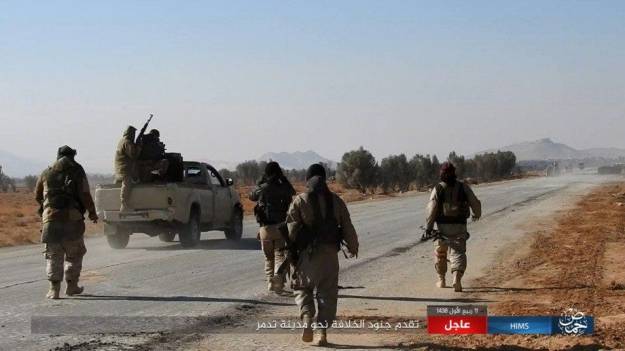
Islamic State in Palmyra, December 2016
By Kyle Orton (@KyleWOrton) on 7 July 2022
By Kyle Orton (@KyleWOrton) on 18 June 2022
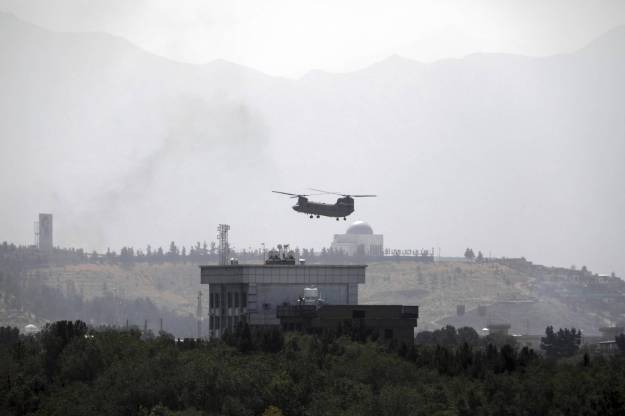
A U.S. helicopter above the American Embassy in Kabul, 15 August 2021 | AP
By Kyle Orton (@KyleWOrton) on 31 March 2022
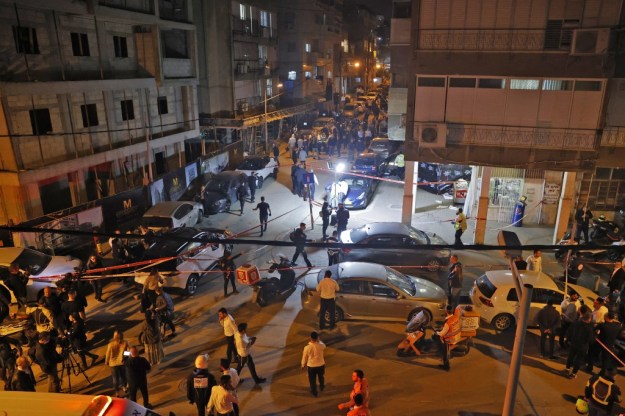
Israeli security forces reacting to the terrorist attack in Bnei Brak near Tel Aviv, 29 March 2022 || Photo by JACK GUEZ / AFP
Israeli Prime Minister Naftali Bennett has said his country is “facing a new wave of terrorism” after five attacks in the last ten days have killed eleven people. The Islamic State (IS) has effectively admitted to carrying out two of the atrocities, the first time in five years the terrorist group has carried out attacks in the Jewish state. This hiatus, partly a reflection of the fact that, unlike some other Islamist extremists, IS does not make the anti-Israel cause a central plank of its propaganda, also reflects the relatively small inroads IS’s ideology has made to this point among Palestinian and Israeli Arabs. Whether this is now changing is unclear. Continue reading
By Kyle Orton (@KyleWOrton) on 26 November 2021
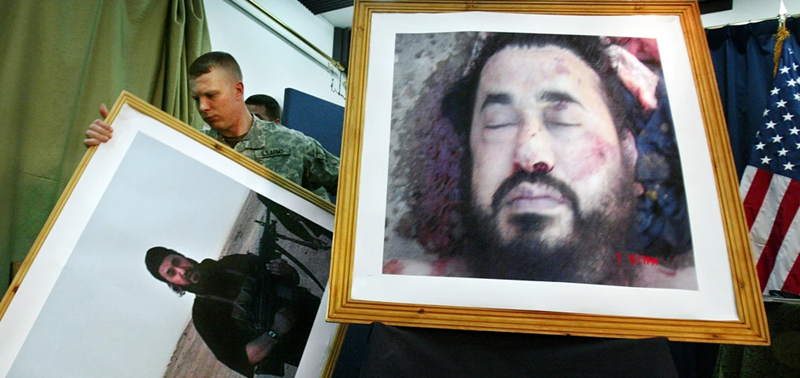
After the founder of the Islamic State movement, Ahmad al-Khalayleh, the infamous Abu Musab al-Zarqawi, was killed on 7 June 2006, an open letter eulogising him was posted by his wife, known only as Umm Muhammad (“the Mother of Muhammad”). The letter dates, it seems, to 6 July 2006, about a month after Zarqawi’s demise.[1] The content is mostly boilerplate: celebrating “the Shaykh of the Slaughterers” for terrorising the Americans and others who wanted constitutional government in Iraq,[2] venomous sectarian incitement against Shi’is, declaring that jihadist victory is near and cannot be derailed by the “martyrdom” of one leader. What is perhaps most notable when reading the letter at this distance is, firstly, that it was published by an Al-Qaeda media outlet, and, secondly, how much space is devoted to praising Usama bin Laden, and declaring the undying fealty of Zarqawi and his men to Bin Laden. Because, of course, the IS movement was at this time nominally a subordinate component of Bin Laden’s network named Al-Qaeda in Mesopotamia (AQM). The Zarqawists’ overt breach with Al-Qaeda still eight years in the future.
Continue readingBy Kyle Orton (@KyleWOrton) on 22 November 2021
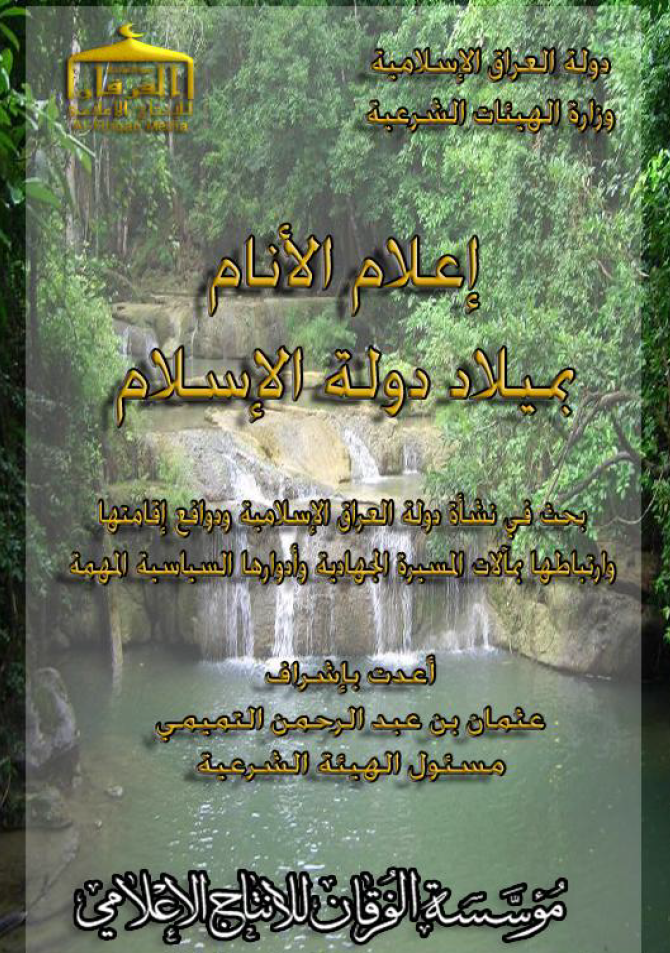
The Islamic State movement published an 87-page book, “Informing Mankind of the Birth of the Islamic State” or “Informing the People of the Birth of the Islamic State” (I’lam al-Anam bi-Milad Dawlat al-Islam), on 7 January 2007. The document was released by Al-Furqan Media Foundation, the central Islamic State propaganda institution, and first appeared on the World News Network website. A rough translation of the book appears below.
By Kyle Orton (@KyleWOrton) on 7 September 2021

Anti-Taliban fighters watch U.S. airstrikes at Tora Bora, 16 December 2001 || REUTERS/Erik de Castro
The State Department spokesman Ned Price said, on 27 August, “The Taliban and the Haqqani Network are separate entities”. The next day, the Pentagon Press Secretary John Kirby slightly modulated this, having first tried to dismiss the question, by conceding there was “a certain amount of … commingling … there’s a marbling … of Taliban and Haqqani”, before saying he was “pushing back … [on] the relevance of that discussion”.
What these officials were trying to do was two-fold: (1) to refute press reports that U.S. officials in Kabul had shared “a list of names of American citizens, green card holders, and Afghan allies” with the Taliban, amounting to having “put all those Afghans on a kill list”, as one “defense official” put it; and (2) to deny that the U.S. coordination with the Taliban to evacuate people the jihadists wanted to kill—a surreal enough situation—had involved the additional political and legal problems of coordinating with a formally registered Foreign Terrorist Organization (FTO), as the Haqqani Network is. Continue reading
By Kyle Orton (@KyleWOrton) on 31 August 2021
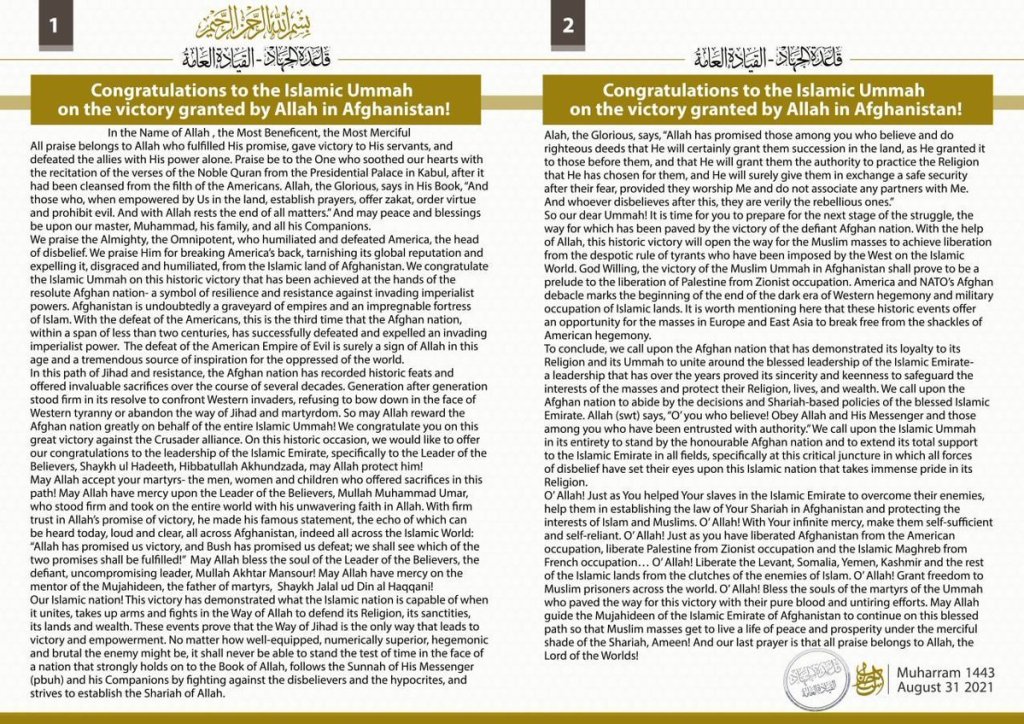
Al-Qaeda’s General Command released a statement earlier today through As-Sahab Media congratulating the Taliban on its victory in Afghanistan. This is the first statement from Al-Qaeda Central since the cataclysmic events in Afghanistan over the past few weeks. The official silence of the organisation heretofore—even as its operatives worked in lock-step with the rest of the coalition of jihadists run by Pakistan’s Inter-Services Intelligence (ISI) to conquer the country—is almost certainly deliberate, to allow the Taliban and the United States political cover to ensure the American departure while avoiding the ramifications of Al-Qaeda controlling the Afghan state, the very thing the mission in Afghanistan was intended to (and had succeeded in, so long as it was sustained) undoing. The statement itself is exactly what one would expect: gloating about the West’s defeat and the damage to American hegemony, saying this proves that jihad is the only way, and that the Taliban’s “Islamic Emirate” is merely the first step in a global campaign to bring the world under the rule of the shari’a. The text of the English-language statement is posted below, with some minor editions for transliteration and translation. Continue reading
By Kyle Orton (@KyleWOrton) on 20 August 2021
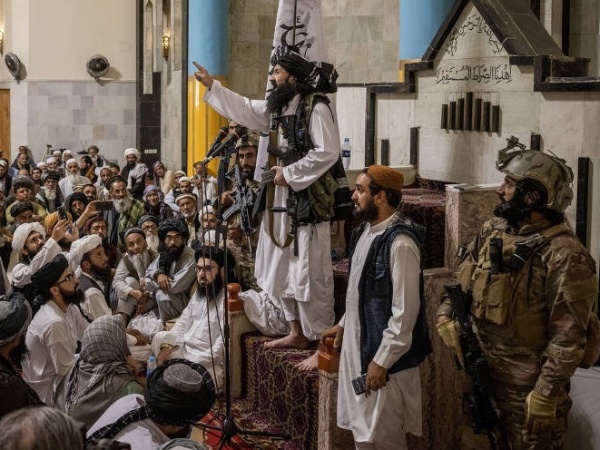
Khalil Haqqani, a senior Taliban leader and simultaneously a leader of Al-Qaeda’s Haqqani Network, leads Friday prayers at the Pul-i-Khishti, the largest mosque in Kabul, 20 August 2021
When the Taliban swept into the capital of Afghanistan on Sunday, little of the coverage focused on Pakistan and yet that was where this victory was made. This is a pattern that has persisted throughout the war. Continue reading
By Kyle Orton (@KyleWOrton) on 17 August 2021
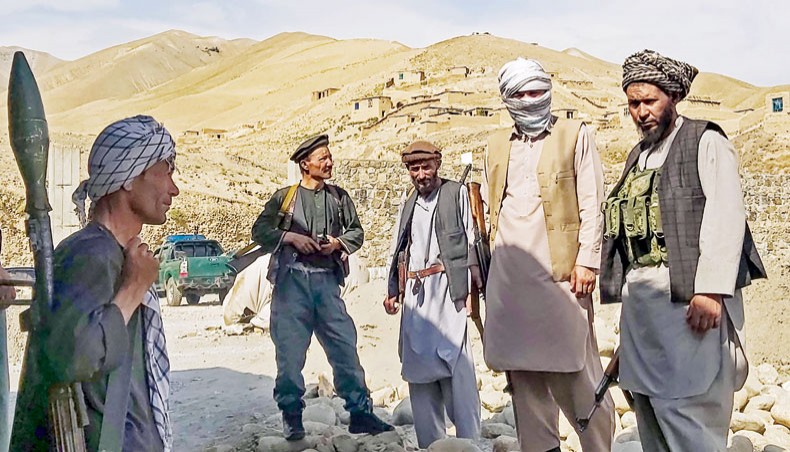
Afghan government forces guarding Taloqan, Takhar province, Afghanistan // July 2021 // AFP photo
Kabul fell to the Taliban on 15 August. There is so much more to be said about the disastrous decisions the United States that precipitated this calamity, not least the so-called peace process whose only concrete effects were to weaken and demoralise the Afghan government, while bolstering the ranks of the Taliban by forcing the release of thousands of jihadists. The chaotic Saigon scenes have testified to the incompetence of Joe Biden’s administration, even at administrative tasks, and the horrors are only just beginning.
This post has a slightly different focus, namely the role of Pakistan, specifically its military and Inter-Services Intelligence (ISI), as the author and operator of the Taliban and allied jihadists. This factor—absolutely fundamental to the conflict—has been, for twenty years, bizarrely absent in much of the coverage, and suggestions recur to this day that the Taliban is actually a problem for Pakistan. When the Pakistan dimension does come up, it will either be to note that Pakistan has some kind of role in funding or otherwise “supporting” the Taliban, and at its strongest the Taliban will be called a “proxy” of the ISI.
Even the word “proxy”, however, underplays the extent to which the Taliban is Pakistan, a wing of its (deep) state power. Continue reading