Category Archives: Jihadi Output

Islamic State Recommends More Gentleness in Dealing With Sinners

By Kyle Orton (@KyleWOrton) on 10 March 2018

1

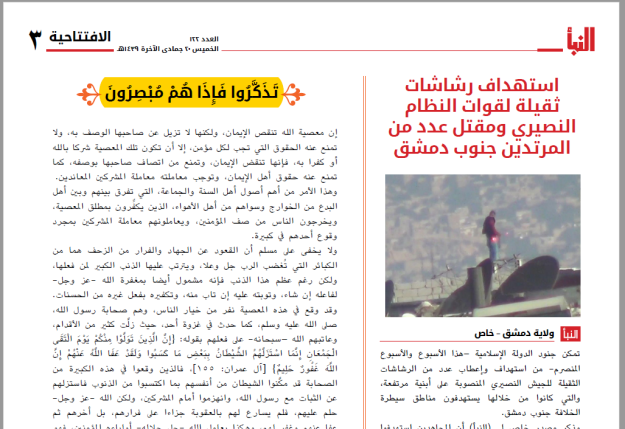
The 122nd edition of Al-Naba, the Islamic State’s weekly newsletter, was released on 9 March 2018 and contained an article, on page 3, suggesting that the use of takfir (excommunication) should be circumscribed. A rough translation is reproduced below. Continue reading

A New Branch of Al-Qaeda Emerges in Syria

By Kyle Orton (@KyleWOrton) on 1 March 2018

Hurras al-Deen logo

A new jihadi faction announced its formation in Syria on 27 February 2018: Tanzim Hurras al-Deen,[1] which translates as The Organization for the Guardians of the Religion or the Religious Guardians’ Organization. Hurras al-Deen is, unofficially, the re-emergence of a branch of al-Qaeda in Syria after the schism between al-Qaeda “central” and Hay’at Tahrir al-Sham (HTS). The first statement from Hurras al-Deen was released via Telegram and is reproduced below. Continue reading

Al-Qaeda Leader Profiles the Founder of the Islamic State

By Kyle Orton (@KyleWOrton) on 28 February 2018

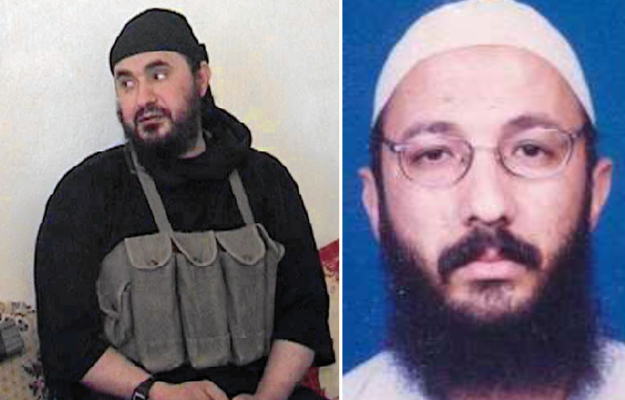
Ahmad al-Khalayleh (Abu Musab al-Zarqawi) [picture via Getty], Muhammad Zaydan (Sayf al-Adel) [picture via Kronos Advisory LLC]

The military leader of al-Qaeda, Muhammad Saladin Zaydan (Sayf al-Adel), wrote a biography for Ahmad al-Khalayleh (Abu Musab al-Zarqawi), the Jordanian jihadist who founded what is now the Islamic State in Taliban Afghanistan in 1999. Zaydan wrote the biography in 2005 while in Iran, under the protection of the Islamic Republic, where he still is. The biography is reproduced below with some interesting and important sections highlighted in bold. Continue reading

Al-Qaeda’s Leader Tells Syrian Insurgents To Avoid State Allies, Focus on Guerrilla Tactics

By Kyle Orton (@KyleWOrton) on 21 February 2018

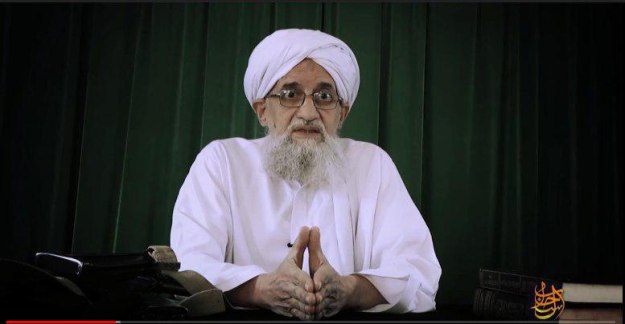
Al-Qaeda’s leader, Ayman al-Zawahiri, released a video statement on 20 February 2018, entitled, “Oh Our Brothers in Syria, Reconcile Amongst Yourselves”. The speech continued themes Dr. al-Zawahiri has hit on many times before, notably encouraging the Syrian insurgency to avoid allying with the West or other foreign states, to unite behind al-Qaeda since all outside actors are conspiring against the Syrian opposition, and to refuse all compromise in imposing the shari’a. Simultaneously, al-Zawahiri suggests that his adherents avoid trying for quick results and “cling[ing] to ground”, an echo of the advice given in the summer of 2016 that al-Qaeda’s operatives and the Syrian insurgents they can co-opt should prepare for a long war focused on guerrilla tactics, rather than holding territory. An English translation of al-Zawahiri’s speech was made by As-Sahab Media, disseminated by pro-al-Qaeda Telegram channels, and is reproduced below with some editions for syntax and transliteration. Continue reading

When Al-Qaeda’s Military Leader Asked The Architect of 9/11 to Resign

By Kyle Orton (@KyleWOrton) on 9 February 2018

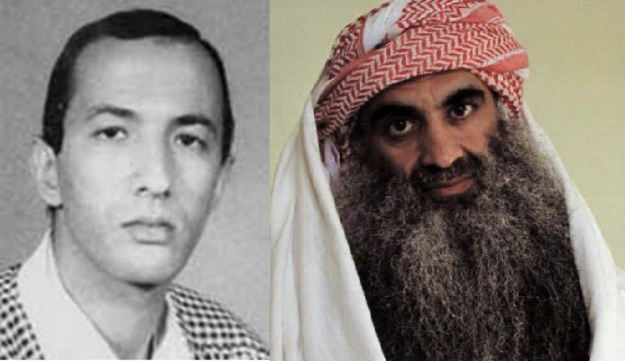
Sayf al-Adel (image source), Khalid Shaykh Muhammad (image source)

Muhammad Saladin Abd al-Halim Zaydan (Sayf al-Adel) wrote a letter on 13 June 2002 to Khalid Shaykh Muhammad (KSM or Mukhtar), the operational planner of the 9/11 massacre. Zaydan criticises KSM’s handling of al-Qaeda in the aftermath of 9/11 and the fall of the Taliban, and calls on him to surrender control to others. At that time the latter was written, Zaydan had been the head of al-Qaeda’s military committee for about seven months, replacing Muhammad Atef (Abu Hafs al-Masri), who was killed by an American airstrike in Afghanistan in November 2001. Zaydan was based then—as he is now—in Iran, with much of al-Qaeda’s senior leadership, at the invitation of Qassem Sulaymani, the head of the Quds Force, the component of the Islamic Revolutionary Guard Corps (IRGC) tasked with exporting the Iran’s Islamist revolution. The letter is reproduced below with the key sections highlighted in bold.

Phrased with much surrounding politeness, Zaydan gets to the point: KSM has been on a spree of external operations—notably with “shoe bomber” Richard Reid and José Padilla (Abdullah al-Muhajir)—that have failed spectacularly and exposed al-Qaeda to ridicule. Instead of learning from his mistakes, KSM has heedlessly rushed to the next plot, says Zaydan. Usama bin Ladin might have signed off on these plots, Zaydan writes, but Bin Ladin is also reckless and refuses to heed advice—instead changing the advisor to get the answer he wants. (Bin Ladin had done this—or tried to—for the 9/11 attack itself, stacking the executive committee with loyalists before the key vote, which he ended up not bothering to hold anyway.) KSM should halt all plots currently underway and resign his duties to others so that stock can be taken of how these disasters have befallen the organisation, Zaydan concludes. Zaydan adds a final note demanding the removal of a post on an al-Qaeda forum that identifies his children by their real names. Continue reading

Islamic State Claims the Failed Paris Attacker: Salah Abdeslam

By Kyle Orton (@KyleWOrton) on 8 February 2018

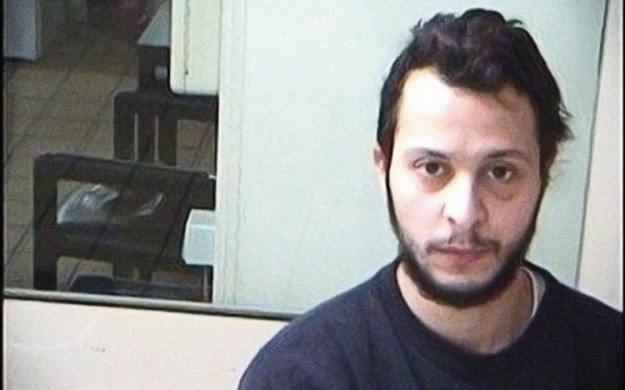
Salah Abdeslam in prison, April 2016 (image source)

In the 118th edition of Al-Naba, the Islamic State’s newsletter, there was an acknowledgment of Salah Abdeslam as a “brother”. Abdeslam is a Belgian citizen of Moroccan extraction, who acted as a logistician and facilitator for the 13 November 2015 massacre in Paris, though failed on the night to carry out his own part in the atrocity. Abdeslam is one of the few conspirators involved in the Paris attacks and the subsequent bombing in Brussels on 22 March 2016 who is still alive.[1] The significance of this is that IS has generally ignored its operatives if they end up being arrested, and Abdeslam is an acute case of this: he has never been acknowledged in IS’s propaganda since the Paris attack, notably being excluded from the twelfth issue of IS’s Dabiq magazine released on 18 November 2015 that named the Paris attackers and described how the operation was carried out. The Naba article is reproduced below. Continue reading

Al-Qaeda Letter on Relations with the Islamic State and Iran

By Kyle Orton (@KyleWOrton) on 5 February 2018

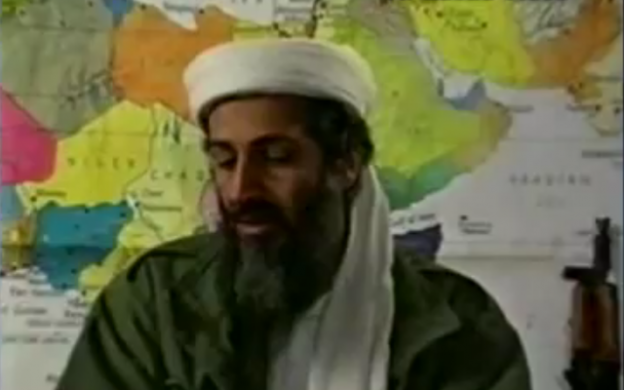
Usama bin Ladin in an al-Qaeda video (image source: CNN)

A letter released by the Office of the Director of National Intelligence (ODNI) on 20 May 2015, the “Letter to Abu Abdallah al-Hajj”, was written by an al-Qaeda leader on 17 December 2007. The letter, reproduced below with some editions in transliteration and some important sections highlighted bold, is interesting for several reasons. Continue reading

Former Al-Qaeda Group Continues Its Efforts To Annex The Syrian Revolution

By Kyle Orton (@KyleWOrton) on 17 January 2018

Ahmad al-Shara (Abu Muhammad al-Jolani), the leader of the Syrian jihadi group, Hay’at Tahrir al-Sham (HTS), released an audio speech, entitled, “Their Plot Will Not Harm You At All” or “Not The Least Harm Will Their Cunning Do To You” [Ali Imran (3): 120], on 16 January 2018. The speech is a continuation of themes HTS—even under its previous names, Jabhat al-Nusra and Jabhat Fatah al-Sham—has used, namely that it saw through the “peace processes” from the beginning as a conspiracy against the revolution, and that only it has the will and capacity to fulfil the desires of those Syrians who want to be free of Bashar al-Asad’s tyrannical regime. The recent insurgent counter-offensive in Idlib is taken by HTS as vindication, and as an opportunity to draw what’s left of the northern rebellion out of Turkey’s orbit and under its influence. A pro-HTS Telegram channel put out a transcript of the speech, which is reproduced below with some syntactical edits.
Continue reading

Islamic State Newsletter Tells the Story of Transition Between Statehood and Insurgency

By Kyle Orton (@KyleWOrton) on 13 January 2018

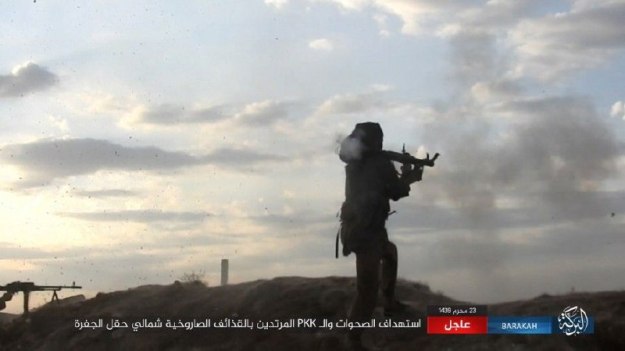
Islamic State, Wilayat al-Baraka, fighting north of al-Jafra with PKK, 14 October 2017

The Islamic State’s (IS) tactical behaviour, particularly its attitude toward the holding of territory, has become a centrally important matter recently with the destruction of the “caliphate” and IS’s reversion to insurgency. Continue reading

The Islamic State Was Engaged in Insurgency Long Before the Caliphate Collapsed

By Kyle Orton (@KyleWOrton) on 11 January 2018

Al-Naba 43, page 3

The Islamic State (IS) brought out the forty-third edition of Al-Naba, its newsletter, on 16 August 2016. On page 3 was an article that made reference to IS’s insurgent activities, which had already begun in areas it had lost. A rough copy is reproduced below.

At that time this article was published, IS was on the verge of losing Minbij, and had issued statements in May 2016 and June saying that the loss of the caliphate would not be the end of the group. By early 2017, IS’s insurgent operations were visibly mature, long before the formal declaration in October 2017 that IS was giving up its statelet and recommencing all-out insurgency. Continue reading