Category Archives: Turkey

Turkey’s Intervention in Syria Improves the Prospects for Peace

By Kyle Orton (@KyleWOrton) on August 25, 2016

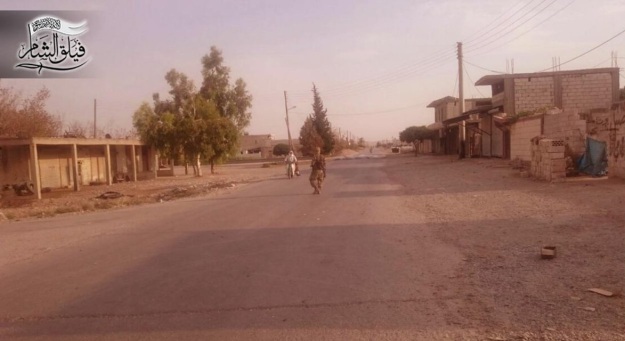
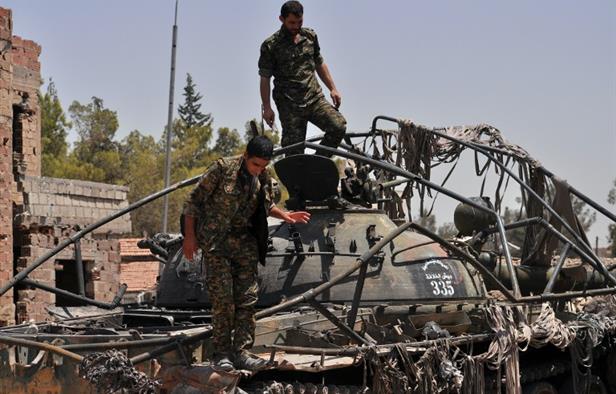
Picture put out by Faylaq al-Sham of Jarabulus soon after the Islamic State was expelled (Telegram, 24 August 2016)

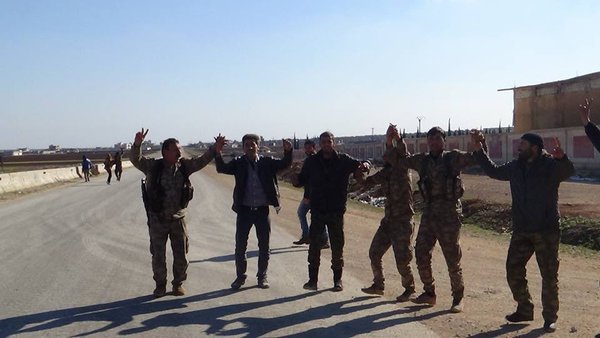
Picture put out by Faylaq al-Sham of Jarabulus soon after the Islamic State was expelled (Telegram, 24 August 2016)

After a horrific suicide bombing by the Islamic State (IS) at a Kurdish wedding in eastern Turkey had slaughtered more than fifty people on Saturday, Turkey moved to expel IS from Jarabulus in eastern Aleppo Province at about 4 AM on Wednesday morning. IS was swept from this last major border town in Syria, a key gateway for resources to the outside world, around ten hours later.

Operation EUPHRATES SHIELD saw Turkey put troops and tanks over the border publicly for the first time, and allow the Free Syrian Army (FSA)-branded and other mainstream Syrian rebels who have been battling IS for years to use Turkish territory to launch the assault. It was supported by airstrikes from the international anti-IS coalition.

For Turkey, this is a strong indication of a change in her threat-perception vis-à-vis IS, but it is also about a (correctly) perceived threat of what was to follow IS. Continue reading

America Picked the Wrong Allies Against the Islamic State

By Kyle Orton (@KyleWOrton) on February 17, 2016

Article published at NOW Lebanon

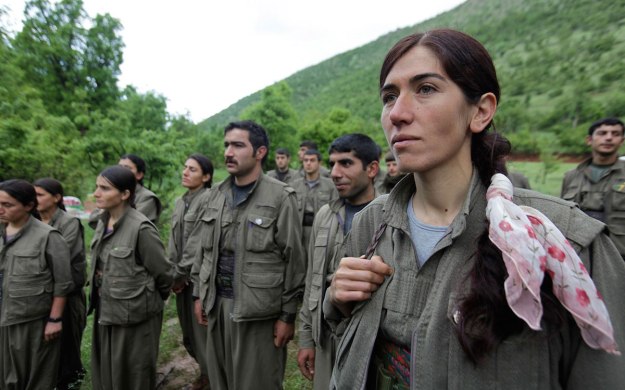
PYD/PKK fighters after they took over the Mannagh airbase on February 10, 2016.

PYD/PKK fighters after they took over the Mannagh airbase on February 10, 2016.

Over the last six weeks the regime of Bashar al-Assad—which by this point means in most areas Iranian-run ground forces and Russian air power—have made territorial gains in northern Syria that threaten the existence of the armed opposition in the area. This threat has been compounded by the Kurdish Democratic Union Party (PYD) and allies, which have also drawn on Russian airstrikes to attack the rebellion in the same areas. The U.S.-led coalition against the Islamic State (ISIS) has made the PYD its main proxy inside Syria—the only force that can call in coalition airstrikes. This policy was obviously flawed given the view of the PYD by necessary anti-ISIS allies like Turkey and the demographic realities of ISIS, which require Sunni Arabs to be able to police their area, and ensure that ISIS begins to look like a protector of Sunnis if Kurds occupy Arab areas; the PYD now attacking the crucial anti-ISIS demographic in alliance with the regime underlines that fact. Continue reading

Is Turkey Responsible for the Islamic State?

By Kyle Orton (@KyleWOrton) on December 20, 2015

1

Turkey concluded its biggest investigation to date into Islamic State (IS) operatives on its territory on Friday, and blacklisted sixty-seven people. This provides a good moment to review what Turkey’s role has been in the rise of IS, especially amid the escalating accusations from Russia that Turkey is significantly responsible for financing IS. The reality is that while Turkish policy has, by commission and omission, made IS stronger than it would otherwise have been, so has Russia’s policy—and Russia’s policy was far more cynical than Turkey’s, deliberately intended empower extremists to discredit the rebellion against Bashar al-Assad. Turkey’s focus on bringing down Assad and Ankara’s fear of Kurdish autonomy led it into these policies and now—having seemingly found the will to act to uproot IS’s infrastructure on Turkish territory—there is the problem of actually doing so, when IS can (and has) struck inside Turkey. The concerns about these external funding mechanisms for IS, while doubtless important, obscure the larger problem: IS’s revenue is overwhelmingly drawn from the areas it controls and only removing those areas of control can deny IS its funds. Continue reading

Turkey Fears A Kurdish State More Than The Islamic State

By Kyle Orton (@KyleWOrton) on July 28, 2015

A version of this article was published at NOW Lebanon 

1

After years of threatening, Turkey directly intervened in Syria on Friday, launching airstrikes against the Islamic State (ISIS), and finally allowed the U.S. to use Incirlik for jet and drone attacks against ISIS. Concurrently, Turkey launched airstrikes into Iraqi Kurdistan against the Kurdistan Workers’ Party (PKK). Ankara is framing this as an equal-opportunities war on terrorists, but Turkey’s actions over the last four years in Syria give a lot of cause for wonder as to which side Ankara is on when it comes to terrorism. Continue reading

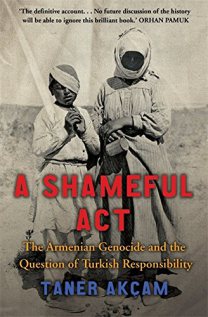
Book Review: A Shameful Act (2006) by Taner Akcam

By Kyle Orton (@KyleWOrton) on June 9, 20151

This is the complete review. It has previously been posted in three parts: Part 1 on the question of whether the 1915-17 massacres constitute genocide; Part 2 on the post-war trials and the Nationalist Movement; and Part 3 gives some conclusions on what went wrong in the Allied efforts to prosecute the war criminals and the implications for the present time, with Turkey’s ongoing denial of the genocide and the exodus of Christians from the Middle East.

A Question of Genocide

The controversy over the 1915-17 massacres of Armenian Christians by the Ottoman Empire is whether these acts constitute genocide. Those who say they don’t are not the equivalent of Holocaust-deniers in that while some minimize the figures of the slain, they do not deny that the massacres happened; what they deny is that the massacres reach the legal definition of genocide. Their case is based on three interlinked arguments:

  • Unlike the Nazi Holocaust when a defenceless population was murdered only for its identity, the Armenians were engaged in a massive armed revolt, and this is why the Ottoman government decided to deport them.
  • The intent of the Ottomans was not massacre but the removal of the Armenians, who had sided with one foreign invading power (Russia) and who were showing signs of collaborating with another (Britain), from the militarily sensitive areas as Turkey suffered a two-front invasion in early 1915.
  • While terrible massacres, plus starvation and the cold, took maybe a million lives during the deportations, when the Armenians reached their destinations in Syria and Iraq, which were also part of the Ottoman Empire, they were well-treated and allowed to rebuild their lives, which would not have been the case had the Ottomans intended their destruction.

Taner Akcam’s A Shameful Act: The Armenian Genocide and the Question of Turkish Responsibility presents evidence to undermine every one of these arguments. Continue reading

Book Review: A Shameful Act (2006) by Taner Akcam, Part 3

By Kyle Orton (@KyleWOrton) on June 7, 20151

Post-War Turkey

The last foreign troops left Istanbul on October 2, 1923. On October 6, Turkish troops re-occupied Istanbul, and on October 13 the Turkish capital was moved to Ankara. The independence struggle won, the focus now turned to the form independence would take.

Having already abolished the Sultanate—that is the executive post held by the House of Ottoman—Mustafa Kemal (later Atatürk) abolished the Caliphate on March 3, 1924. Atatürk also scrapped the office of Şeyh-ül İslam, banished the House of Ottoman (packing Sultan Abdülmecid onto the Orient Express), and closed the separate religious schools on the same day. The ulema had given much ground during the reforms of the nineteenth century but they had also frustrated and defeated many reformers; Atatürk would not be one of them. The promulgation of the Republican Constitution on April 20, 1924, confirmed parliamentary supremacy over the shari’a, secular law over theocracy.

In the late 1920s, further reforms were made. The fez, which “had become the last symbol of Muslim identification,” was banned. Atatürk had said the fez was “an emblem of ignorance … and hatred of progress”. Turks would wear the costume “common to the civilized nations of the world,” which is to say Europe. Atatürk adopted the Swiss legal code, which removed the Holy Law from personal status—abolishing polygamy, making both parties to a marriage equal, allowing divorce, and allowing people to change their religion. Islam was disestablished as the State religion, and as the final step the Arabic script was changed to Roman. The connection with the East was broken, and Turkey was firmly oriented West. Continue reading

Book Review: A Shameful Act (2006) by Taner Akcam, Part 2

By Kyle Orton (@KyleWOrton) on June 4, 20151

The First Phase of the Trials

On October 30, 1918, the Ottoman Empire signed its final treaty of defeat. The Ottomans’ long decline began in 1683, and by the 1830s the Empire was referred to as the “sick man of Europe”. The armistice was a near-total surrender, allowing the occupation of any area the Allies deemed necessary for their security. Unfortunately, it was neither the end of the war nor the end of the massacres against the Armenians.

The Allies—Britain, France, and Russia—issued a declaration on May 24, 1915, saying:

In light of the crimes against humanity and civilisation committed by Turkey, the allied powers warn the Sublime Porte that members of the Ottoman government involved in the mass murder will be held personally responsible for these crimes.

Not coincidentally, within days of this an official deportation law was passed through the Ottoman Parliament and would thereafter be issued by the Interior Ministry as legal cover for the CUP’s actions. This was a first introduction of the concept of crimes against humanity, and of individual responsibility that extended to senior Generals and Heads of State. The Russians fell to the Communists and for reasons of realpolitik the French and Italians soon dropped their demands for punishing the Turkish war criminals, but the British were relentless. Continue reading

Book Review: A Shameful Act (2006) by Taner Akcam, Part 1

By Kyle Orton (@KyleWOrton) on June 1, 20151

A Question of Genocide

The controversy over the 1915-17 massacres of Armenian Christians by the Ottoman Empire is whether these acts constitute genocide. Those who say they don’t are not the equivalent of Holocaust-deniers in that while some minimize the figures of the slain, they do not deny that the massacres happened; what they deny is that the massacres reach the legal definition of genocide. Their case is based on three interlinked arguments:

  • Unlike the Nazi Holocaust when a defenceless population was murdered only for its identity, the Armenians were engaged in a massive armed revolt, and this is why the Ottoman government decided to deport them.
  • The intent of the Ottomans was not massacre but the removal of the Armenians, who had sided with one foreign invading power (Russia) and who were showing signs of collaborating with another (Britain), from the militarily sensitive areas as Turkey suffered a two-front invasion in early 1915.
  • While terrible massacres, plus starvation and the cold, took maybe a million lives during the deportations, when the Armenians reached their destinations in Syria and Iraq, which were also part of the Ottoman Empire, they were well-treated and allowed to rebuild their lives, which would not have been the case had the Ottomans intended their destruction.

Taner Akcam’s A Shameful Act: The Armenian Genocide and the Question of Turkish Responsibility presents evidence to undermine every one of these arguments. Continue reading

Turkey and Saudi Arabia Move Against Assad

By Kyle Orton (@KyleWOrton) on May 5, 2015

1

Zahran Alloush, Abu Issa, Hashem al-Sheikh

An effort is underway, led by Saudi Arabia and Turkey, mediated by Qatar, to unify the largest Syrian Islamist rebel brigades. With these regional powers now seemingly reading from the same script after years of internecine competition that has fractured the Syrian rebellion, there is also talk of a direct Saudi-Turkish intervention in Syria to overthrow Bashar al-Assad. While increased support to the Syrian insurgency from the Gulf and Turkey is already arriving, a direct intervention seems unlikely, though not, in the current context after the Saudi-led coalition went it alone in Yemen, impossible.  Continue reading

Obama’s Abandonment of Kobani Isn’t Just A Disaster For The Kurds

By Kyle Orton (@KyleWOrton) on October 9, 2014

Syrian Kurdish refugees at the Turkish frontier

Syrian Kurdish refugees at the Turkish frontier

After three-and-a-half years of resistance, the United States finally intervened in Syria on September 23 with airstrikes against the Islamic State (I.S.). The I.S. had begun an attack on the Kurdish-controlled enclave in northern Aleppo along the Turkish border on September 15/16. By October 5, the Kurdish forces had been driven back into the Kurdish-majority town of Kobani (a.k.a. Ayn al-Arab), and I.S. had them surrounded. The desperate scenes of Syrian Kurds fleeing over the Turkish border in the face of the takfiris’ recalls the Iraqi Kurds making a run for the hills after the March 1991 uprising against Saddam Hussein was crushed. Then as now the Kurds believed they had stronger American backing than turned out to be the case. Continue reading