Tag Archives: Christians

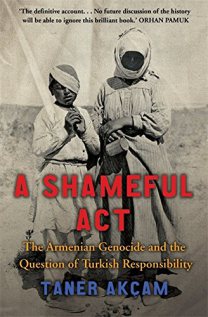
Book Review: A Shameful Act (2006) by Taner Akcam

By Kyle Orton (@KyleWOrton) on June 9, 20151

This is the complete review. It has previously been posted in three parts: Part 1 on the question of whether the 1915-17 massacres constitute genocide; Part 2 on the post-war trials and the Nationalist Movement; and Part 3 gives some conclusions on what went wrong in the Allied efforts to prosecute the war criminals and the implications for the present time, with Turkey’s ongoing denial of the genocide and the exodus of Christians from the Middle East.

A Question of Genocide

The controversy over the 1915-17 massacres of Armenian Christians by the Ottoman Empire is whether these acts constitute genocide. Those who say they don’t are not the equivalent of Holocaust-deniers in that while some minimize the figures of the slain, they do not deny that the massacres happened; what they deny is that the massacres reach the legal definition of genocide. Their case is based on three interlinked arguments:

  • Unlike the Nazi Holocaust when a defenceless population was murdered only for its identity, the Armenians were engaged in a massive armed revolt, and this is why the Ottoman government decided to deport them.
  • The intent of the Ottomans was not massacre but the removal of the Armenians, who had sided with one foreign invading power (Russia) and who were showing signs of collaborating with another (Britain), from the militarily sensitive areas as Turkey suffered a two-front invasion in early 1915.
  • While terrible massacres, plus starvation and the cold, took maybe a million lives during the deportations, when the Armenians reached their destinations in Syria and Iraq, which were also part of the Ottoman Empire, they were well-treated and allowed to rebuild their lives, which would not have been the case had the Ottomans intended their destruction.

Taner Akcam’s A Shameful Act: The Armenian Genocide and the Question of Turkish Responsibility presents evidence to undermine every one of these arguments. Continue reading

Book Review: A Shameful Act (2006) by Taner Akcam, Part 3

By Kyle Orton (@KyleWOrton) on June 7, 20151

Post-War Turkey

The last foreign troops left Istanbul on October 2, 1923. On October 6, Turkish troops re-occupied Istanbul, and on October 13 the Turkish capital was moved to Ankara. The independence struggle won, the focus now turned to the form independence would take.

Having already abolished the Sultanate—that is the executive post held by the House of Ottoman—Mustafa Kemal (later Atatürk) abolished the Caliphate on March 3, 1924. Atatürk also scrapped the office of Şeyh-ül İslam, banished the House of Ottoman (packing Sultan Abdülmecid onto the Orient Express), and closed the separate religious schools on the same day. The ulema had given much ground during the reforms of the nineteenth century but they had also frustrated and defeated many reformers; Atatürk would not be one of them. The promulgation of the Republican Constitution on April 20, 1924, confirmed parliamentary supremacy over the shari’a, secular law over theocracy.

In the late 1920s, further reforms were made. The fez, which “had become the last symbol of Muslim identification,” was banned. Atatürk had said the fez was “an emblem of ignorance … and hatred of progress”. Turks would wear the costume “common to the civilized nations of the world,” which is to say Europe. Atatürk adopted the Swiss legal code, which removed the Holy Law from personal status—abolishing polygamy, making both parties to a marriage equal, allowing divorce, and allowing people to change their religion. Islam was disestablished as the State religion, and as the final step the Arabic script was changed to Roman. The connection with the East was broken, and Turkey was firmly oriented West. Continue reading

Book Review: A Shameful Act (2006) by Taner Akcam, Part 1

By Kyle Orton (@KyleWOrton) on June 1, 20151

A Question of Genocide

The controversy over the 1915-17 massacres of Armenian Christians by the Ottoman Empire is whether these acts constitute genocide. Those who say they don’t are not the equivalent of Holocaust-deniers in that while some minimize the figures of the slain, they do not deny that the massacres happened; what they deny is that the massacres reach the legal definition of genocide. Their case is based on three interlinked arguments:

  • Unlike the Nazi Holocaust when a defenceless population was murdered only for its identity, the Armenians were engaged in a massive armed revolt, and this is why the Ottoman government decided to deport them.
  • The intent of the Ottomans was not massacre but the removal of the Armenians, who had sided with one foreign invading power (Russia) and who were showing signs of collaborating with another (Britain), from the militarily sensitive areas as Turkey suffered a two-front invasion in early 1915.
  • While terrible massacres, plus starvation and the cold, took maybe a million lives during the deportations, when the Armenians reached their destinations in Syria and Iraq, which were also part of the Ottoman Empire, they were well-treated and allowed to rebuild their lives, which would not have been the case had the Ottomans intended their destruction.

Taner Akcam’s A Shameful Act: The Armenian Genocide and the Question of Turkish Responsibility presents evidence to undermine every one of these arguments. Continue reading

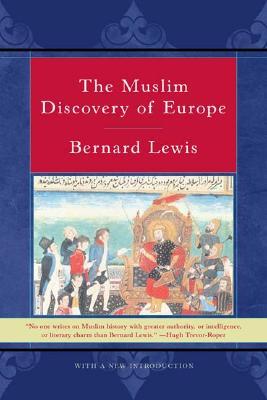
Book Review: The Muslim Discovery of Europe (1982) by Bernard Lewis

By Kyle Orton (@KyleWOrton) on May 7, 2015

1

With the triumph of relativism and the current economic woes of the West, the sense that Western civilization is unique and in some respects—to use an old-fashioned word—better than the alternatives, and worth defending and exporting, is waning. But Bernard Lewis’ The Muslim Discovery of Europe suggests a longer view in which Europe, while containing all the faults of previous civilizations, has been one of the few to begin the process of correcting those faults, and has corrected many more than any other civilization.

One feature of European civilization that stands out as unique is curiosity. Continue reading

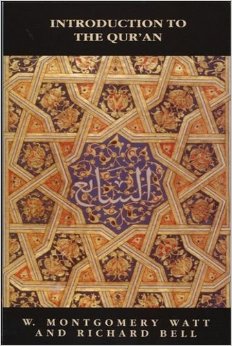
Book Review: Introduction to the Qur’an (1953) by Richard Bell

By Kyle Orton (@KyleWOrton) on January 13, 2015

4

Richard Bell’s Introduction to the Qur’an is, at less than 200 pages, a brief and easily-digestible explanation of the context in which Islam’s “holy” book arose, and the problems of reconciling theological orthodoxy with historical accuracy. More than six decades after publication, the book remains influential in scholarship of the Qur’an. Continue reading

Al-Qaeda Issues Strategic Guidelines for Jihadist Warfare

By Kyle Orton (@KyleWOrton) on January 7, 2015

Al-Qaeda’s emir, Ayman al-Zawahiri, released a document on 14 September 2013, entitled, Tawjihat ‘Amma lil-Amal al-Jihadi (توجيهات عامة للعمل الجهادي), variously translated as: “General Guidelines for the Work of Jihad” or “General Guidelines for Jihadist Action”. Al-Zawahiri’s document is reproduced below. Continue reading

What To Do About Syria: Sectarianism And The Minorities

By Kyle Orton (@KyleWOrton) on December 24, 2014

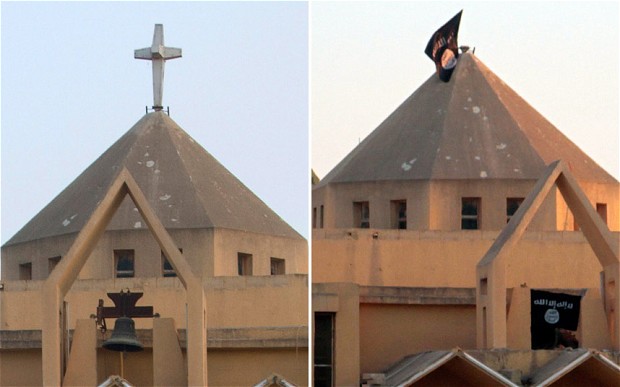
The Armenian Catholic Church of the Martyrs in Raqqa City

The Armenian Catholic Church of the Martyrs in Raqqa City

In the last few days I’ve been asked a lot about my longstanding view that the beginning of a Western strategy in Syria is the removal of Bashar al-Assad. The question has come from various angles and been phrased in various ways but it always boils down to: “What comes next?”

The best response I have seen to this comes from Thomas Nichols: “When someone says ‘tell me how it ends,’ it’s another way of saying: ‘I just don’t happen to like this particular case for intervention,’ for whatever reason.” Continue reading

Film Review: The Islamic State (2014) by Vice News

By Kyle Orton (@KyleWOrton) on August 25, 2014

Abu Mosa, the Islamic State's press officer

Abu Mosa, the Islamic State’s press officer

This is an extraordinary piece of work from Vice News. Earlier this month they released a five-part film after one of their journalists, Medyan Dairieh, embedded with the Islamic State (I.S.), formerly ISIS, in Raqqa City, the de facto headquarters of I.S. in north-eastern Syrian. It’s an extraordinarily brave thing to do given the number of journalists I.S. has kidnapped, the number of journalists killed in Syria (at least sixty), and of course the penchant of the Zarqawi’ites for beheading Westerners on video, as gruesomely underlined again with the murder of James Foley. Continue reading